Muscle, Movement, and Bone Strength: Why Resistance Training Is Essential Beyond Walking and Jumping
Many clients with osteopenia or osteoporosis are told to walk more, stay active, and protect their bones, but what if they are missing one of the most important factors influencing bone strength?
Bone health is not just about the skeleton. It is connected to the muscles that support it, the forces placed on it, and the body’s ability to adapt and rebuild.
In this episode, Dr. Ritamarie Loscalzo explores the often-overlooked relationship between muscle and bone and why practitioners need to look beyond general recommendations like “stay active” when supporting clients with bone loss.
You’ll discover why strength, movement capacity, and individualized progression are essential pieces of a comprehensive bone health strategy.
What’s Inside This Episode?
- Why some clients continue losing bone despite being active
- The connection between muscle health and bone resilience
- The overlooked role of strength when evaluating bone health
- Why “exercise” is not a complete recommendation for clients with bone loss
- The questions practitioners should ask before creating a movement plan
- How to recognize when a client needs a different starting point
- Why personalized strategies matter more than generic protocols
- How muscle, metabolism, and whole-body health connect to bone strength
Resources and Links:
- Download the full transcript here
- Grab your Beyond Protocols Guide for a step-by-step framework integrating genetics, labs, and functional assessments into root-cause solutions
- Join the Next-Level Health Practitioner Facebook group here for free resources and community support
- Visit INEMethod.com for advanced health practitioner training and tools to elevate your clinical skills and grow your practice by getting life-changing results.
- Check out other podcast episodes here
Transcript
Dr Ritamarie
Your client can walk every day, take calcium, take vitamin D, avoid falling, and still lose bone, and one of the reasons for this is bone does not only need movement, bone needs muscle. It needs force, it needs pull, it needs load. It needs the message that says this body still needs to be strong, and for many people with osteopenia or osteoporosis, the message is missing. They may be active, but under muscled.
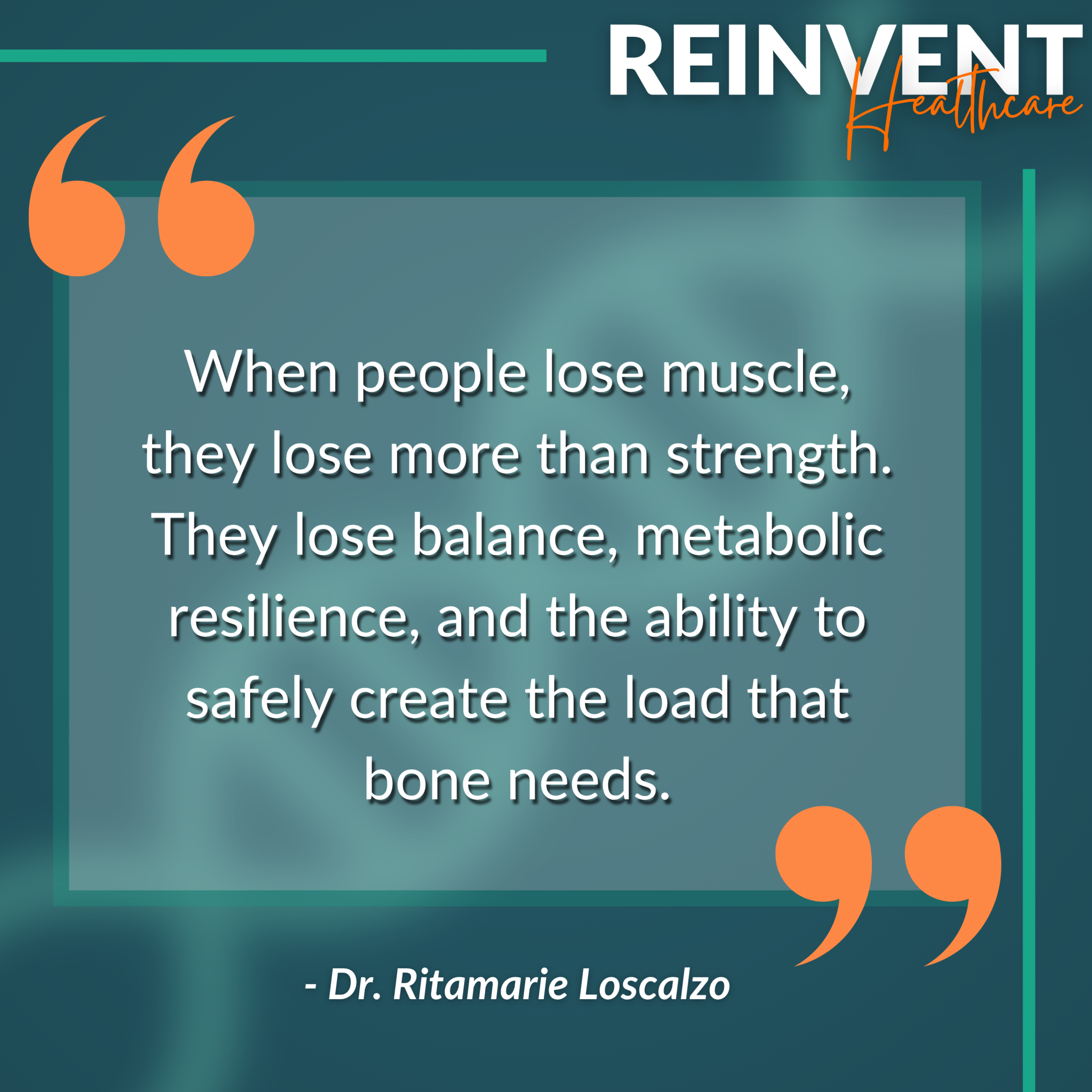
They may be walking but not loading. They may be careful but are becoming more fragile, even in spite of it. They may be afraid to lift, afraid to bend, afraid to twist, afraid to jump, and afraid to challenge their body. That fear can become part of the problem, because when people lose muscle, they lose more than strength. They lose the mechanical signal to bone. They lose balance. They lose metabolic resistance.
They lose metabolic resilience. They lose confidence. They lose the ability to safely create the load that the bone needs.
Today we're going to go beyond the usual advice to walk more and do more weight-bearing exercise. We're talking about muscle movement and bone strength, and in our previous episode, we talked about walking, impact, and jumping. We talked about why walking is helpful, but often not enough. We talked about how impact, heel drops, stomping, and jumping can send important signals to bone when they're appropriate and safe.
Today we're going to go beyond walking and jumping into one of the most important bone-building signals practitioners need to understand. Muscle. Bone doesn't build in isolation. Bone listens to guess what? Muscle. Muscle pull on bone is one of the key ways we stimulate them. Those osteocytes. When muscles contract against resistance, they create force on the bone attachment sites, and this force is information. It tells the bone you're needed.
Dr Ritamarie (00:02:38)
Stay strong, adapt, and this is why sarcopenia and osteoporosis often travel together. Low muscle means low mechanical signal. Low muscle also indicates a higher fall risk. Low muscle can worsen insulin resistance. Low muscle reduces independence, and that happens a lot as people age.
Low muscle can reduce the capacity to load bone safely, and if someone has bone loss, I want to know how much muscle do they have? Can they get up from a chair without using their hands? Can they easily climb the stairs? Can they carry their groceries? Can they balance? Can they lift something heavy from the floor in a safe way? Are they afraid of movement? A lot of people are. Are they in an under-eating pattern or under-eating protein? That's common.
Are they losing weight too quickly? And a lot of people are with all the new weight loss charts, because a bone health program without a muscle-building is incomplete. This is where I think practitioners can make a huge difference. We as functional health practitioners can make a huge difference. Instead of simply saying to a client, “Do weight bearing exercise,” we can say we need to build the muscle that tells your bones that they're still needed. It's a much stronger message, and “Let's go deeper.”
Let's go deeper into resistance training. Resistance training is not just about getting stronger muscles. It's not just about creating a signal through the muscle into the bone. It tells the bone we need you to be stronger. When the muscles contract against resistance, they pull on the bone, which creates a force, which creates information. The bone responds to that information. The osteocytes say, build, build. That's why practitioners need to think beyond vague advice, and stay active, and do weight-bearing exercise.
Someone can be active but be underloaded, underloaded. A client can walk every day. I have those. They walk every day, but they still have low muscle mass, because walking doesn't build muscle mass. They can do gentle exercises and still lack strength, because that's not loading the bones. That's not loading the muscles. They can do gentle exercise and not have strength, not have balance.
Dr Ritamarie (00:04:59)
And they need more load to reduce the risk of fractures. This becomes especially important after menopause, during aging, and with weight loss and chronic stress. So many people are on this weight loss merry-gound. Over fasting, fasting's a good thing, but too much fasting can cause the loss of muscle, which can cause the loss of bone.
Any contributing factor, anything from Immobility and injury that leaves you in bed, surgeries, all of that stuff that contributes to muscle loss, because it's underutilizing the muscles. Core muscles, as they begin to decline, we're not just losing strength, we're losing the ability to safely load the bone. We're losing metabolic reserves. We're losing insulin sensitivity. Trained muscles are insulin sensitive.
We're losing balance and power and confidence, the ability to safely do things. People become more afraid of the very movement they need the most. That fear matters, because when someone's been told they have osteoporosis, they may start moving like they're fragile. They may avoid lifting and bending and stairs. They may avoid challenging their body, which is exactly what they need. They may avoid things that feel like effort, because they're afraid.
Yes, some caution is appropriate, especially when fracture risk is high, as shown on a DEXA or REMS scan. Too much fear accelerates the problem because bone needs the signal, bone needs the muscle to challenge it. Muscle needs to be challenged regularly, and balance needs practice. The nervous system needs to have the confidence to do these movements. The goal isn't reckless movement, the goal is intelligent progression enough to signal the bone to build, but not so much that it risks harming the situation and the body that might be weakened.
Dr Ritamarie (00:06:58)
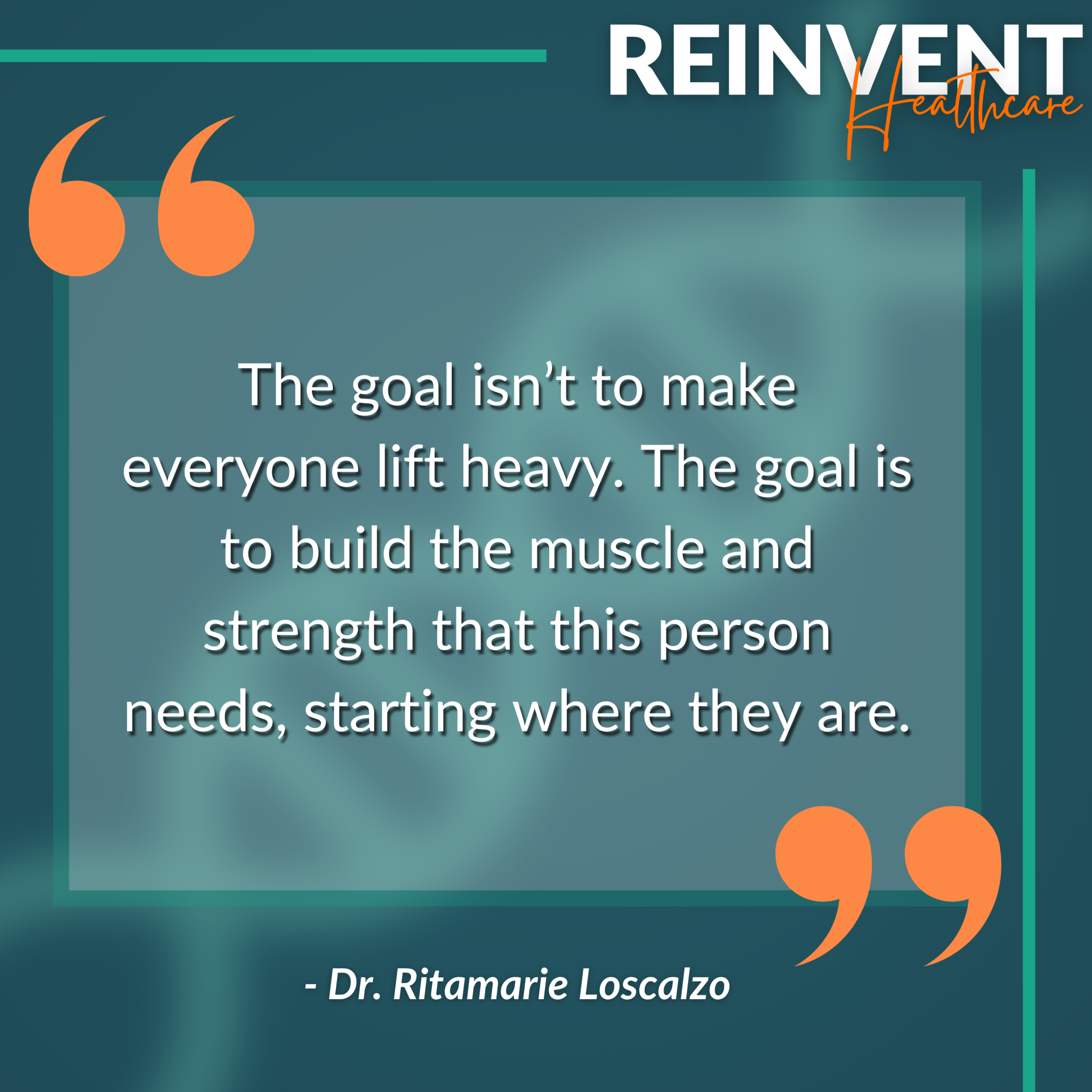
This is where resistance training becomes foundational. A lot of people are afraid of resistance training, because they're afraid that they're not strong enough. They're afraid to hurt themselves, and this may be true. That's where we need to step in and help them to do the right kind of resistance training. Maybe it's sit to stands, get on the chair, stand up. That's a practical movement, it also is similar to squats in building leg muscles. Squats are important.
Maybe people are scared of squats, so they can do partial squats. They can do squats with their hands against a wall to hold them up. They can do assisted squats with bands. There's a lot of ways to do it. Things that cause the hips to hinge, because that's where a lot of the fractures and the weaknesses occur.
They can do rows. Rows are easy, whether it's a rowing machine or muscles or with resistance bands. You can do presses, bridges, step ups, little step ups leading to bigger and bigger. Then loaded carries, because those are practical, holding things in your hands and walking around.
They can go to the gym and use the machines. They can use dumbbells, and you can get small sets or larger sets. I have progressively built my sets of dumbbells at home as I got stronger years ago. I get more and more heavier and heavier, or go to a gym and join a gym or get resistance bands, because you can generally keep on increasing the resistance there.
Body weight progressions, I shared on a previous video about a client who started out with push-ups against the wall, and progressed to push-ups on the counter, and then progressed to push-ups on the bathtub, and then push-ups on the floor. She was 82. Watch that episode if you want more information about that.
A lot of other movements can be set up for people, but they have to match their capacity, not their future capacity, not their past capacity, but their current capacity. Which is where it's really helpful to have people work with trainers.
For one client, a sit to stand from a chair can be very good for strength training, for resistance training, and for another, that same movement may need to progress to a weighted squat,
Dr Ritamarie (00:09:18)
We have to work with people where they're at and not just give them
heavy duty stuff to do that's beyond where they're at. They get frustrated, they can't do it. Progressing where they're at in terms of their strength but also in terms of their stamina.
A light resistance band might be the best entry point for a lot of people, and for other people, heavier pulling movements might be needed. This is where personalization comes in.
A farmer's carry might be too much for someone, especially if they try to lift 25-pound weights. A farmer's carry with just a can of soup in their hands may be just fine. It's really helping people to identify the resistance that they can use to help, not hinder or hurt them. The key is progression. Start small and gradually progress up. Bone and muscle need enough challenge in order to adapt and in order to grow stronger. It should never outspace safety. That's super important.
Our job as practitioners is to ask, what can this person do now? What signal is missing for them? What movement can they perform safely? What do we need to help them to build first? Is it strength? Is it balance? Is it their posture? Is it their confidence? Maybe we need to look from a food perspective at protein intake and carbohydrate intake and the right nutrients, phytonutrients, and phytochemicals.
Do they need coordination? Do they need more recovery time? Do they need to stabilize their hips, or do they need all of this? This is how movement becomes personalized. I talk a lot about beyond protocols. We can't just throw a protocol at somebody, here's an osteoporosis exercise program. We have to look at where they are and customize it for them.
Let's talk about weighted vests, because those are very popular these days. They can be useful, and again, there's nuance to it. A weighted vest increases the load during walking and stair climbing and squats and sit to stands and other movements. It may create a stronger mechanical signal than body weight alone.
Not everybody should start with a weighted vest. Some of the concerns that we have in starting people there is if they have poor posture, kyphosis, that forward bending of the head, back pain, osteoporosis in their spine, where we have to be super careful about loading their spine, balance problems, they may fall.
Dr Ritamarie (00:11:46)
Joint pains and just general fragility. We need to look at avoiding giving them too much load too soon. A weighted vest shouldn't pull somebody into a forward posture. It shouldn't worsen their pain, and it should not increase their fall risk. If it does, then that's not the right thing for them. It shouldn't make them have to compensate for it.
For some people, starting with weighted vests is a great thing. People who are doing a lot of walking already and it's just not enough to stress their bones, a weighted vest might be perfectly fine.
In order to know that, we need to look at their posture, look at their gait, look at how comfortable it is, assess their balance and assess their pain. They come in different weights. I would like the kind that would allow you to change the weight. It starts with just the vest and then you can gradually put it in. I haven't looked in detail at the weighted vest to see if there are some like that.
I've seen them where there's like six pounds, five pounds, ten pounds, but like the ankle weights, I have ankle weights that go from one pound up to 20 pounds, and you gradually can stick the little weight sticks, one pound weight sticks in to get it higher and higher. That might be a way to go with a weighted vest.
We need to look at their balance. If they're off balance, if they already have a forward posture, maybe it's not the best idea, because it might throw them off balance and cause them to fall.
You need to look at how their breath is, how their stamina is. We need to also look at their confidence and progress very slowly. Some people use a weighted vest for short walks. Others might use it for sitting up from a chair. Others might use it for step-ups, just to increase the resistance. That might be easier than holding weights in the hands. Others might not be ready at all. And that's all okay.
It's not asking, are weighted vests good or bad? The better question is, does this added load improve the signal safely or does it create more compensation? That's a big difference.
Let's talk about yoga. Yoga can be wonderful for bone health, and there are specific yoga practices that are specifically designed for bone health. We want to make sure that we get people into that. There's YouTube videos, there's programs. One of our nutritional endocrinology students is bone health certified in bone health, yoga for bone health, and she has classes that she does to teach you the right ones.
We even within our Unstoppable Health Circle Library, we have recordings of her teaching that. It’s really important. Yoga is great for supporting parasympathetic and balance, but it's also good for posture and strength. She explains that it's certain lengths of movement and holding the postures that way and focusing on the breath and getting the nervous system regulated. There's all kinds of things, and when you focus on these things, it helps prevent falls and helps people to be more aware of their body, and extending into specific poses that's going to be helpful.
They're all relevant to fracture risk, but not all the yoga poses are appropriate, and we need to be very careful about that.
Deep spinal flexion can be risky with somebody with vertebral osteoporosis, because that can cause fractures. Loaded twisting may not work with disc problems, especially.
We need to look at that in a very specific way and not just say, do yoga for osteoporosis, do bone smart yoga, find a class, find a video, find someone to guide you through yoga for bone health.
We need people to focus on posture, balance, hip strength, spinal, hip and spine are where the DEXAs are measured. Controlled transitions, breath, nervous system, and not overdoing it.
Yoga can be a super important part of a bone health plan. Not for everybody, but definitely can be helpful, and that's something where it is great to find somebody that you can refer to that will help people with this.
It's interesting to note that many people think that if something's gentle, it must be safe, but that's not necessarily true. Yoga is gentle, but in certain ways, yoga can be pretty non-gentle, certain types of yoga. It's really a matter of finding the right movements for the individual person. Like I said, the research shows that it's holding specific postures for specific lengths of time that accentuates the pull on the bone.
Dr Ritamarie (00:16:17)
We as practitioners just need to think about the individual person. What do they need? Are we looking for pull on the bone to help to support that? And there's definite evidence to that. Or, do they need more balance? Because a lot of yoga poses really help people with balance. Do they need breath work? Do they need to be in the parasympathetic state more? Getting out of the sympathetic fight, flight? Do they need their hips to be stable? Do they need specific postural things? All of these things are super important to be asking.
In summary, it's a difference between saying do yoga to help your bones, because it may not, it may just be like walking, it's nice to do but not helpful, and prescribing bone smart yoga.
Since this episode is about movement, and this is a hormone-focused bone series, we need to connect movement back to endocrine physiology. Movement influences insulin sensitivity. It supports glucose uptake. It can also improve inflammatory tone, and it can support sleep and stress reduction. These are really important things that we need to look at.
Movement helps preserve muscle, which helps testosterone and growth supportive signals. It can influence myokines, which are signaling molecules released by the muscle. Those communicate to bones. When we talk to people about movement for bone, we're not just asking them to add mechanical load. We're influencing the endocrine terrain. Strength training can help preserve muscle and improve insulin sensitivity.
Impact may signal bone remodeling, but we have to be careful about impact. Balance training may reduce falls, but while they're doing it and learning it, they may increase falls. We have to really be careful, and we really need to do very person-specific ideas here.
Walking can support glucose regulation, circulation, mood, and recovery, and it's part of a big program. We do need to make sure that we're actually actively having people work their muscles, whether it be with little resistance bands, whether it be with specific body weight exercises, or whether they get some dumbbells, and they start to go, and they go to the gym, and they start to lift heavy.
Not everybody is in the position where they're ready to lift heavy, and that's what helps build muscle. It's working with people exactly where they are. That's why we move beyond protocols. That's why I really keep harping on this beyond protocols to personalized plans.
We could ask somebody to do some yoga, and lift weights, and walk, and jump, but not everybody with bone loss can jump. We talked about that in a previous episode. Not everybody should wear a weighted vest. Not everyone needs to avoid impact, even if they need to avoid impact right now.
We need to look at their fracture list risk, their strength, their balance and their hormone status. And all of this plays into creating customized protocols for people. Not protocols, I keep saying that word, because it's so ingrained, but customized plans for people.
In the next episodes, we're going to talk about the different kinds of scans, the DEXA, the REMS, advantages, disadvantages, the various lab testing that we can do, and we're of course going to talk about food, because it's critical to address food.
When we're talking about osteoporosis, when we're talking about increased bone health, we need to address the stress, the sleep, the nutrition, the food, not just nutrients, but food. We need to address timing like we've talked about in previous episodes. We need to address blood sugar, gut health,and the microbiome. We need to address everything that plays in, including strength training and resistance training.
Really, the question to ask is what movement is safe for them right now and is going to really support building up their bones. Building a personalized plan is so, so important, and if you haven't already downloaded my Beyond Protocols guide, go ahead and do that. It has a couple of videos that go with it to just help you to think beyond protocols and into specific frameworks that you can use with people.
Let's talk about a personalized framework for improving somebody's bone health.
Number one, we should assess risk, and that looks at fracture history. If they have a DEXA or REMS, the Echolight, looking at their T-score, their Z score, the fragility score, which comes with the REMS.
Do they have pain? How's their balance? Are they on medications, not just bone support medications, but other medications that can interfere with bone metabolism? What's their risk of fall? How have they had any falls? What is their medical history and their spinal health history? Do they have any fractures? What's their confidence level? Are they scared? Are they ready to jump in here?
The next step is to assess their capacity. Check it out. Can they squat? Can they hinge at the hips? Can they carry? How much can they carry? Can they balance on one foot? Can they get off the floor without using their hands? Can they climb stairs? Can they tolerate impact? Can they follow instructions? That's a biggie. Can they control alignment? How do they recover? How well? How quickly?
Then step three is building the foundation. We need to build a foundation of strength. They need protein to build muscle. That doesn't mean they have to eat steak and eggs. Protein from plants is fine, but it has to be addressed.
How's their posture? How's their balance? Let's look at their breath and their sleep. Sleep is critical. How's their nervous system? Are they sympathetic or parasympathetic dominant? Do they get enough nutrients, not just calcium and vitamin D? And how's their confidence?
Dr Ritamarie (00:21:53)
Step four is adding the osteogenic signals. That includes progressive resistance training, step-ups, loaded carries, heel drop stomping, some of the jumping stuff that might be appropriate, the gentle stuff, or if they're ready to jump off boxes, go for it.
Hopping and jumping, all of this stuff, and the weighted vest. We have to figure out what's appropriate, and when they're ready, if they're ready for power training. I have an osteoporotic patient that works out with a trainer every week and she's increasing her lifting, but she does it supervised, because she's afraid to do it at home, because she doesn't want to try to lift too heavy and not have somebody spotting her.
These are all the things that we need to do to help people create that personalized plan.
Step five is to monitor if they're doing this exercise. Are they increasing their pain or fatigue? Are they getting more confident? Are they having any falls? What's their strength? You can do that easily. I can push this much weight on week one, and on week four, I can push 10% more, 5% more, whatever. Looking for those strength changes, and if they're doing the work but not increasing the strength, we may have to look at the nutrients. We may have to look at the protein.
What's their body composition? It’s very helpful to do a full body DEXA, which will measure your fat, lean mass, and visceral fat, or a bioimpedance to measure their muscle versus their fat.
These are all important things to do, and bone turnover markers. We're going to have a whole episode on bone turnover markers. Very important, and not everybody's doing them.
Repeat imaging whenever appropriate. Most doctors that do osteoporosis screening, they'll redo the DEXAs once a year, because you're not going to really see much difference. I've seen people see small differences in just six months with the food, but basically 25% has to change in order for it to show on the DEXA.
The next step, progress intelligently. Use the body, use their feedback as the indications. You may not be doing this alone. If you're mostly a nutrition type coach, and you're reading labs, you may have to partner with someone who can help you with the strength training, with the yoga, and people you can send to, but you maintain overall looking at the person and the monitoring.
Dr Ritamarie (00:24:11)
Don't ever let the progression out pace the safety. Stay safe. It's really important. That's where many people need guidance. They're either doing too little, because they're afraid or too much, because they're desperate. We can help them find that middle ground. Enough signal to matter, but not so much that it's harmful.
For us as practitioners, I divide bone-supported movement into categories. Category one, foundational strength, sit to stand, squats, etc. Once they get past that, then you can add some weight. They can do rows without weight. They can do rows with weight. They can do presses. They can do bridges, assuming they are comfortable with that. They don't have low back problems. They can do step-ups.
Category two is loaded. You start to add loaded with farmers' carries, carrying suitcases. They're going to have to do that. That's functional. Well, how can we do that? Stair climbing, loaded walking. That could be with the vest, it could be with just carrying weights. My husband carries these little weights in his hand, because it adds some extra support to that.
Then category three is impact and power. Start to do heel drops and stomps when they're ready, small hops, jumps that are not going to impact where they're at right now, landing drills. Some people are going to jump in at step three. Some people are going to start at the beginning, but powerful sit to stands, using weights for that.
Then step four would be things that are going to help their balance, Single leg balancing, standing on one leg and alternating that. They may only be able to do it for a second. They may only be able to do it when they're hanging on to something. Then tandem stances and tai chi type movements can be super helpful. Controlled transitions from seated to standing, or laying down to standing, or going upstairs, and things like that, but maybe with weights or maybe doing it quickly. Gait training is important.
Category five is posture and spine support. Support them in spinal extension if that's appropriate. Scapular retraction, which is the movement we need to do to do a pull-up. Core stability, it's not just about push-ups and pull-ups, it's about core stability, sit-ups, and various things that you can do, and hip mobility. Avoid excessive, loaded flexion in people who have spinal osteoporosis.
Dr Ritamarie (00:26:32)
Nervous system reset is so important. This is part of bone building. Breath work, gentle yoga, meditation, restorative movement, and then of course walking plays into this and sleep, because bone remodeling doesn't happen during punishment. It happens through stimulus and recovery, and we have to make sure that the recovery is built in.
Let's bring this all together. Bone responds to movement, but not all movement sends the same signal. Walking is helpful, but may not be enough. Jumping can be powerful but is not for everyone.
Resistance training is foundational, because muscle tells the bone it's needed. Weighted vests can be useful, but only when they have the right posture, strength, and balance, and you support their fracture risk.
Yoga can support balance and posture and, of course, nervous system regulation, stability of the hip, spinal extension, but it needs to be bone smart.
Recovery matters, because bone remodeling doesn't happen like that. We have to recover muscles. They need recovery. Every day pushing, pushing, pushing is not a good idea.
For us as practitioners, we're not asking what bone exercise everyone should do. We're asking what movement or signal is missing for this person and how am I going to support them to have more strength, more pull on the bone, more osteosteo site stimulation for osteogenesis that they feel comfortable with. That's not just biochemical, that's not just hormonal, that has to do with the structure and the strength training, because it's so, so important.
Our job as practitioners is to give people customized programs and work with people where they're at to help move them to where they want to be, which is most people strong, independent, low fracture risk. We’re addressing their hormones, addressing their nutrition, and addressing everything that's in their pattern. That's where personalized care begins.
In the next episode, we'll be talking about testing, bone metabolism, lab markers, and natural approaches to bone building when medications might be indicated. There's times when they absolutely need it, and there's a lot of people who say, No, I don't want it, but there are times when you're going to need it. We'll talk about that.
After we've covered this, we're going to really look at how we evaluate from the standpoint of labs and from the standpoint of imaging and how we really truly help people to create personalized plans.
This is exactly why the future of healthcare has to look different. We have to get away from this person has this T score, Z score, whatever, and this is the medication they need, and by the way, walk and go to the gym.
That's not enough, and we need to personalize. That's where healthcare right now is falling apart. I want to make sure that you are here, because you want to help us with reinventing healthcare. We can't wait on building bones until they break a bone. We can't wait until they are diagnosed with osteoporosis and diabetes and other things that are considered natural effects of aging. We need to help them, before it gets there.
The future of healthcare has to be proactive. It has to be personalized, and it has to be focused on root causes. Did a person have celiac disease and that's what caused them to have this problem? It has to recognize that bones, muscles, hormones, the gut, the brain, the immune system, metabolism are all communicating. Osteoporosis isn't a bone problem. It's a problem with the overall system communicating.
That's where nutritional endocrinology is what I specialize in, and I'm passionate about. It helps us understand the language of the body and how it communicates. It helps us to see the patterns underneath the diagnosis, and it helps us to ask better questions. Everything's about questions. It helps practitioners move beyond generic recommendations to precise personalized root cause care. This is the kind of work we need in healthcare.
No more symptom management, no more generic protocols, more pattern recognition, more systems thinking, and more practitioners who know how to help clients rebuild resilience from the inside out. Thank you for joining me on my quest to reinvent healthcare. And until next time, shine on.
Listen on your favorite podcast platform!





Share This Episode