Understanding Trauma’s Impact on Metabolism, Immunity, and Chronic Illness with Dr. Aimie Apigian
Trauma isn't just something that lives in our minds. It has a profound impact on our biology. In this episode, Dr. Ritamarie sits down with Dr. Aimie Apigian, a double board-certified physician and expert in trauma biology, to explore the hidden impact of trauma on metabolism, immunity, and the nervous system. Dr. Apigian explains how unresolved trauma can trigger physical symptoms, including chronic illness.
You’ll discover the biological processes that make trauma a root cause of illness, why the body keeps the score, and how trauma creates a feedback loop that keeps people stuck in their symptoms. Dr. Apigian shares actionable strategies for practitioners and self-healers to help break the trauma cycle, understand the body’s response, and guide their clients toward healing.
What’s Inside This Episode?
- How unresolved trauma rewires your metabolism, immunity, and nervous system
- The “Body Trauma Loop”: Why trauma keeps you in fight or flight
- How childhood trauma shapes adult health, metabolism, and immunity
- The 3-phase healing process: From safety to expansion
- Why “little T” trauma can be just as damaging as “big T” trauma
- How to recognize when trauma is the root cause of chronic symptoms
Resources and Links:
- Download the full transcript here
- Download our FREE Guide to Fasting for Health and Longevity
- Join the Next-Level Health Practitioner Facebook group here for free resources and community support
- Visit INEMethod.com for advanced practitioner training and tools to elevate your clinical skills
- Check out other podcast episodes here
Guest Resources and Links:
- Dr. Aimie Apigian’s Website: biologyoftrauma.com
- Dr. Aimie Apigian’s Book – The Biology of Trauma: Get the book here
- Dr. Aimie Apigian’s Podcast: Biology of Trauma Podcast
- Free Gift: Nervous System Reset – Five Somatic Practices
- Connect with Dr. Aimie on Social Media:
- Instagram: @dr.aimie
- LinkedIn: Dr. Aimie Apigian
- YouTube: Dr. Aimie Apigian
Guest Bio
Dr. Aimie Apigian, double board-certified physician (Preventive/Addiction Medicine) with master's degrees in biochemistry and public health, revolutionizes trauma healing by revealing how our cells—not just our minds—store trauma. Her book “The Biology of Trauma” (foreword by Gabor Maté) transforms our understanding of how the body experiences and holds trauma. After adopting a child during medical school sparked her journey, she developed an integrative science-based sequence for the healing journey. Through her practitioner training, podcast, YouTube channel, and international speaking, she bridges functional medicine, attachment and trauma therapy, proving that repairing trauma's impact on the mind, body, and biology is possible.
Transcript
Dr Ritamarie
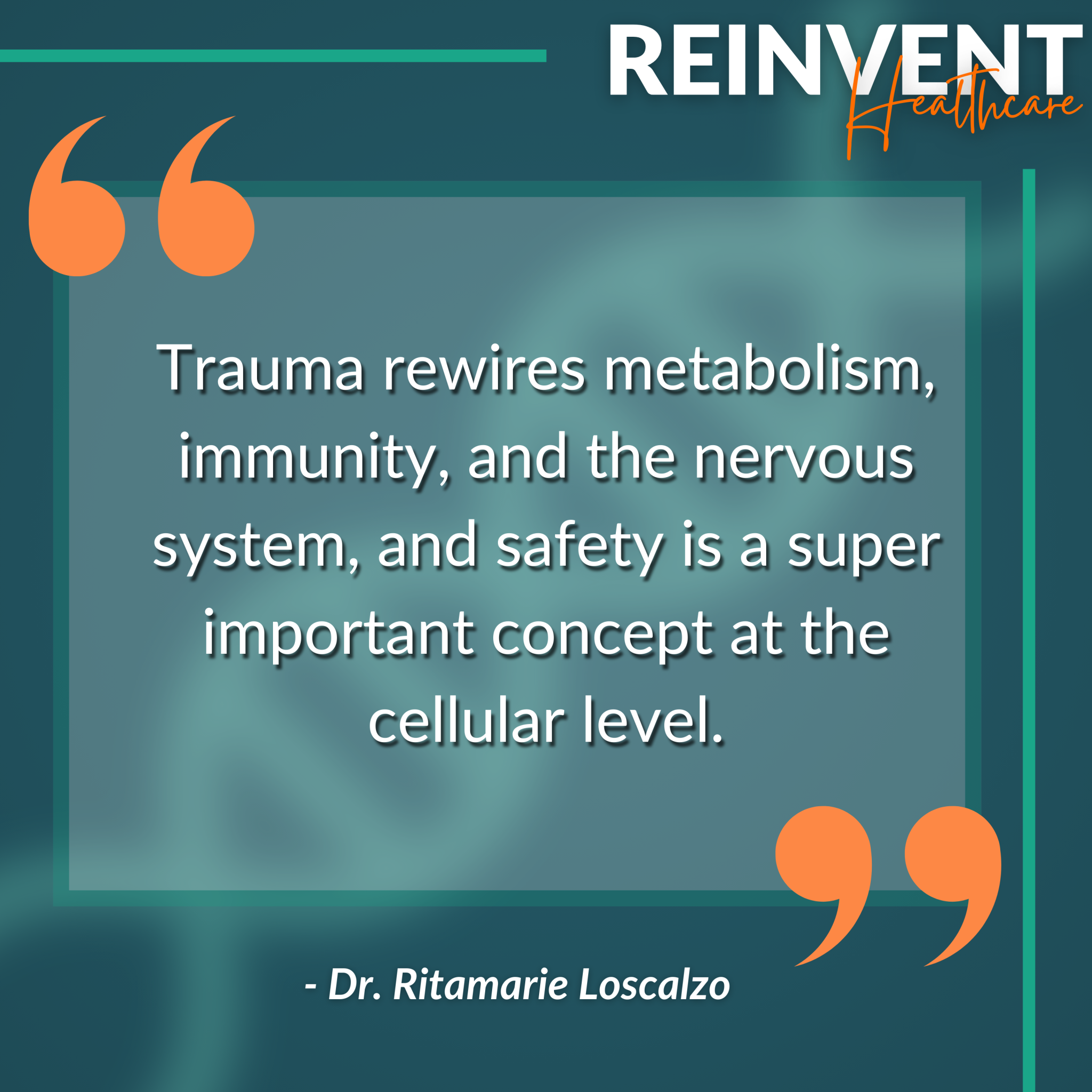
You can have the perfect diet, balanced hormones, and pristine diet and lifestyle habits and still have symptoms. Why? Well, because biology remembers what the mind forgets. And today we'll uncover how trauma rewires metabolism, immunity, and the nervous system and what it takes to restore safety. Safety is a super important concept at the cellular level.
Today we are talking with Dr. Aimie Apigian about a super important topic that is often overlooked, the biological impact of trauma and how it can cause physical symptoms long after the trauma is gone.
Dr. Aimie revolutionizes trauma. She's been in her practice since she left her standard medical practice, and we'll talk a little bit more about that, I want to hear about the evolution of that, to create online programs, to write the recent New York Times bestselling book, The Biology of Trauma, to really help us as practitioners to jump in and not just focus on the biochemistry and the labs and all that, which are super important, obviously, but to really look, for those stuck patients, at what's going on behind the scenes, what kind of traumas we can help them to overcome.
So I'm so excited to have you here. She’s a double board certified medical practitioner. She has lots of experience in this, and we're going to jump in and talk to her about how she got into this trauma biology and what does that mean to us as health practitioners, health coaches, et cetera, to helping our clients. So welcome Dr. Aimie, I’m so excited to have you here.
Dr. Aimie (02:07)
I’m excited to be here. You're one of my favorite people to talk to about this. So I think that with your experience, I feel like you've seen it all Dr Ritamarie. You've seen it all. So you've seen how buried emotions actually do hold a person back and make them sick.
Dr Ritamarie (02:23)
Absolutely. I want us to understand as a practitioner, health coaching, functional medicine community, how does that work? Because we can say that, and those of us who don't have the training and expertise that you do will say that, but not really understand. I like to understand the nitty gritty details and how all that works, the neurochemistry and all?
So first of all, what prompted you to get into this field of trauma biology?
Dr. Aimie (02:50)
You're telling my story. So I was at that place where I needed to understand the how, because the how was going to give me the tools to do something about it. And it was just such a general idea that of course I know that the body keeps the score. Of course I know that adverse childhood experiences make us sick 20, 30, 40 years later, but what can I do about it?
Dr Ritamarie (03:17)
Right. What can we do for ourselves? Because so many of us, even as healers, we're experiencing that sort of trauma biology ourselves. But also, what do we do to help these people who come to us and have been struggling and are eating this and meditating and doing all this stuff, but still there's something holding them back?
Dr. Aimie (03:37)
And that was me. So yes, I became a foster parent and then I decided to adopt my foster child. But it really wasn't until I got sick that it really hit home, this connection with your physical health. And I didn't have any answers, Ritamarie. I didn't know what to do. I didn't know where to go. I'm a physician, right? I, of all people, I know the body. I know the physiology.
I started trauma therapy, because that's what I think that I'm supposed to do. I'm supposed to go talk to someone about it, right? And realizing that my body was just hitting a wall, and I was working so hard and still stuck, still noticing that, you know, shoot, I'm still doing the same things. I'm still emotionally eating. I'm still guarding my heart and keeping people at a safe, emotional distance. I'm still doing all of this.
Even though I can understand what I'm doing now and why I'm doing it, I still can't stop what I'm doing. And that was when I was like, I've got to go deeper. I've got to figure out what is keeping me stuck. And that's how the lens and the framework for the biology of trauma came to be.
Dr Ritamarie (04:48)
Wow. Yes, I know, so many of us who are in this health space, this alternative, if you want to call it that, it's really not alternative, but it's functional, and it's what works. It's the actual medicine, if you want to call it that, healthcare that actually helps people, actually cares for people. So it's not really alternative, but for those of us who are in this space, who have either left traditional medicine or never got into it because of an experience with it.
It's what we live. We have a specific experience. I had a specific experience that got me into this. You had an experience. And so when we can come from that lens of having experienced it, we're able to so much better have empathy, first of all, for the people we're caring for, and know what they're going through. And when they're hitting a wall, right, and know the frustration, but also that it's a helplessness when they're hitting that wall.
So tell us more. Tell us about all the adverse childhood events. We already hear that. I've read numerous studies and a really good book. I can't remember the name of it right now, but I loved that book, because it really hit home for me. This wasn't just in somebody's head. It was physically in their biology that those adverse experiences impacted.
So tell us a little bit more from a practitioner’s view. My audience is generally health coaches, medical doctors, and nurses who left the system and want to do more, right? They really want to look at the body functionally.
How do we know when we're in over our heads with this, right? Like if we're not trained in trauma biology, but also how do we know when we should be looking at this for people.
Dr. Aimie (06:34)
Yes, there's two important things that I would want your practitioners to understand. And that is this idea that trauma, yes, it becomes our biology, not just psychology, it becomes our biology, which means that the work that your practitioners do is incredible for trauma healing, because you're helping to address, and I use the word repair, repair the impact of trauma on our biology.
And there are specific aspects in which that trauma has impacted the biology. But really the most important concept of the biology of trauma is that our biology becomes a cue of danger to our nervous system. And most people are not aware of that. When they start to feel anxious, they're looking for who in my life is causing me stress, because you are clearly the problem.
What in my life is going wrong? Because that is clearly the problem. Not realizing that it could be their own inflammation. It could be their own level of oxidative stress. It could be their toxin burden. Those aspects of our biology inside of us is causing cues of danger to be sent to our nervous system that says we're under attack, we're in danger, and then a person will feel anxious and think that it's something outside of them.
So just the fact that our own biology is creating this feedback loop that whether the biology came first or whether the trauma came first, it doesn't matter because our own biology can be a source of danger to our nervous system.
Dr Ritamarie (08:20)
It's like a vicious loop, almost, right? You have this trauma and that creates this physiological presentation and then that physiological imbalance and inflammation. And all that creates a danger signal, and that replicates that response that we have when we have true physical danger or emotional danger. Does that sum it up?
Dr. Aimie (08:45)
Yes. And I call this the body trauma loop. You're just looping. Which comes with its own consequences. But this loop is looping between the sympathetic stress state and the overwhelm or the trauma state. Those are two very different physiological states.
Again, that would be an important thing for your practitioners to understand is stress is one physiology. Trauma is a different physiological state.
Dr Ritamarie (09:17)
Let's go deeper with that, because I really want everybody to understand that.
Dr. Aimie (09:21)
And I learned the body's instinctual trauma response when I was helping my foster-adopted son work through his past trauma. And I had tried so many different things. I had done many different things, and I was literally taking them across the country to find anything that was helping.
And one of the aspects that really helped was an art narrative process, meaning art, you're going to draw it out, and it's a narrative. So it's a story. You're drawing out a story. And the story that they had him draw was the internal experience of the body during a trauma response.
And Ritamarie, this was the first time that I'd ever seen this response laid out so clearly, because up until then, it had just felt like this trigger happens and then all shit hits the fan.
Dr Ritamarie (10:23)
Yep. There was no pattern. There was no way you could trace what was going on.
Dr. Aimie (10:27)
There's no sense. It's just a mess. It's chaos ,and you're spiraling out of control. And so to be able to see that there is this very sequential process.
It actually is very methodical. The body is actually very deliberate and intentional to make a decision to go into a trauma response. I was fascinated by this, and it helped him so much that it changed his entire life, our entire relationship. And that was the very first thing that I went and got myself trained in when I decided that I wanted to learn how to incorporate trauma into medicine.
And as I studied deeper, the physiology became very clear. There are five steps that the body takes to go into a trauma response. And these steps are shifts in the nervous system. And each one at each step, it's like an escalation of your nervous system and its survival response.
So we start with a startle. Now the startle is part of the sympathetic nervous system. And so already with that startle, you're going to give it a little bit of adrenaline. You're going to get a little bit of noradrenaline, actually that pre-stored hormone in your tissues that makes you jump even before you realize what you're doing. And you can feel your energy go up, your senses start to hyper attune to your environment, because you need to pick up all the information you can. Is this a real danger or is it not?
It was just a noise. It was just a sound. It was just the door slamming because of the wind, but there's no danger. Those are all the things that we need. And we've got about 15 seconds for our physiology to decide, is this a real danger, or can I relax?
Dr Ritamarie (12:18)
15 seconds. That's a good number to know. Like 15 seconds, it's not very long. But again, when you're in that situation, it could feel very long, because you're in that hyped up. I don't know yet whether it's safe.
Dr. Aimie (12:32)
Yes, exactly. And not knowing is a reason to escalate to the stress response.
So if after 15 seconds, you still don't know if it's a real problem, isn't that a problem to not know? Yes. Especially for those. So 15 seconds is what our body needs to be able to say, that's not a problem at all. My grandkids are jumping out from behind the corner to scare me. I'm going to tackle them. I'm going to tickle them. We’re going to co-regulate. We're going to come back to safety.
Or like me, if you forget something that's cooking on the stove, and you start to smell something, there's one of your senses, right? And it's picking up danger, danger, danger. We're smelling something, and you run into the kitchen, you turn off the stove, and you're fine, right? Danger is over. And that allows our body to reset to safety, which completing our responses is actually one of the most important things that we can do for our health moving forward.
Dr Ritamarie (13:39)
Yes. Okay, so the completion, this is an important point, right? So that startle is a sympathetic response, but completion of that keeps it in the realm of it was a temporary sympathetic response.
Dr. Aimie (13:52)
When we don't know how to complete our responses, and we will need to learn how to complete our startle responses, our stress responses, and our trauma responses. Three types of responses that we need to learn how to complete, because if we don't, it continues to progress, and then it becomes stored. And now we end up carrying all of these responses from our past, because we simply didn't know how to complete them or resolve them at that time.
Dr Ritamarie (14:23)
Okay, so is that why when we hear about PTSD and somebody's been in a war or whatever, there are certain triggers that cause them to go back to that place where it wasn't safe? Even though, right now they're safe, they're taken back to a place where it wasn't and then they relive it. Is that an oversimplification?
Dr. Aimie (14:43)
That's exactly it. That is a great description of what happens when we have not completed a response from the past. It can be triggered, because it's still there. That memory is still there. And it's a memory that says, this is still present. It's not that it's in my past. It feels like, and it's a perception that, it's happening right now. And here's what people need to know about the nervous system.
It is not about our reality. It's about our perception.
Dr Ritamarie (15:16)
That's right. Bingo. I talk to people about that all the time. We can make believe, and the body doesn't know if we're at the beach or in the middle of a stressful traffic jam or whatever. Yes. So we can use it to our advantage, but it gets used to our disadvantage probably more often than not.
Dr. Aimie (15:34)
Which is without understanding what's happening inside of us. Absolutely. Once we understand, and we can feel that, “Wait a second, I'm having a response to this,” now that allows us to have a very different relationship with our body.
It's the disconnection, the disconnection from our body, that doesn't allow us to even feel when my body starts to say, I'm feeling uneasy here.
I spent most of my life overriding those kinds of messages and sensations in my body. I felt that my body was just getting in the way. I've got a job to do. I need to get things done. I need to focus. I can't listen to you right now. You're just supposed to go along with what I tell you to do. Oh, you think that you want to feel tired right now? No, no, no. Let's go grab some caffeine.
Do you think that you want to rest? No, no, no. Let's go grab some of that sugar, so we can get that dopamine, and we can have the rush, and we can keep going, because no, no, no. I need to focus, and my body can't slow me down.
So I spent my life overriding all of those messages until one morning my body said, “We're done. That's not working for us anymore.” And I couldn't get out of bed. The chronic fatigue had become so bad, and I could no longer push through it.
Dr Ritamarie (17:00)
You can no longer override it. Couldn't. Your body was drained enough that you couldn't override it, right? And how many of the people that we see day to day, day after day that are fatigued and can't get out of bed, or they just can't do what they used to do, they can't exercise, because if they do, they're in bed for three days. How many of those have been chronically overriding?
Dr. Aimie (17:23)
One of the patterns that we can use to recognize if this person is holding on to stored trauma, is this a pattern of depletion. Do they feel depleted? Do their labs come back with signs of depletion? Do they describe a sense of depletion in their life, in their relationships, in their sense of joy or lack of joy?
The pattern of depletion is one of the classic patterns that we can use to even recognize that a person is holding stored trauma.
Dr Ritamarie (17:58)
So here's the question. Is it important that we get to what that trauma was and have them do traditional talk therapy? You talk it out? Or is that maybe even counterproductive, because you're starting to relive it? I'd love the answer. What your perspective is on that.
Dr. Aimie (18:17)
When we work on stories in the past, there are two options. One is to resolve. The other is to relive. Which one are you going to do? Both are possible. Most people are reliving. And it's simply because when we work on a story of the past, we go into all of the emotions of that story. We're not able to separate the story from the emotions of the story, until we've resolved it, until we've completed it.
And when we experienced those emotions, the reason why it was a trauma for us at that time in our life was because those very same emotions that you're feeling right now were so overwhelming. Your body was like, we can't feel all of this. We're going to die. We should shut that off. We should disconnect. We should dissociate to some degree.
And so the very same emotions that shut us down before, are now being re-presented to us. The shame, the powerlessness, the helplessness, the feeling trapped, the feeling alone. And if we don't know how to move through those emotions in a different way to get a different outcome, we just get the same story and the same result and we relive.
Every time we relive that, we reinforce that these emotions are too big for me, and we reinforce the very thing that we're trying to change
Dr Ritamarie (19:52)
Wow, this is big, and it's heavy. So the thought that came to me as you were saying that, when these feelings come up in the present time from something in a past trauma, are the people, most people in your experience, necessarily aware of what that trauma is, or they're clueless at this?
Dr. Aimie (20:11)
What a great question. I find that most people who come into my programs don't really even relate to the word trauma. I have to define trauma for them as anything that for any reason at that time in your life overwhelmed you. It was just too much. It was just too fast, too big.
Or it was just too long having to live in chaos, in neglect, in a sense of depletion. And when I describe that, people are like, yes, I've felt that way, before where I just wanted to curl up into a ball, and pull the covers over my head, and make the world go away. Yes, I've felt that way before. And I'm like, that was your body and a trauma response.
And that's when the light bulbs come on for them. And they are recognizing that whether I knew it or not, my body has been holding trauma. But where we go from there is actually more important. It's more important for us to see how is it showing up in your life today. Because we can have past trauma that we've resolved. And resolved trauma is not the trauma that makes us sick today. It's the unresolved.
And that's why we look for patterns that are showing up in your life today, because that's how I know, is this unresolved, that it's still seeking to be healed? It's still seeking that resolution. If it's showing up in your life today, then we've got some work to do. So let's look at what are the patterns in your life, in your relationships and in your health today, rather than going through an inventory of, let's look at everything that's happened to you and see if you qualify for the word trauma.
Dr Ritamarie (22:17)
Okay, yes, because that could be traumatic in and of itself, just pulling up stuff that was resolved, but now you're remembering and go, oh, but then a lot of people talk about the big T and the little T trauma. Can you address that? Do you play into that?
A lot of times, if you look back, I mean, I didn't have any big traumas. I wasn't beaten, wasn't sexually abused, but there were times when I felt very small because of the way the conversations were going with parents or aunt's uncle's grandparents, well not grandparents, my grandparents were pretty amazing. But, when I've talked to people about, well that's a little T, and it still gets stored in your nervous system, and you still have to resolve it.
There was one incident. It just kept coming up whenever I'd be talking about it. Like I was 11 years old, like why do you even remember that? Well, because my body took it as a trauma, a small T I guess, trauma. But yes, so I'd love to hear your response to that. Is everything a big T-TRAMA until it's resolved?
Dr. Aimie (23:13)
Trauma is anything that for any reason at that time in your life, it made you feel so small that you wanted to hide.
Dr Ritamarie (23:27)
Yes, interesting. Yes.
Dr. Aimie (23:29)
Trauma is anything that created a trauma response in your physiology.
That's it. Did it create a trauma response in your physiology? Because now we're looking at the physiological cost.
Dr Ritamarie (23:45)
Yes, and it is a big physiological cost for a lot of people. And I find that we're doing all the right things. And then, I'll send them off to talk to somebody about the traumas and stuff and resolve that. And they get resolution and some of them don't.
What does it take to resolve those old traumas? What is that process? How long does it take? What can we share with our people when we say, you know what, I really think there's an unresolved thing going on, thing, trauma, whatever. What can we expect will happen and how long will it take to resolve?
Dr. Aimie (24:23)
It's actually quite simple. That doesn't mean easy. Simple. Meaning we know the principles of the body. We know the principles of healing. We know what the process is. There is a path. And a lot of people don't know that there is a path, so they're trying to do step three without having done steps one and two first. And that's where we feel very frustrated with working so hard, but not getting where we want to go.
The process is really three phases. Three phases and every person should know what phase they're in so that they know what to focus on. And they know whether this modality, this tool, is right for them at this phase. Because it may be a great tool, but that's a tool for phase two, and I'm in phase one. I'm not there yet.
Dr Ritamarie (25:25)
And there's lots of things in life that have that phased thing. And if you jump ahead too quickly, you're not going to get the results. So I love to hear what those phases are so we can recognize them.
Dr. Aimie (25:37)
Yes, these are the same things that you teach, right? Like there are phases of how we start to work with someone, work with their body, and how far their metabolism has gotten off skew, or how far their mitochondria have become compromised. And the toxins, right? You can't jump into active removal of toxins. You've got to do a preparation phase.
So these are principles of the body. And because we're working with the body, it is no different than working with stored trauma in the body. They are the same principles. We're just applying it to a different problem.
So the principle is that we always start with creating safety. Why? Because even referring to toxins, there's a reason why the body's holding onto toxins. And it's because it hasn't felt safe to let go. It's not that it wants to hold on. It just is saying it's actually feeling dangerous to let go.
Dr Ritamarie (26:40)
Yes. And I explain to people that those toxins are safe in your fat. You may not like them there, but they're safe in your fat. When you release them, there’s a chance of them going to your brain, to your heart, to your vital organs, and causing some damage. So your body holds onto it in fat.
Dr. Aimie (27:00)
So now 27:01 we have these toxic emotions from our past. And what happens when we open Pandora's box? Do you think that they just magically get sucked out into the air, into the wind, right? No, it's like toxins.
They get released, and they can circulate, and they can actually go into the brain. And now they're circulating in your blood. They're not packed away nicely and tightly in your fat cells.
They're moving, you're feeling them. And for so many people, Ritamarie, it feels dangerous to feel. I'd rather not feel. This is painful. This is grief. This is sadness. This is terror of a time in my life when I really didn't know if I was going to make it. And you want me to feel that again? That feels stupid, dangerous. Why would I open that up? And so the first step is not opening up. And that's where most people get wrong. Most people think I need to go to therapy, so I can open up. No, you have to make it safe to open up.
Dr Ritamarie (28:15)
Great, so tell us how we do that. That's probably a big process that you take people through.
Dr. Aimie (28:24)
It can be, it depends on how unsafe it feels to open up. If you have someone who's been in a trauma response since their birth, maybe they were born premature. Maybe they were born with the cord wrapped around their neck. Maybe they were adopted at birth. Maybe all these options, right? All of the options. But it starts them in this trauma response from day one of their life. They've been in survival mode their whole life.
And for them to say, okay, I'm now going to feel my body, their mind is like, no, we are not. And it will become a huge internal stress for them to try to force themselves to feel and to open up. They will get more sick. Their autoimmunity symptoms will flare. Their chronic fatigue will flare. Their digestive system will go into havoc.
So these are the ways in which we can even know as practitioners, as health practitioners, you're trying to go faster than what your body feels safe to do. Because we're seeing the impact in your physiology. So actually what we do is we slow things down with the trauma work and that actually allows us to go faster.
Because when we try to go faster, it stops everything. Our body and our brain are just like, “We refuse. We're digging our heels into the ground, and there's nothing that we can do to actually override our body's survival response.”
So the first step is deciding how much safety actually feels safe. Because when we truly feel safe, our shoulders soften. What happens when our shoulders come down? Ooh, all of that stuff from our gut, we start to feel, because we don't feel as much when our shoulders are up here. This is partly why and how our body protects us from feeling. Let me just scrunch up that vagus nerve, scrunch things up, and then I can't feel anything from my neck down. And as our shoulders come down, because we're now feeling safer, guess what will start to rise? And so we don't want to immediately go from shoulders up to all the way down. It's too much feeling that will come up.
Instead we say, what if we just can do a 1% safer right now? And I'll do 1%. And then this feels manageable. This feels like something I could do Ritamarie. This feels like something that I can stay within my window of capacity and not get overwhelmed by this flood of emotions. And other people may look at me and say, but your shoulders are still up.
And I'm like, I know, but they're 1% more safe. And tomorrow might be the day that I can do another 1%. And then another 1%. And this is how we actually start to befriend our body and work with our body rather than coming in and doing what we've always done, which is we're going to force our body to do what we want it to do.
Dr Ritamarie (31:44)
Yes, that makes total sense. It really does. So you're mentioning the shoulders up, is that just an example of a defense pattern? But there's others, right, that you're guiding.
Dr. Aimie (31:53)
Yes. There's many others. There's many others, but muscle tension is certainly a part of stored trauma, because our nervous system says tight muscles protect me. Tight muscles guard against feelings and emotions, and they keep me ready because if there's a danger, I need to be ready.
And so if my muscles are already tight and ready, well then I'm going to be more prepared when that next shoe drops, because I always know that there is a danger right around the corner even if I don't see it right now.
Dr Ritamarie (32:26)
Wow. Okay, so that's your step one is that prep, and there's a variety you're saying of responses that different people will be having and the goal is to get them to just let them go slowly, slowly.
Dr. Aimie (32:44)
Slowly, gently. This is why there's a lot of things out there right now that are not done slowly. They're not facilitating slow opening. And I'm looking at it and being like, I think this is going to get some people into some hot water, because I don't think many people realize how much their body is holding, how much trauma they've actually been packing.
We don't know that until we start to open up, because it's so well packed that we don't even know it consciously. And that's why phase two is what comes next, is support. Safety is the first phase. Support is the next phase. Why? Because as we open up, these emotions will fill up that space.
These emotions have been the uncomfortable ones that we have not wanted to feel. Anger and grief being two of the most uncomfortable feelings that we can have. And we try to stuff them down, and here they are, rising to the surface. And support is the idea that these emotions will cause me stress. And can I hold that stress without going back into shutdown and overwhelm? And in order for us to be able to stay with stress, we need to have a capacity.
We need to have a capacity, and everybody has a daily capacity. How much stress can you hold today? And if the demand exceeds our capacity, that's when our body is going back into that trauma response. So it comes down to what is my capacity today?
How much stress can I hold? Can I hold this amount of grief that is surfacing today? And this is old grief. It's not current, it's old grief. Can I hold the stress of that old grief so that it can move through, and we resolve and not just relive? And so support is the idea that when we have support, when we feel like someone has our back, when we feel that someone's at our side.
When we have support, we can hold so much more stress. It's when we feel all alone that it becomes overwhelming. So now we want to learn how to create support in our life for ourselves and by ourselves. So this is where we all start to look at the repair tools. What can I do with my biology so that I have a greater capacity to hold this stress of this past grief that's coming up?
How can I repair my mitochondria, my oxidative damage, my nutrient depletion, my deficiencies? Because those are going to determine my capacity. And so this idea of support, this is why this phase takes quite a bit of time, because we find ourselves in over our head and then we're back in the trauma response, and we're learning how to come out of those now.
We've never done that before. So we're learning that skill. And then we find ourselves back in stress, and we're trying to figure out, how do I support my body in this stress so that I can now complete this stress response? So that's the second phase.
The third phase is really where everybody wants to get to. The third phase is expansion. So now that I have these skills of creating safety for myself, now that I have these skills of learning how to support my body so that they can hold more stress, I don't want to stay where I am. I want to grow. So that's expansion.
And again, what most people are doing is they're trying to jump to expansion. I want more joy. I want more connection. I want more authenticity, but they haven't created the safety to allow that growth. They haven't created the support for that growth. And by skipping those phases, they fall flat on their face, because it's not safe yet to expand when you don't have safety and support, yet.
And so those are the foundation. I say this in terms of those first two phases can feel like our life is getting smaller, because we're finding and seeking and creating safety. But safety at this point means like, I've got to create this bubble. I've got to get my body out of the spiral and into safety, which means I've got to push some things out. I've got to push some people out of my life, perhaps. I've got to stop the spiraling out of control and come to safety. That feels like getting smaller. And so we don't want to stay small to stay safe.
Some people can do that, and that's why they get stuck. They're just trying to avoid all of their triggers, which means that they've got to stay really small to avoid their triggers, because they see triggers as bad. No, no, no.
Triggers are when you need to learn the support skills so that you can ride those triggers and the emotions that they create and then be able to expand your life. We're expanding from the inside out rather than trying to force change from the outside.
Dr Ritamarie (38:32)
And there's a lot that people do. I mean, you as a therapist with them or a practitioner with them, can take them through stuff, but really what it sounds like, it's empowering people to do this for themselves.
Dr. Aimie (38:47)
And that right there is already disrupting the impact that trauma has had on us. The trauma response creates the sensation of there's nothing I can do, helplessness. And that's why it's so important for me to come in and from the very beginning, day one, I say, you're going to learn how to do this for yourself. I don't want you to depend on me. I will guide you, but we are disrupting that helplessness and having you see that no, there is so much that you can do now.
Dr Ritamarie (39:26)
That's great. And the book, right? I know you've had an online program and were guiding people through this stuff. The book, The Biology of Trauma. The first two questions I have with that: Is that something that people can follow through and be able to get to this place of stage three? But also are a lot of people who are in the trauma response, even capable of sitting down and digesting the information in a book?
Dr. Aimie (39:51)
Yes, really important questions. I wrote this book especially for those people who don't think that they've had trauma.
And I start the book in a way that I walk you through the steps, the physiology, and I help a person see that it's more about what's happening in their life right now. So we're not going into stories of the past. We're not excavating the childhood memories or things that will be super triggering. That's not what this book is for. This book is to show you that our body experiences trauma more than what we have thought.
We've called it stress, because we haven't known a different word for it. But that is something that overwhelmed your body at that time. And here's how we know that it's been holding on. Here's the impact of that.
So section two is all on why and how the body holds on to that pain, fear, and overwhelm.
And then section three is, that's where we're at. We're now a person who's likely been living decades with their body holding on. Where do you even start? What do you need to pack for this journey? What is the roadmap? And I lay it all out, these are the three phases. This is what each phase is. This is how to do each phase. This is how to recognize that these are the support and repair tools that you will use at this stage.
This is what you can start with right now. And this is what the possibilities are. This is what is possible, because so many have lost hope. And it's not that they've just lost hope. It feels dangerous to have hope, because they've been disappointed so many times. And so bringing a little bit of that, it is possible.
And you can do it, because it's something that's not just a secret or something that either is magical, and it'll either happen for you or it won't. It's like, no, there is a very strategic process, and anyone can learn these skills and this knowledge of their body.
Dr Ritamarie (42:18)
It's very empowering. And I have two questions. One may seem like a silly question, but you started with saying that the book was written for a person who doesn't know they have trauma, but the book is called The Biology of Trauma. So why would those people even pick up the book?
Dr. Aimie (42:34)
Yes, that's a really great question. And that's why getting the headline was really important for me, because I'm then describing how a biology of trauma shows up. It shows up as pain, as fear, as overwhelm. And being able to show someone that these things, while we've had different words for them, they're really creating a biology of trauma.
I need you to take it seriously, because it is creating a biology of trauma that will only lead to dis-ease. That's the only path. It never leads to health. It never leads to happiness. It never leads to wholeness. A biology of trauma only leads to more disease.
And so I wanted, as a physician coming from a preventive medicine physician, I wanted to express the seriousness with which we're dealing with.
Dr Ritamarie (43:38)
Yes, yes, and it is. I think part of your definition, when you said, trauma takes away some of the stigma, because I think there's like, well, I didn't get raped, and I didn't get sexually assaulted, and I didn't get beaten. So therefore there's no trauma in my past. And how wrong can we be? Right.
And, even with the ACEs study, right, if you have even one of those of the 10 things on the ACEs questionnaire, even one of them makes you more likely. Once you have two or three or four, which a lot of people do, it's how much do you rely on that questionnaire? Do you use that a significant amount or no?
Dr. Aimie (44:17)
I don't. And, as you say this, there's that little twinge within me that says, but I'm a preventive medicine physician. I should be right. And there's that word should. And the reason for that is, because the adverse childhood experiences study came out of the preventive medicine department.
It was a preventive medicine project that developed this idea of obesity seems to be the driving force for all chronic disease and mortality. We need to solve the problem. They gave that job to Dr. Vincent Felitti. He designed an amazing weight loss program to solve the world's mortality problems, preventive medicine at its best. And that's when he discovered, the problem isn't obesity.
The problem is their childhood, something happened in their childhood that changed something in them. And this is just an expression of that. This is not the problem. This is just the downstream symptom of the real problem. That's how we discovered it.
That's why I even chose to become a preventative medicine physician was that I could more deeply understand and study trauma and health. And so for me to now say, I don't. And I would say that that's not actually being trauma informed to use an adverse childhood checklist necessarily.
The timing is everything, because if they have never met you, if they are feeling this out on their own, like again, we're asking them to go into these memories to answer these questions. And there's only two options, either resolving it or reliving it. And they don't have the skills yet to resolve it. And so until I have given them those skills, or I have ensured they have the skills to resolve, I'm not asking them about the stories of their past.
My job is to teach them the skills so that then we can go into the stories and resolve them.
Dr Ritamarie (47:37)
And we write them, we resolve them. Yes. So something else that came up as you were sharing an example, and you said, it might've been since birth, right? And the cord was wrapped around the neck. And so it made me think about my oldest child. He was adopted at birth. He had the cord wrapped three times around his neck. He was in NICU for not very long, 24, 48 hours, but that's a trauma he had early on.
Does that still carry for him even if we've worked at having this loving, beautiful household for him and are there things that would trigger that later in life? He's 31 years old now.
Dr. Aimie (47:15)
Yes. Does he have patterns? Are there patterns of his behaviors, his responses, his relationships that indicate that he is afraid? Afraid to be abandoned, afraid to be alone, afraid to be in his body?
Dr Ritamarie (47:40)
Not afraid to be abandoned or alone. He's never had any health issues. So that was a disconnect. Well, this thing didn't create, like he was an unhealthy kid and whatever, some fears, some maybe, I mean, he's well adjusted right now, but he had some adjustment issues at puberty. But yes, so yes.
Dr. Aimie (48:02)
Yes. Puberty is always a time, as is menopause, right? Those hormonal shifts. So what I say is that a person comes to me, and I say, is this causing enough problems in your life that you feel you need to do something about it? And sometimes the answer is no, it's not causing enough problems that I want to do something about it. And I'm like, great.
Like this is everyone's choice. Everyone gets to choose whether they want a deeper layer of healing.
Now, there can then be times in our life when something happens that we realize, “No, this is now causing me a problem. I want this in my life. I want a deeper connection with my spouse. And I'm realizing that there's just this resistance. And so now I see the deeper layer, and I'm ready to work on the deeper layer.” But there's always layers, right? Like there's always layers. And I really am a firm believer that there is no, have to. There's only, do you want to? Would you like to?
Dr Ritamarie (49:14)
Well, this has been quite amazing. Lots of great information, lots of great resources for our practitioners and a lot of people who are self healers that listen in on these podcasts and these shows on YouTube.
But here's the thing, we need the resources. So I would highly recommend for everybody to get your book. And I know that you had given us a link or something that you have some kind of free course.
Dr. Aimie (49:44)
Yes, I do. So part of learning how to shift one's biology the fastest from a biology of trauma to a biology of safety, I've learned that somatic, using the body and movement and touch, is one of the fastest ways to create that safety that we talked about in phase one.
So I am happy to share my five-day nervous system reset. That's five somatic self-practices, and I have that on my website, biologyoftrauma.com/book And so they can get that.
Purchase the book. You come, you put your order information in, and you get my five day nervous system reset.
Dr Ritamarie (50:17)
Nice, nice. And I think everybody, if you're working with clients, especially the kind of complex cases we're seeing now with autoimmune and fatigue and hormonal imbalances, we need to be informed about how we can handle this and know when we need to make a referral perhaps to somebody who specializes in this, when there's a deep seated trauma that is getting in the way. And it's only going to continue to get in the way unless they resolve it.
And I love that concept of resolving and that differentiation between the sympathetic response, which you gave a good example of the startle, and then safet,y and then it's resolved. Whereas one of these really traumatic experiences that live on are not safety, right? Like somebody in war, right? There's no way they're going to resolve that, right?
Yes, so it's coming back to it and being able to resolve that, so it doesn't continue to eat away at their health ongoing.
We didn't have a chance to really discuss the biology of how that causes fatigue, autoimmune, et cetera. That's something I'd like to go deeper on and maybe we can have you back on another one and just specifically focus on that. And I'm sure you get into some of that in your book and in your courses.
Dr. Aimie (51:37)
That is all section two of my book.
Dr Ritamarie (51:40)
Section two of the book. So yes, get the book. Read section two and really understand, because I'm a big fan of us understanding mechanisms. When we understand mechanisms, and we can simplify that and explain it to our clients and our patients, they understand it. It's not just do this and do that. It's an understanding that goes deeper, and it empowers them to take charge and to do what they need to do.
I just so appreciate you being here. And I think that what you're offering folks is a different perspective on these chronic health challenges or a perspective that's there that we need to be able to recognize, right?
We need to be able to recognize whether this is a simple case of this person who eats like crap and doesn't exercise and smokes cigarettes versus someone who is doing a lot of the right things and really wants to get well, but there's these things that keep getting in their way and holding them back, right?
So thank you. Any last parting words you have to say to our listeners?
Dr. Aimie (52:43)
Yes. Thank you. Your practitioners are in such a position to really help people, perhaps more than they even know, where realizing that the work that they do, they may be the first ones to say there's something deeper here. And because it's coming from them, that person will listen. And so what an opportunity your practitioners have to really make an impact.
Dr Ritamarie (53:11)
Well, thank you so much. I so appreciate you being here, and I appreciate all of you listening.
The future of healthcare is to really not just be symptom suppressors and drug pushers and all that. It's to truly get to the root cause and provide the care, the level of care, and really identifying when physiologic symptoms are there but that there's something else driving that.
And until we help them to resolve that, their health challenges are going to persist in spite of good diet and exercise and sleep and all the other good things.
I appreciate you being here. And for further information, go to the show notes. We'll have all the links to Dr. Aimie’s resources, her book, her course. And I really want you to go out there and keep learning, right?
Keep learning and keep increasing your skill set so that you can be the best person out there, the best practitioner out there to help these people who are just kind of looping, and they're not getting resolved.
So until next time, shine on.

Listen on your favorite podcast platform!





Share This Episode