
This Scan Predicts Heart Attacks Before Symptoms Start (Even with Normal Labs)
What if you could detect heart disease before symptoms appear, before the first stroke, before the fatal heart attack, before the diagnosis? In this episode of ReInvent Healthcare, Dr. Ritamarie sits down with Joseph Ence, founder of Vasolabs, to explore a powerful and underused cardiovascular screening tool.
Most people think normal labs mean a healthy heart, but that’s a dangerous myth. In this episode, we expose why standard tests often miss the earliest signs of cardiovascular disease and what you can do instead. Whether you're a practitioner or on your own healing journey, this is the kind of root-cause strategy that puts the power back in your hands.
What’s Inside This Episode?
- Why 50% of people with heart disease never know until it's too late
- The test that shows early arterial plaque… before labs say there’s a problem
- How vascular age is calculated and what it reveals about true risk
- What Joe saw in his own arteries that triggered a major health transformation
- Why showing patients their own plaque may be more powerful than any lab result
- The critical difference between soft plaque and calcified plaque and how to track both
- When normal cholesterol and blood pressure still mean you're at risk
- Why sugar is the most dangerous (and overlooked) drug for your arteries
- What every practitioner needs to know about Lp(a), homocysteine, and oxidized fats
- How you can bring this tool into your clinic (or find someone nearby who offers it)
Resources and Links:
- Download the transcript here
- Get our FREE Cardiovascular Risk Assessment Guide
- Join the Next-Level Health Practitioner Facebook group here for free resources and community support
- Visit INEMethod.com for advanced health practitioner training and tools to elevate your clinical skills and grow your practice by getting life-changing results
- Check out other podcast episodes here
Guest Resources and Links:
-
Find Joseph Ence at vasolabs.com
-
Connect with Joseph on Socials
- Get the Links referenced in this episode here
- Instagram: @_vasolabs
- Facebook: Vasolabs
- LinkedIn: Vasolabs on LinkedIn
- YouTube Channels:
Guest Bio:
For over 20+ years, Joseph Ence has been dedicated to helping people take control of their heart health. After discovering plaque in his own arteries and losing 84 pounds, Joe's mission became personal. He now creates clear, visual reports that empower others to understand their heart health and take proactive steps toward a healthier future. His goal is simple: to give people the tools they need to live longer, healthier lives. When Joe started Vasolabs, he knew he wanted to create more than a business—he wanted to build a community. His approach is rooted in education, empowerment, and making advanced heart health diagnostics accessible to everyone. By offering non-invasive CIMT scans, expert telemedicine consultations, and tailored health plans, Joe and his team help people understand their risks and make informed decisions.
Transcript
Dr Ritamarie
So what if the first signs of heart disease are not elevated blood pressure or elevated cholesterol, LDL, whatever, but honestly we're inside the arteries, and we could image it. We can actually see the beginning of a buildup of plaque, a stiffening and inflammation in the artery walls. Wouldn't that be great?
Well, that's not science fiction, it's reality. And we can do that. And I'm super excited about today's episode where we're going to discuss just how to do it and just how readily available it is for you as a practitioner or you as somebody concerned about your heart.
50% of people who have heart disease don't know it until they drop dead, 50%. It's actually a little higher than that for women. I think this is super important for us to be able to predict and do something about. And that's what today is going to be all about.
And so, before we get started, I just want to remind you that if you are interested in digging into some of the early assessments in labs, so not to say that labs aren't super important, we have a downloadable, just grab my free copy. You'll see it in the show notes page or in the description on YouTube.
So I'm delighted to have as a special guest today, Joseph Ence, Joe, as I like to call him. And he is the founder of Vasolabs. And Vasolabs is a company that does CIMT, carotid intima media testing. And that helps us to see inside the body, because we can't do that in the heart, but we can do that in the carotid arteries. And he's going to help us to see how we can help people determine if they have risk factors like plaque buildup or stiffening of the arteries and inflammation. And he's amazing. And we've had him come and speak at our live events and actually do all this testing with us, which was absolutely incredible. And I'm super excited to have him here today. So welcome, Joe.
Joseph (02:22)
Thank you, happy to be here.
Dr Ritamarie (02:24)
So this is something that you got into because of personal stuff. And I'd love for you to share with some people a little bit about what you've shared with me about how seeing your own stuff going on caused you to go, whoops, I’ve got to do something different. So let's hear.
Joseph (02:44)
Yeah, beautiful. I found myself about 85 pounds heavier than I am now. I wasn't looking out for my health, and I happened to be in ultrasound before, and we took tests out of research and brought them to clinical use. They use their research to track the effectiveness of pharmaceuticals and nutraceuticals. It's the test you use to track cardiovascular disease.
And I was working on this project, and I started scanning myself, and I found two fatty streaks in my artery. They weren't quite plaques yet, but you could definitely notice them, some lumpity-bumpties in the walls of my artery. And it concerned me, and I made some health changes. I changed my diet, started watching sugar, and I noticed I felt better. I noticed I had energy throughout the day. I noticed I wasn't a slave to hunger all the time.
That was huge that I could go a full day without eating, and it wasn't a big deal, it's okay to be hungry a little bit once in a while. I mean, right, you're filling out the length and breadth of what you can do with your body. I cut out the sugar. I exercised, I went on a raw milk diet, which is very unusual. I don't know that I recommend it, but I like it. I gained nine pounds of muscular skeletal mass in a year from that.
You know, it is just a big journey how everybody's a little bit different. Everybody needs a little bit different care. And my contribution is I can come into your office, or I can teach you how to do this.
These new ultrasound probes are cheap, they're inexpensive, and they're high quality. I mean, until about nine months ago, I would lug a suitcase ultrasound machine with me everywhere I went. And now these smaller probes are, the quality is finally good enough that you can see with that resolution, the small plaques. You can see the wall arterial thickening, and you can show it to a patient, which I think is the best part.
I mean, yes, it's been compared to research every way that you can imagine it. Blood pressure, cholesterol, lipid sub-fractionations, all of that. It's very well researched. But the study came out in 2019 that if you show your patients what's going on in their arteries, don't make an argument. Don't tell them it's okay. Just show them, hey, yeah, that's some buildup. I'm going to give you the pictures, give you the films. Those patients reduce their risk by 50% in a year. It's called the VIPVIZA study, VIPVIZA. And I now try to bring that to all the practices. I try to put the tablet in front of the patient's face. I try to show it to them, explain what's going on. I even have a favorite model I travel with just to show them the lining of the artery, which is the intima in media, the plaques in the arterial wall. And once a patient sees that they're causing damage, and it's their own dang fault, they'll take responsibility and kind of work on it.
Dr Ritamarie (05:32)
Yes, I love that. And it reminds me of how I talk to people about nutrigenomics, about genetic testing, right? And when they see certain genetic markers, then they go, I guess I better do something about that. And if you combine the power of combining the CIMT with the genetic markers that say, hey, you have this APOA E44, or you have this LPA SNP, or you have any of a number of these SNPs that predispose them to cardiovascular disease, and they then see, you’ve got early signs or later signs of plaque buildup. They're going to be motivated to do the changes that you probably could have told them to do anyway without those things, but they're not going to do them until they see that. And this study bears that out, right?
When they actually see that it's not just a pie in the sky theoretical thing that you're telling everybody that comes through the door, it's actually happening in their body and they're at much higher risk than the average person, which is still already high. I think it's phenomenal.
Joseph (06:35)
I love showing it and demoing this technology, because whoever the provider is, the healthcare provider, that light bulb goes off over their head, and they say, I can offer this to patients? Yes, you can. You can offer this experience.
The data is pretty good too, doc. I mean, just the experience of seeing the plaque, but the data, how much inflammation is there? And as far as predictability, at the highest levels, if their arteries are pretty nasty, chunky monkey, like 80 something percent of them have a heart attack or stroke in the next 10 years. And they got levels to it where if your arteries are pretty clean, it's like 0.013% chance of an event in the next 10. So it's pretty predictive seeing how clogged or chunky monkey your arteries are.
Dr Ritamarie (07:17)
It’s powerful. And the other thing is you can follow it, right? So you can do it six months to a year later and see if the interventions that you've recommended and that they're doing are actually working. And when they see, wow, look at where that was a year ago and now look at it. They're excited, and they want to keep going. I mean, because it's exciting. Or if they say, I didn't quite do what you told me to do, and it's still kind of there, it's maybe stopped, because I did it a little bit, or it's gotten bigger, again, very motivating, you know?
Joseph (07:48)
Absolutely motivating, showing them that they're causing some kind of damage. And then they got their time. You're not only going to spend an hour or two with them, tops. And if you can show them that there's damage being caused, I mean, that's their body. They're going to take good care of it. You just have to show them how and what levers to switch to make it. But a little bit about that.
It was the tracking tool for the FDA. It still is since the 80s. And in the research, if you could stop the intimal lining from getting thicker, that was considered a win. Just arresting the progression is considered a huge one, stopping the inflammation. But the plaque was so useful, because you can see soft plaque, you can see calcified plaque, and then everything in between, which we call heterogeneous or mixed.
But a little bit about this compared to the calcium score done at the cardiology office. That's a great test. If you are sick, it will catch it, but it's not a tracking tool. I mean, if you get on tons of therapy, all that soft plaque that's in your heart or wherever is going to slowly turn into calcified plaque, which is good. You do want that, but it's only going to go up, and it's kind of demoralizing when a patient says, I did everything you told me to and now that score's even higher.
Carotid IMT is a great tracking tool. You can show it to them every six months, every year. The research was done in one year increments, but you can show it to them, and that's the moment you and the patient have together, little bit intimate, this is what you are, this is your arteries, no lies.
Dr Ritamarie (09:16)
It's empowering to someone to see that their actions can actually result in an improvement, right?
Joseph (09:23)
Yes, handing your patient control is huge, because they're helpless. They don't know how much sugar they're eating. And then I love that exercise you do, doc, with the continuous glucose monitors. I mean, A1C is one of the biggest contributors, or the highest correlation, to cardiovascular disease.
Dr Ritamarie (09:41)
Or insulin is probably higher, but nobody measures it. Not everybody measures it, that's a problem.
Joseph (09:47)
Right? Those poor diet coke drinkers getting that aspartame, and their brain still drops the insulin. They still get these insulin spikes without the sugar, and that's not as effective either.
Dr Ritamarie (09:59)
So given we have these tools and given a lot is known, what do you think keeps cardiovascular disease as the number one killer? Why isn't that shifting with all the resources that we have?
Joseph (10:12)
Sugar is a drug. There's nothing not a drug about sugar. The way it lights up the brain, that when people go off of it, they get migraines and feel horrible. Sounds like addiction to me. That's the number one, but there's a lot of other things in our diet that's not pure. Glyphosate can't be good for us. Kills the gut bacteria that we're trying to build. I mean, if you consider what's going on in your gut, what's going on, like you're trying to build an English cultivated garden of biome that helps you break down your food better. And if you compromise it by nuking it with antibiotics, with glyphosate that snuck into your food here and there, corn syrup's not so great either for it. Like those big three seem to do a lot of damage on people, but it's ubiquitous, it's everywhere.
Dr Ritamarie (11:01)
Say nothing about all the processed oils, right? The hydrogenated and trans fats that people are eating, the preservatives that damage the endothelial lining. All of those things contribute, and it's when we can give people good reason to look at that. And you talk about sugar, I've heard you speak a few times, and you talk sugar all the time. Is that in your opinion, the highest risk or are there other things or is it a cumulative risk?
Joseph (11:30)
I think the effort to achievement on sugar is the biggest right away. The amount of effort you would take into removing your sugar or changing your diet or finding foods that don't make you feel yucky the next day, that has the biggest. what you were saying, yeah, all those, okay, seed oils, let's dish it. I'm sure you talk about it a lot, but.
Dr Ritamarie (11:50)
Well, here's the thing, I'm going to be contrarian and say, you can't just lump seed oils as seed oils, because it's not really a food category.
So talk about what you're going to say, and then I'll give you my opinion about seed oils.
Joseph (12:04)
All right. I read a few books about this, and it's just fascinating to me how in World War II, cotton seed oil was an engine lubricant in the engines of the vehicles. Fast forward to the 1970s. We have tons of cotton seeds, because we make cotton, and they just don't know what to do with it. They're trying to find a use for it. In the 70s, they start feeding it to cows. The cows all died.
The next you read of it is Malcolm Gladwell's book in the McDonald's test kitchen where they're trying to figure out a cheaper way to make fries at McDonald's. They used to deep fry in tallow, which that's okay enough. But this cottonseed oil, it doesn't go bad, it doesn't go rancid. You can filter it, you can keep it in that deep fryer for a long time. And even though McDonald's totally agreed and all the research bore out that tallow fries tasted better and were probably better for you, this cottonseed stuff is just put everywhere.
And so since the 1990s, you'll notice that America's lost testosterone, which is part of the cotton seed conspiracy. But the worst of it all was now that they make Triscuits, and these delicious little snacks, which are designed by Nabisco to really be grabby, but they don't just deep fry it. They hyper heat this cotton seed oil and spray it onto the raw crackers, and they use that to cook them. And that adds so many more oxidants and so much more horrible stuff.
It's just not natural. And to your body, it tastes delicious, but it beats up your gut biome. It hurts you. It's not great for you. And so trying to cut those out has been a huge increase in at least my head being clear and feeling a little better throughout the day. But I ate some of my wife's corn balls the other day, and I'm feeling it.
Dr Ritamarie (13:51)
You felt it, okay. So here's the thing, right? Cotton seed oil, totally agree. Those highly processed, refined, industrialized-type oil, processed oils, absolutely, they're a killer. People are lumping seed oils into one category.
What about something like flax seed oil that's expeller pressed at low temperatures, dated, and it can't be sold past a certain date, kept in the refrigerator? That's different than what you described as cotton seed oil, right?
Sesame seed oil, that's used a lot in Asian cooking and in macrobiotics and all, but it's very carefully extracted. And I'm not a big oil fan to begin with, first of all, I think oils are not the best food for us, we need to eat whole foods instead. But I think that the public gets confused, because we're lumping all seed oils together. They're not, right?
Cottonseed oil, the way you just described it, canola oil, those things are highly processed and most of it is found in guess what? What you just described, highly processed, ultra processed foods that people shouldn't be eating in the first place. So I think I'm just cautious about saying seed oils are bad, because they're not all. And there's no category, seed oils, right? Because they're lumping all this stuff in there that's very different from each other, right?
Ultra processed seed oils, refined, extracted in these horrible ways and then used for highly palatable, highly unhealthy ultra processed foods that are addictive. That's a killer. That's killing people.
Joseph (15:37)
You're spot on. It's the smoke point. That's what kind of made it for me. If it burns before butter, it's probably okay. If it burns after butter burns, then you're getting into the high test stuff that's not designed to burn. It's a little more foreign to our bodies than anything else. Is that a fair way to do it? I mean, you can get a handout with the cottonseed and the tallow and the ones that you mentioned, sesame and how about peanut oil?
Dr Ritamarie (16:03)
Or Coconut. You know, I'm against peanut to begin with, unless it's really carefully processed, because peanuts, they're mostly omega-6 versus 3. I mean, very high in omega-6, arachidonic acid is very high, which is an inflammatory fatty acid. Most of them naturally produce the antifungal aflatoxin, which has been found in study after study to be carcinogenic.
So if you're just grabbing peanut butter and eating it, or peanuts, and eating them off the shelf, you're getting a big dose of aflatoxin, and so many people have mycotoxin disease, right? So you’ve got to be careful. There are a couple of companies that carefully check for the aflatoxin content, and they're low.
There's this protein powder that I actually started using a little bit. I'm a little cautious of it, because I haven't done peanuts in so many years, but they've been tested. It's been tested. And the protein powder doesn't have the fats in it. So it doesn't have the omega-6s. Anything with omega-3s and 6s, if it's been heated to temperatures above like 118, 120, most likely oxidized and rancid and going to cause free radical damage in the body.
So you’ve got to be careful of omega-3s and 6s. That's why people promote coconut, right? It's highly saturated, even though saturated fat gets a bad rep. That's why they promote tallow and butter, because those are highly saturated, not unsaturated, polyunsaturated six and three. There's still controversy.
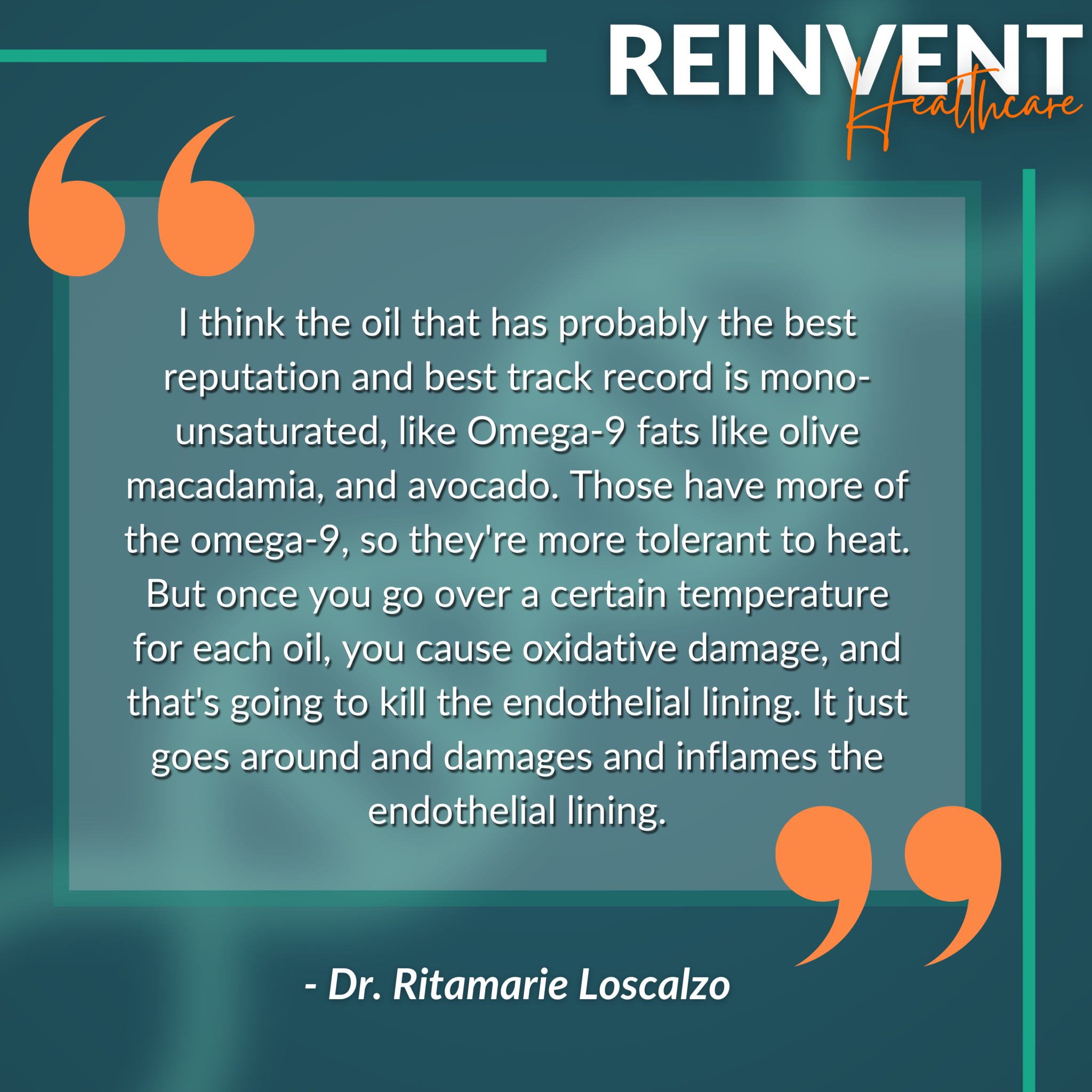
There's controversy over saturated fat versus unsaturated fat. The one that has, I think, probably the best reputation and best track record is mono unsaturated, like Omega-9 fats like olive and macadamia, to an extent, and avocado, those have more of the omega-9, so they're a little bit more tolerant to heat.
Once you go over a certain temperature for each oil, you cause oxidative damage, and that's going to kill the endothelial lining. It just goes around and damages and inflames the endothelial lining.
Joseph (18:10)
It's ruthless stuff. Define saturated for me in a way that I can explain it to a patient.
Dr Ritamarie (18:15)
Sure. So if that is saturated, meaning that all of the carbons are saturated with hydrogen, there's no empty bonds. So we have carbon, carbon, carbon, this is carbon and hydrogen, and there's no bonds that are open. So it's stable, right?
When you have an unsaturated, a mono unsaturated is one, there's one of those bonds, one of those carbons has an opening, right? So it's less stable than saturated, but still pretty stable.
And then the omega 3s and 6s, the unsaturated fats, those have more than one bond that's open. The 3 versus the 6 has to do with at which point in that chain. So is it at the third carbon versus the sixth carbon that the bond is on. The first of the unsaturated is there. So that's basically in layperson's languages and how you can explain it to people.
Joseph (19:15)
It was still pretty technical. Like, do they look different when I look at them? Is one clear at room temperature?
Dr Ritamarie (19:22)
When you look at the oil, no, not necessarily. The ones that are mono unsaturated, unsaturated, if you put it in the refrigerator, they will harden. If you put a polyunsaturated with 3s or 6s in the refrigerator, they don't harden. So it's a temperature at which they freeze or bond together, right? And that's why we're careful, like with the saturated, they are more solid at body temperature. And so are the monos. So that means that if you have a buildup of monounsaturated or saturated, mostly saturated fats in the body, they can be solid at that temperature. And of course we don't want solid fats floating around in the bloodstream.
Joseph (20:02)
Now I was at a conference once and the speaker got up and said, fat, oils are fat. And that's not good for you, especially. And I don't know if I agree with her, but I'd like you to riff on that. So all oils or as long as I'm specific about the oils, my body will still run clean.
Dr Ritamarie (20:18)
So I personally think that if we're going to be eating fat, well, we should be eating fat. We all need fat, right? And everybody to a different extent based on genetic factors and family history and the body's biochemistry, but whole foods, fats, right? You want the fat from a whole food. When you extract it, you are just getting the fat. You're leaving behind the carbohydrate, the protein and the fiber. You have a whole food, you have a whole olive. There's not just fat there.
They're a high percentage, they're probably 75% fat, but that other 25% has other vital nutrients and fiber to buffer. You pull it out, the fats, once they get extracted, and depending on whether they're saturated, unsaturated, or monounsaturated, unsaturated, they are stable when they're in this whole food.
Once you heat it, even heating a whole food, once you heat it, the temperature starts to break some of the bonds and make them unstable. And then once you extract just the oil, same thing, the oil is exposed to the air and there's other things that oxidize it, right?
So there's a lot of controversy out there. Some people saying oils are fine, just eat plenty of olive oil. First of all, it's not a whole food. And I believe that we should all be eating whole foods.
So when you look at flour, that's kind of, well, when you look at whole grain flour, it's just ground, right? It's still going to be less stable, and it's going to affect the blood sugar more similarly to sugar, because it doesn't have the fiber still intact. Once you extract it and make a white flour, right? You're taking away the bran and the germ, then that's not a whole food anymore. Same thing with oil. Oil is to fatty foods the same way that white flour is two whole grains, right?
So yes, some people need the oils, right? Some people are so thin, and their digestion is a mess, and they can't really extract, very well, the nutrients from the whole foods. And sometimes they just need the calories. So I always tell people, if you're super skinny, it may be fine to be adding oils to things, right? Because you need that to get to have your caloric intake and to get your fatty acids.
Most people, guess what? They're not skinny. They're overweight. They don't need the extra calories from something that's not going to fill them. And the fiber in the whole food fills them. So I'm not a big fan of oils. That's not to say I don't ever eat oils. I have certain things I don't ever eat. I have rules, but that's not one of them because if my husband makes a stir fry, or we go to a restaurant, and they make a stir fried vegetable dish, and they do it. But I'm careful. I ask what kind of oil they're using to do it. If they're using olive oil or coconut oil, it's okay, I'll have it, because I can't go in the kitchen and make it without. You don't need oil to make good food.
That's one of the contributing factors, I think, is oxidized fats. And if you're not careful about the fats you're eating, and you're not careful, you are going to get those plaques and those fatty streaks that you're talking about.
And you're seeing it here. You're seeing it in the carotids. Talk about how does that translate, and what kind of research there is that translates, to what’s also going on in the heart and other peripheral, vascular, et cetera. What's the connection?
Joseph (23:49)
So blood goes from your heart to your toe and back in about 10 seconds if you follow the main pathways. Like blood's whipping around our body. And if there's damage in your neck, it makes sense. And there's a lot of research studies that say if I can find a plaque in your neck, in your carotid artery, there's a corresponding plaque to your heart, to the vasculature around your heart, the coronary tree.
And so we're using the science that if I can find it in your neck, it's probably in your heart, and you want to be concerned. Now the carotid is actually slightly more predictive of stroke than heart attack, but it's the same disease, and it's whipping around your body so fast that not paying attention to your cardiovascular system, like we can find evidence of it. And there's some clinics where we'll look at the neck. If that's clean, they'll have us look at your femoral artery, right between your legs, real close to the surface.
And that's fine, that's a great test as well. And every once in a while, you're looking for like 4 in 100 people that may have none here, in their legs, but thorough doctors are using stuff like that to really go after it. But this correlates well with coronary calcium, and it correlates well with all those other risk factors.
Dr Ritamarie (25:03)
And it makes sense that if you have the device, and you're checking the carotids, why not check other places? Because a lot of people get peripheral vascular disease, right? They get clots, they get it down in their ankles, their feet. so femoral would be a good indication there. They may not be as easy to detect. Like what if you tried to look at the arteries in the ankle? Would that be predictive? What other things can we look at with this technology?
Joseph (25:31)
I'm a slave to convenience. The carotid's right near the skin surface. I can see it well. But there's a few windows throughout the body. I mean, the size of your pinky every time. Seeing that plaque build up over time. I mean, I've had some good saves in my career where the patient's 90 something percent clogged, and they won't operate at a hundred.
In fact, when I do this at clinics, the doctor at 70% blocked, he'll send you off to the vascular surgeon, because it's a little bit beyond the scope of what your primary care is going to do. But cutting out the things that we talked about, the sugars, the seed oils, the diet, exercising, those all have the cheapest, biggest impact you could hope for.
Dr Ritamarie (26:16)
Absolutely, absolutely. So what's one of the most profound shifts you've seen by doing someone starting at day zero, their first time getting it done, and then going back and doing it six months to a year later. In terms of how much recession of the plaque you've seen?
Joseph (26:30)
This one kid, we scanned him before, he was a mess. And then after bariatric surgery, so he got his stomach stapled, and he quit smoking at the same time. And I think he lost about 30 vascular years in six months. That's the most dramatic I've seen. You know, that's really only like two, three tenths of a millimeter. But for one patient, that's huge.
In the research they measure at one year increments, so I think I said that. And so that's kind of how they're used to looking, but if you've got some things that are definitely bugging you, some bad habits that you're keeping up, you'll see a quick drop right away.
Dr Ritamarie (27:11)
And tell us about the vascular age. You mentioned that, and I know that's one of the things you report on. Tell us how that's calculated and how valuable that is.
Joseph (27:19)
That's a great question. There's been lots of big research studies. The FDA is using this to validate the effectiveness. They do the background studies to make sure this is a good tool. And they scan 10,000-people studies. And in it, they were able to stratify the American population getting thicker with inflammation as we get older.
And so I will graph that and point that to you, and I'll say, “All right, you compared to this population. You have the arteries of a 20 year old or 40 or 60 year old.” We'll give you down to the year. And it's a pretty good tool, because that's what patients remember. What's my vascular age? How old are my arteries? They don't remember the number. They barely remember if there's plaque there.
But the vascular age seems to resonate really strongly. And so, we'll do that lookup. And then we'll have your previous values there. So you can see if you're trending down, trending up, are your changes working? That's a pretty popular feature of the report as well.
Dr Ritamarie (28:17)
I like that. And let me ask you this, I'll play devil's advocate. If you're giving me my age, I'm 69 years old, but my vascular age is 50 years old, is that in comparison to other people who are 50 years old? Because I want to be 20, but the average person in our society at 20 already has plaque buildup, right? So how does that actually get calculated?
You know what I mean?
Joseph (28:48)
Just by your date of birth and a look up on that formula. This research study, but full disclosure, this research study was done in the 90s and America's gained 20 pounds, 30 pounds since then. And so, we use it as our best heuristic to show people. I could use newer databases, but that would cause hassle in a bunch of different spots. But let's compare ourselves to our best self, America in the 1990s.
Dr Ritamarie (29:13)
I'm just the same as a 30 year old in our current society, who is a mess, right? I want to say, my arteries are clean like a baby. Right. But that's the thing, right? I think it's a great tool. And when I did mine, it came back as 50, 52, or whatever it was. But I'm like, that's not good enough.
I don't want to be 52. I want to be 20. I want to be 18, right? With no plaque, right? That's what I want to see. At 18, I probably had more plaque than I do now, because that was in the middle of my M &Ms and Cheetos and Diet Coke and all that stuff era. So I probably had more back then than I do now.
Joseph (30:02)
And we're seeing plaques on younger and younger people all the time. We'll scan some kids in their 20s, and I'll think, I won't say this, but I'll think in my head, you're not going to make it to 50, kid. The way they're beating up their body and abusing it, and they do. But you see someone in their 40s with no plaque, doesn't happen very often. It is super correlated to income, and the foods you eat, and the care you take. So yeah, take care, take care.
Dr Ritamarie (30:26)
And your genetics, I mean, that plays a role, right? Both of my parents died real young of sudden heart attacks. Grandparents did, cousins did. So there's some genetic, and the early lifestyle, and being exposed to cigarette smoke, secondhand for the first 21 years of my life. All those things play in. So what we have to look at is the big picture for each person, right?
What are their risk factors and how do we reduce those risk factors and then see this improvement. It's like you're looking inside the body. That's why I'm so attracted to this and why I've had it done a couple of times and will continue.
Joseph (31:06)
Use the tools to express to your patient the severity of what's going on. You're not thinking about it, but your heart's beating every second. The blood's flowing every second. And if you've got bad stuff in your arteries, it's irritating and causing problems every second. And I can be grateful for my body working without me knowing it, but I have got to pay attention that when I'm not thinking about it, damage is being laid down, if I'm not careful about it.
This is a great tool to show your patient, spend a minute, let them kind of feel that energy. And it's super useful that way.
Dr Ritamarie (31:38)
How would you tie this into, you know, in a complete assessment with some of the more advanced cardiovascular testing? We do more advanced cardiovascular, we don't just test your cholesterol, triglycerides, HDL, LDL, or calculated LDL is not even what they do. We look at much more advanced stuff. Do you see a correlation? Have you done any kind of looksies at that?
Joseph (31:59)
With the advanced stuff?
Dr Ritamarie (32:02)
Yes, like the particle sizes, LP(a), APOB, APOA, CRP, homocysteine.
Joseph (32:08)
Yes, I used to go to all the talks for cholesterol, and the speakers were paid by pharma companies. And it was so convincing. And I pay attention to it. I don't want bad cholesterol. But that research study came out that most people in the ER have normal cholesterol, at least 50% with a heart attack have normal cholesterol. Well, that's pretty potent information. What do you do with that?
And then a few years later, that centenarian study came out with everybody who lived to be over 100. And their cholesterol was over 250 or higher. So the cholesterol narrative, I think there's some fractionations that are super dangerous. Lp(a), if I find plaque bilaterally on both sides of the neck, then I'll definitely tell the doc, hey, make sure to check their Lp(a). There's not a lot you can do with it. There's some things you can do with it. There's more coming out every year.
But, that's probably it. A1C, the sugar is super effective in predicting. Blood pressure is a huge one. But, it's super correlated, it correlates tightly with the bigger risk factors. Not 100%, because there's always somebody who's like George Burns at 100 years old smoking soft cigars.
Dr Ritamarie (33:25)
I would have loved to see his genes and his cardio. I would love to see his numbers, right? And it may be laughter.
Joseph (33:35)
And of all the people I've scanned that were smokers, most of their arteries were really bad. But I've scanned two people that were hard smokers and their arteries were clean, and it kind of blew my mind.
Dr Ritamarie (33:45)
And when you're scanning, and you're going into a clinic or doing it at a place, are you able to see the history, or is that something the doctor does, and then they just ask you to scan?
Joseph (33:58)
When it was paper charts, the doctors gladly handed me the chart and let me do whatever I wanted with it. And I'd look if there was something going on, but usually I wouldn't. And now that it's on computers, no, but we do want to do some research. If there's any docs that are willing to open up their records to correlate with patients, we'll have the patients sign the waivers, of course. But yes, there's research to be done correlating this with what's going on out there.
Dr Ritamarie (34:22)
Yes, I think that it would be good research to have someone with the full extensive cardiovascular panel and inflammation panel, not just the miniscule thing that’s done typically, but to see how those compare, how much correlation is there with elevated LPA? How much correlation is there with high homocysteine and other things? And LPA and homocysteine elevations are very much genetically monitored. Although there's lots of things you can do to lower the homocysteine.
But I'm just lucky. I have both of those genetic predispositions, right? And my homocysteine has been elevated in my opinion. I don't want it higher than 8, and it was up to 9. So I'm doing stuff to bring that down. And my LPA has been high, but you did my arteries, and we didn't find any signs of problems. So that's good, right?
But I want to keep on top of that. And I want to keep on top of the diet and lifestyle things that I do to protect myself.
Joseph (35:24)
Have you noticed that some people can tolerate a bad diet until they hit 30 or 40 years old and then it really clobbers them? I have seen that a lot, too.
Dr Ritamarie (35:33
Yes, and some of them for longer. Some of them, I'll see that it doesn't clobber until they're 50. Right?
Joseph (35:40)
Yes. I mean, I've had some pretty fun moments like scanning at conferences. I like showing off the technology, and I'll find a calcified nugget in a pretty healthy person. And they'll say, there's a plaque there. I'm surprised there's a plaque there. And I'll say, let me guess. And I put on my mystic hat. Did you have a divorce or bad event 5, 10 years ago? How did you know?
Well, I think stress affects you pretty hard, so you may want to make sure you're as stress-free as possible. And that's why that plague formed.
Dr Ritamarie (36:14)
Yeah, that's a good one. That's a really good one, because so many people look at the world around us like stress is just second nature to most people, and we can't control out there, but we can control how we let it impact us.
So we teach a lot of mindfulness practices, and meditation, and heart math, and things like that, because I feel like if we can't get the sympathetic dominance under control and get people into a parasympathetic mode, no matter how good their diet is, they're going to have problems. That cortisol raises the glucose, which raises the insulin, which thickens and stiffens the artery lining. So we have to address that as practitioners as part of it. We can't just focus on our dietary things or the herbs or the nutrients. We have to really have that be an integral part of the plan.
Joseph (37:05)
You know what I did not respect as much as I do now is sleep. These poor nurses that stay up all night, the night shift gals, they’ve got crappy arteries, the firemen. Sleep, sleep is a big one and purpose. All those people that retire and die, because they don't have purpose. They have no way to receive service or give service. That's incredibly important to the human soul.
Dr Ritamarie (37:30)
It's an important piece. I like that you brought that up. We had a guy who joined our Nutritional Endocrinology Practitioner Training, and I think you met him at our conference, but he literally was heading towards retirement age, and he said, I'm retiring in September, and I want to join this program, so I have a purpose. Basically, that's the way he said it. He goes, I see all these people that I've been working with, they retire and then they die. I don't want that.
I want to turn my energies towards being in an engineer-type job and helping other people. And it's just so beautiful to see that that's just such a reflection on what's going on.
Joseph (38:08)
I really enjoyed hanging out with your group. It was a bunch of really good, earthy, honest people looking for honest answers. And the amount of depth you went into with your testing, I did not expect that doc. Going through the Dutch test, the biochemistry of what's going on in the gut. It was so refreshing, because not even the MDs talk about that. They just want to gloss over it.
Dr Ritamarie (38:35)
Yes, and it's what I talked about on a recent lecture I gave on nutrigenomics is that what we're looking at is a system that's broken. It's a system that is called a healthcare system, and it contains neither one of those things. It's a medical management system.
So we are dedicated to put both health and care back into that name, because that's what people need. They need to be cared for. They need to have their stress levels go down. Oxytocin, the hormone of community. Like we had so much oxytocin going in that conference that you were at. We had so much oxytocin, and oxytocin counteracts cortisol. Oxytocin makes us feel a sense of belonging. And the more we can put oxytocin generating things into our care, our healthcare, that's what we're about at the Institute of Nutritional Endocrinology. And that's why I'm so passionate about doing it and bringing people like you who are at the forefront of technologies that can save lives.
But I love hearing you say that. Yes, we have this great technology, but we need to put people back on purpose. And when people are on purpose, and they have a goal, which in our community, the goal is to create impact while they're creating income, because you need to create income to have impact.
But we are dedicated to that. And that's why we do these podcasts and bring people like you in with innovative technologies that are saving lives.
Joseph (40:08)
Purpose is so underrated. Purpose with a passion gets you out of bed in the morning, it lets you help people. Where do I give, where can I help? I mean, that engineer who built the group, he built a group of people to help, which I found so wonderful. I'm retiring, I'm going to make this better.
And I didn't really think much of that until I read some books on the Blue Zones, the people who live really long. What did they have in common? And that was one of the big ones, that they received service, and they gave service. No pride involved, just I'm here to help. I'm happy to brush the floor with a toothbrush or deliver fruit to kids. But everybody ate reasonable diets and had a purpose.
Dr Ritamarie (40:50)
Well, thank you. This has been really great. And I think hopefully it's opened everybody's eyes to the fact that this is a testing that you should be looking into.
What's the best way for them to find what you do? Because you travel around, or you have people on your team that travel around.
Joseph (41:06)
I travel, I love demoing this, I love working with pharma reps, nutraceutical reps, showing this to doctors. But vasolabs.com is our website. I have real people, Americans, answering any questions you have, like how do I buy an ultrasound probe for $5,000? We'll send it to you.
Where do you get these supplements, that supplement? What is a good heart attack and stroke prevention program have? And a glucose monitor is definitely part of it and lots of patient education.
I'm happy to talk and make all my resources available, but what I really want is just people to be using the ultrasound probe like a stethoscope, that you can show the patient what's going on, enlist them emotionally and motivationally, and help them advocate for themselves, because most Americans just aren't paying attention well enough to see what's killing them.
Dr Ritamarie (41:54)
Yes, they're not paying attention, and they're not being given the information. That's the big thing, right? What people are eating is just ultra processed crap that's hurting them in ways that we probably will be finding out even more as time goes on. So I think that's super important.
I love that you said, like a stethoscope. One of our practitioners whose specialty is blood sugar, because she has a daughter with type 1 diabetes. And she says basically, a glucose monitor should be something that everybody has in their home, whether it be as continuous or just a glucose stick, $15 at the grocery store, that you buy. And she said that if any kid comes over to her house or friend of hers, friend of her kids, or whatever, and if they say, “I have a headache.” “I don't feel well.” Let's test your blood glucose. Because that's what happened to her daughter who had this, was feeling like she had this flu, and she had this, and she just couldn't get well, and the doctors kept doing all this stuff. And then one day she wouldn't wake up, and she was in a coma, diabetic ketoacidosis.
They had no idea she was diabetic, right? So it's like all of these kinds of symptoms of feeling poorly could be blood sugar. So she won't let anybody get away with it. If a friend comes over, and they're complaining, let's test your blood sugar, because it's so important.
And so every home should have a glucose meter, and every doctor's office should be testing for the carotid intima, and testing the thickness, and all that. So I think it's critical. I love that. It's like a stethoscope.
Joseph (43:30)
Fool the mom once, shame on her. You will not fool her twice. I'm glad she's looking out for all those kids. That's a beautiful thing.
Also, the places where you can buy the cheapest glucose monitors. I keep track of that for my physicians. They're like 40 bucks for two weeks or 80 or 90 for a full month's worth. I'm totally thinking everybody at the wealthy conferences I go to, they're giving them away now, because they're such a handy tool.
Like everybody at the conference gets one now, and it's coming down from the wealthy to everybody. And now that they're 80 bucks for a month, it's one of the best exercises I can write.
Dr Ritamarie (44:10)
Nice. That's great to know. Will you give us those links? We'll put them in the show notes and description, so everybody can have access to it. I thank you. And we'll have all the links to Joe's resources in the company. And if you're in a place where you're going, who can do this, go on the site. There's a map, and you can find locations in the area. And if you don't see any specific ones, just contact the company and say, “When are you going to be somewhere near wherever?”
And if you have enough people, if you have like 10, 15 people in your practice that you think need to, or in your community that you think need to get tested, just contact them and say, can we make a special trip? And they'll come with their little suitcase now and bring it along.
And if it's something you want to do in your practice, you have an online practice, it's not that practical, because you have to be with a person to do it. But if you want to do it, and you see people in person, reach out to them, because this equipment has come down.
I am so tempted to buy one, even though I have an online practice, maybe I'll just do clinics here and there. I'll just once a month, like invite people over to get it done. And they'll help you with the reports. They'll generate the reports for you. So it's a great opportunity for us as practitioners to really go above and beyond and be able to help people to make the right diet, lifestyle, supplementation choices to save their lives.
It really is a matter of saving lives.
So thank you, thank you, thank you. And those of you here I highly recommend that you grab my free guide to cardiovascular testing. Because those tests that we were talking about, those advanced testing, my guide describes what they are, and you can grab it for free. So just check the show notes, or the description, and we'll have that there.
And keep doing what you're doing. Because we're the future of healthcare. The future of healthcare is not anymore this symptom suppression, cut it out. Or like, “No, we're not going to run those tests until the person has symptoms,” but that may be too late, because 50% of the time, that first symptom is dying of a heart attack. And I know for a fact, three people in my family, four people in my family, five people. Now I'm thinking about two grandfathers, two parents and a cousin. That just was their first sign that they had heart diseases. They died. We don't want to wait for that.
So when the doctor says, “No, we're not going to run those advanced tests, because you don't have symptoms. You don't have cardiovascular disease.” Do they know? Did they do a CIMT? Did they do these advanced testing that tells you about endothelial dysfunction and inflammation? We need to be that. We need to be the future of health care and go out and do the best work you can. And until next time, shine on.

Listen on your favorite podcast platform!





Share This Episode