
Vision Loss Starts in the Kitchen: What Every Health Pro Must Know with Rani Banik
Most practitioners never consider the eyes when evaluating metabolic health. But what if vision changes are an early sign of deeper dysfunction?
In this episode of ReInvent Healthcare, Dr. Ritamarie Loscalzo sits down with Dr. Rani Banik—a board-certified neuro-ophthalmologist and integrative medicine expert—to explore how eye health is influenced by diet, oxidative stress, and blood sugar imbalance.
If you’re overlooking the eyes in your assessments, you may be missing a key opportunity for early intervention. From macular degeneration to diabetic retinopathy, the clues are often visible—literally—before the labs confirm a diagnosis.
This episode is a must-listen for practitioners who want to expand their root-cause lens and empower clients to protect their vision naturally.
What You’ll Discover Inside:
- The 3 Silent Vision Wreckers You’re Probably Ignoring- (And what they have to do with mitochondria and metabolic health)
- Why Blue-Light Glasses May Be a Waste of Money- (And the science-backed alternative that works better)
- The Truth About Carrots—and the 30+ Nutrients Eyes Actually Crave- (Hint: It’s not just carrots and beta carotene)
- The Nutrient Deficiency Hiding Behind Dry Eyes and Eye Strain- (And how most patients are barely getting 1/10th of what they need)
- How to Catch Diabetes Before It’s Diagnosed- (Through an unexpected early warning system in the eyes)
- The Food Prescription for Clearer Vision- (Plus: what carnivore diets might be missing)
Resources and Links:
- See the Full Transcript here
- Check out our Free Guide to Food Swaps: Good, Better Best
- Join the Next-Level Health Practitioner Facebook Group for free tools and training
- Visit INEMethod.com for advanced health practitioner training and tools to elevate your clinical skills and grow your practice
- Explore More Episodes on ReInvent Healthcare and Functional Endocrinology here
Dr. Rani Banik’s Resources & Links
Explore Dr. Banik’s work at DrRaniBanik.com
Watch the full iHealth Summit recordings at theeyehealthsummit.com
Check out her books:
Beyond Carrots – Best Foods for Eye Health A to Z and Dr. Rani’s Visionary Kitchen
Follow Dr. Banik on social:
- Instagram @dr.ranibanik
- Facebook: https://www.facebook.com/rudrani.banik.2025/
- EnVisionHealth: https://www.facebook.com/groups/1864863853844167
- Website: www.drranibanik.com
- Youtube: https://www.youtube.com/@dr.ranibanik
- Podcast: https://www.drranibanik.com/theeyeqpodcast
Dr. Rani Banik’s Bio
Dr. Rudrani (Rani) Banik is a board-certified neuro-ophthalmologist. She completed her MD at Brown University, residency at UC Irvine, and fellowship at Wilmer Eye Institute. Dr. Banik runs a private practice based in NYC and is Associate Professor of Ophthalmology at Mount Sinai. Dr. Banik is also certified in Integrative and Functional Medicine. She focuses on the root cause of eye diseases, and uses strategies based on nutrition, botanicals, lifestyle modification, and supplements.
Dr. Banik is often featured as an expert in the media. She has been voted Castle Connolly Top Doctor and NY Magazine's Best Doctor in Ophthalmology annually since 2017.
Dr. Banik is the author of two best-selling books,“Beyond Carrots – Best Foods For Eye Health A to Z’ and “Dr. Rani’s Visionary Kitchen.”
Transcript
Dr Ritamarie
Did you know that foods actually can impact the eyes and the health of the eyes? I'm super excited to have a special show today. We're going to explore that.
Today we have someone who's unique in the field of ophthalmology in that she looks at nutrition and food as part of eye care. And I think that we're going to explore that today in a way that you're going to see that it's not just knives and glasses and all that other stuff, that there are ways to keep people's eyes healthy in a way that's more natural and nutritional.
So I've got today Dr. Rani Banik. She is a board certified neuro-ophthalmologist. She completed her MD at Brown University, her residency at UC Irvine, and a fellowship at Wilmer Eye Institute. She runs a private practice in New York City, is associate professor of ophthalmology at Mount Sinai. She's also certified in integrative and functional medicine, which is where her uniqueness comes in. She focuses on the root cause of eye disease because just like throughout the rest of the body, eye diseases have a root cause. And she uses strategies based on nutrition, botanicals, lifestyle modification and supplements.
She's featured as an expert in the media. She's been voted Castle Connolly Top Doctor in New York Magazine's Best Doctor in Ophthalmology annually since 2017. So she's got a lot of credibility here in this field and a lot of experience here in this field. And I'm super excited to have her. Dr Banik is also an author and she has two bestselling books. One is called Beyond Carrots, The Best Foods for Eye Health, A to Z, and Dr. Rani's Visionary Kitchen. Dr. Rani, welcome to our show today. I'm super excited to have you here.
Dr Rani Banik, MD (02:08)
Thank you so much, Dr. Ritamarie. I've really been looking forward to this.
Dr Ritamarie (02:11)
We, in integrative and nutritional medicine, like to believe that everything in the body can be cured with food. That's not always the case. There are times when we need other care. But what I want people to understand is some of the diseases, like what can go wrong with the eyes? Like you're an ophthalmologist, which is different from an optometrist. An optometrist deals with the prescriptions and the vision of the eye, and you're looking at the eye itself and the health of the eye itself. So I would love to hear from you, like what are some of the top things that we see when the eyes start to malfunction?
Dr Rani Banik, MD (02:50)
So I always tell my patients, if you're fortunate to live long enough, you will have three things that happen to you with your eyes. Everyone, just about everyone gets these three things with their vision. The first thing is presbyopia. And what that really means is just that it's harder to read close.
So, as people reach 30 and 40s, 50s, they kind of have to hold things further and further away. We sometimes call this “my arms aren't long enough” syndrome, where you are really holding things way out here, especially if you're reading a menu in a restaurant, if it's dim lighting, it's really hard to see. That does happen to everyone. And it's a change that happens in the lens
where the lens becomes more stiff. So it's not that the muscles aren't working properly, it's just that the lens physically becomes more stiff. It's not allowing us to focus up close.
And there are nutritional ways to approach that.
The second thing that happens to just about everyone is cataracts. Again, if you live long enough, you will develop a cataract. Now, most people develop early cataracts in their late 50s, early 60s, but just having a cataract doesn't mean you have to rush into anything.
It does not mean you have to go under the knife. All it means is that there's a change in the lens. And this other change in the lens is because of oxidative stress. And yes, there are many nutritional strategies to fight that oxidative stress.
And then the last thing that happens to just about all of us are the age-related changes around our eyes. So these are the cosmetic changes like fine lines, wrinkles, dark circles, bags and sags. We all get them. It's like getting gray hair.
All of us will get that at some point in our lives. And there are also nutritional strategies to help with those types of issues.
Dr Ritamarie (04:27)
Well, that's awesome. But there are also some age-related diseases that not everybody gets. What about some of those?
Dr Rani Banik, MD (04:40)
So the three things people most worry about are number one, macular degeneration, or also called age-related macular degeneration. You've probably seen, if you watch television, you've probably seen ads on TV for all of these new drugs that have been developed and FDA approved for AMD.
I'm a big, big proponent of nutrition first. And actually, the studies have shown that if you have the right type of nutrients in your diet, specifically the macular carotenoids, you can reduce your risk of developing vision loss from AMD by over 40%, about 43 to 47%. You can reduce risk of developing vision loss from diet alone, which is really phenomenal to know that. Dietary changes can make such an impact. And yes, maybe if you have the right diet, you won't need to get those special treatments and eye injections to help fight AMD.
The other thing that happens, not to everybody, but it can happen, is glaucoma. And glaucoma is a disease of the optic nerve, and it's usually associated with high eye pressure, and also it's associated with mitochondrial dysfunction and oxidative stress. So there are nutritional ways to manage that, as well as lifestyle. Lifestyle is very important as well for glaucoma.
And the third thing is diabetic retinopathy. We know that diabetes is becoming an epidemic around the world. And even young people are getting diabetic these days. Pre-diabetes is so rampant as well. And with chronic high blood sugars that damages the little blood vessels in the back of our eyes. And it causes something that I like to call “leaky eye syndrome”. Many people have heard of leaky gut, leaky brain. Diabetes is a type of leaky eye syndrome where you get little blood vessels that basically leak out blood and fluid and fats and proteins, and it causes vision loss. And it's preventable.
It is 100% preventable with diet and lifestyle changes alone.
Dr Ritamarie (06:32)
Wow. So that's good to know. We talk a lot about metabolic health here on our channel and on my YouTube channel and on my podcast and all. And it's true. It is an epidemic. Like 93% of the population is estimated to have some kind of metabolic dysfunction with their blood sugar management. And the scary part about the diabetic retinopathy is, I see it in people who haven't been diagnosed yet. I see it happening even before the diagnosis because of the years of chronic sugar imbalance.
Dr Rani Banik, MD (07:01)
Yes. I'm so glad you brought that up, because I've diagnosed countless people with diabetes just from their eye exam. They came in for glasses or some other issue, and we dilated them, we took a look at the retina and lo and behold, we found changes, and they had no idea that they had this problem. It's just so rampant, so common. The other thing you mentioned about, this is a sign that there has been chronic metabolic dysfunction. It's not just a short-term issue. This is if you develop diabetic retinopathy, It means that your blood sugars have been unregulated for at least five years. At least five years.
Dr Ritamarie (07:36)
It's scary. And you also mentioned that with macular degeneration. Tell us a little bit about which people are more prone to getting macular degeneration.
Dr Rani Banik, MD (07:48)
So we know that it's definitely more common as people get older. So if you take people in their 50s, for example, in that decade of life, it's not so common. Maybe only about 2% of people in their 50s develop macular degeneration. But if you look at people 75 and over, that number goes up to 30%. 30% of people over 75 may be at risk. So yes, there's age-related risks, but there are so many other things. It's not just being in your older years where you were destined to get this. That's not the case. There's genetics, there's nutrition. And I mentioned earlier about the foods.
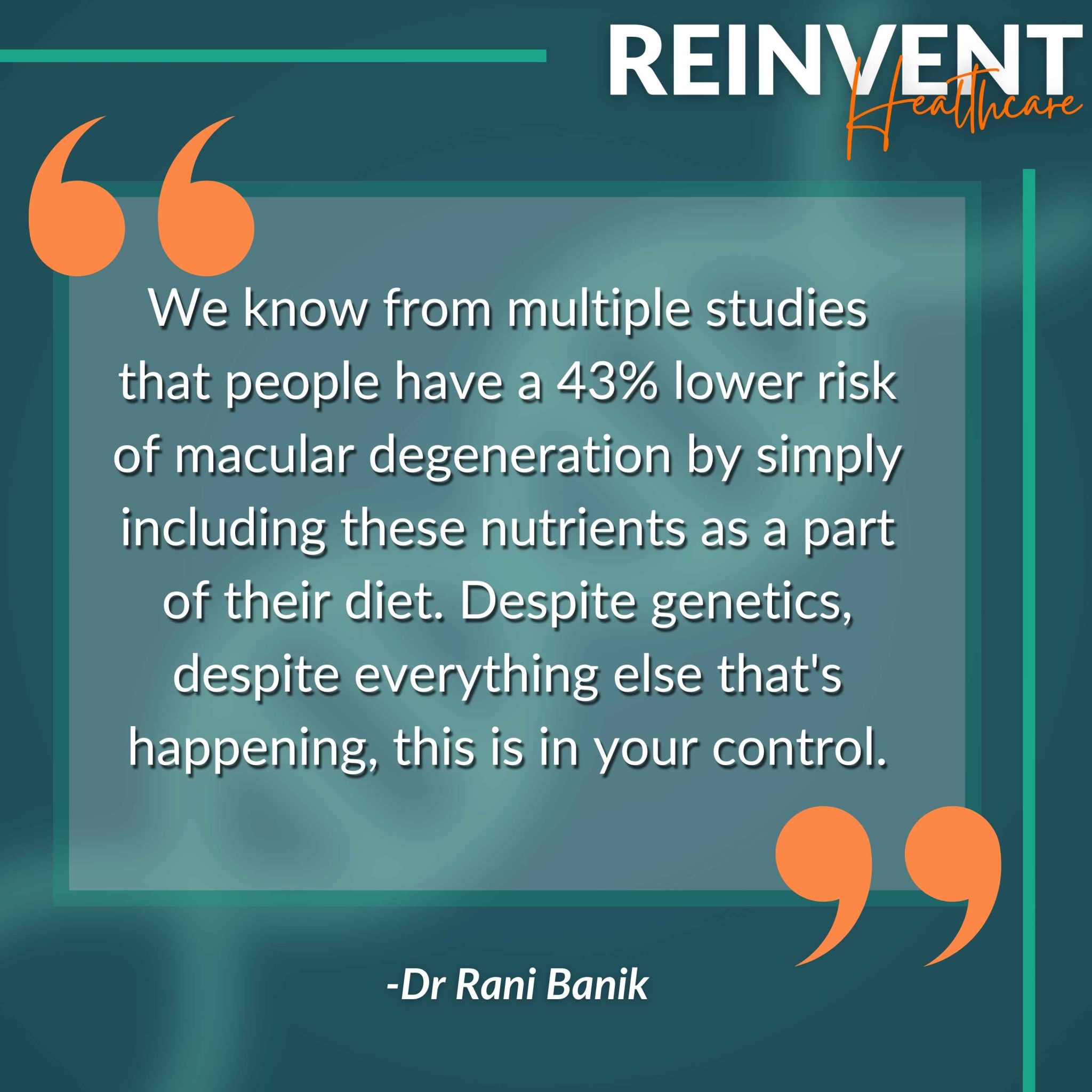
So we know from lots of studies, not just one study, but multiple studies that people who are in the highest quintile of lutein and zeaxanthin intake. So the highest quintile means you're in the top 20% of people who eat these nutrients. You have a 43% lower risk versus people in the lowest quintile have a much, much higher risk. So by simply including these nutrients, especially if you're elderly, it's important to make this a part of your diet. It's so, so critical. And it's a simple thing. It's in your control. Despite your genetics, despite everything else that's happening around you, this is in your control.
Dr Ritamarie (09:03)
And that's what we want to look at, modifiable diet and lifestyle factors that affect disease risk, eye health, and body, full body health.
So before we get into some of the nutrients, I want to talk about some specific nutrients, but you've mentioned over and over, oxidative stress. So tell us why oxidative stress is such an important factor to control when it comes to eye health.
Dr Rani Banik, MD (9:26)
So, I'll explain a little bit about the eyeball. I'll just pull out my eye model here to show you. So, we think about the eye, most people just think about the very front part of the eye, just the white part of the eye and the colored part of the eye. But the eye is so complex. This is just on the outside of the eye. Then if I give you a sneak peek inside the eye, you see there's so much else going on. So the eye, even though it's such a small organ about the size of a golf ball, has over 40 different parts, 40 different parts that all work together to give us our vision.
And a lot of these structures, especially the ones in the front part of the eye here, the cornea, which is this dome-shaped structure that allows light to come into the eye, the iris, which is the colored part of the eye. Your iris may be blue or brown or hazel or green. And then the lens, which is what becomes a cataract later in life. These structures are so susceptible to light damage. Light coming into the eye, yes, it helps us to see, right?
We want light to come into the eye, but this light, certain wavelengths of light, are very powerful, and they can cause what we call oxidative stress. And the way I like to explain this to people, , my patients, is I say oxidative stress is like biological rusting. So imagine you have a metal pipe, right? A nice new, fresh metal pipe. You expose it to the elements, water and sun and oxygen, and eventually it starts to rust.
And this is what happens inside the eye. Now it's not physically rusting, but the structures are so delicate inside the eyes. They start to degenerate from all of this toxicity, from light toxicity, from some inflammatory foods we may be having in our diet, from our lifestyle, from air pollution. So this is all what we call oxidative stress. And it also has to do with free radicals.
So our bodies, I'm sure you and your audience know, when we metabolize, metabolism is good, but it produces these byproducts called free radicals, especially structures that have a high metabolic rate, like the eye. The eye has one of the highest metabolic rates in the body along with the brain. It's actually an extension of the brain. And so with that high metabolic rate, it's constantly consuming energy. There's a lot of free radicals produced. And these, if they're unchecked, if we don't have enough antioxidants in our diets or via supplements, then that will cause damage to the ocular structure. So again, the eye is complex, very delicate, very vulnerable to oxidative stress.
Dr Ritamarie (12:01)
And overall, controlling oxidative stress controls everything in the body, right? Cardiovascular conditions are associated. Cancers are associated with increased oxidative stress. Just about anything we can think of can be associated with oxidative stress.
So what nutrients, right? You wrote this book, Beyond Carrots, A to Z, et cetera, et cetera. So what are some of those nutrients that are super important beyond carrots, beyond beta carotene, which most people have heard of and know about?
Dr Rani Banik, MD (12:29)
What I tell people is beta carotene and carrots are the tip of the iceberg. You know, when you think about an iceberg, you only see about like 10% of it. And then the majority, 90%, is under the water. Well, when it comes to ocular nutrition, yes, beta carotene, vitamin A are important, but there are over 30 nutrients our eyes need. Again, because our eyes are so complex. We have the cornea, which is mainly made out of collagen and water.
The lens is also made out of protein and water. And then the retina, we call this the neurosensory retina, because it's neural tissue, and it's got nine different layers. It's got blood vessels inside of it. So all of these different structures have their own requirements, their own nutritional requirements.
And we think about nutrition. I like to divide it up into three categories of nutrients that we need for eye health. One would be the macular carotenoids, which you may have heard of, lutein, zeaxanthin, meso zeaxanthin. These are kind of hard to pronounce, hard to remember, but they're important for macular health and also oxidative stress protection. Then we have bioflavonoids, which come from plants. These are protective. They have very potent anti-inflammatory antioxidant properties.
And then we have the omega fatty acids. Now, many people think of omegas, they think about heart health and brain health and skin health, but there's also a lot of evidence to show that the omega fatty acids, particularly the omega-3s, EPA, DHA, and even some omega-6s like GLA have been shown to be beneficial for eye health.
So again, there's lots of nutrients. You don't have to memorize them all. You don't have to remember them all, but there are certain food groups that I talk about in my book that can be beneficial if you have them on a regular basis. So not just once in a while, you need to include these food groups on a weekly basis and rotate through them to make sure that you're getting all of these nutrients to support your complete eye health.
Dr Ritamarie (14:30)
So let's talk about what some of those foods are so people can get them, because I'm not a big fan, and I don't teach my practitioners to do a lot of supplements. Of course we need supplements, because of the environment and the depleted soils and all that stuff. But I like to stick to the minimal effective dose of supplements and be able to get as much as we can from food given that the situation isn't critical, that we need to put the nutrients in supplements. So what are some of the top high foods?
Dr Rani Banik, MD (14:56)
So I would say the number one food group would be leafy green vegetables. Spinach, kale, collard greens, and some of the cruciferous ones that are also leafy greens like broccoli, bok choy. Why are these important? Because they have really high levels of lutein and zeaxanthin. And I'll share some numbers with you. I don't want to get too scientific, but I think this is important for people.
Dr Ritamarie (15:22)
This is a group that likes science.
Dr Rani Banik, MD (15:25)
So in terms of lutein, we need about 6.5 to 20 milligrams of lutein a day. How much do most people get? Most people who are on a Western-style diet, they're getting less than one to two milligrams of lutein a day. So there's a huge gap between what we need and what we're getting. So we need to improve that gap.
And the best way is to have lots of leafy greens in your diet. And I typically recommend, now this may seem like a lot to people, but in terms of getting that content up there to their recommended dose, I recommend anywhere from three to five cups of leafy greens a day.
Now, if you're someone who doesn't like leafy greens, or let's say you have an oxalate sensitivity, or whatever, it's just not palatable to you, there are other foods that can provide you with these nutrients. And so people don't realize that a lot of the orange and yellow types of foods, for example, bell peppers. When most people choose to buy bell peppers, they kind of gravitate towards the green ones. But I tell my patients, instead of the green ones, have the orange and yellow ones, because the orange and yellow in these bell peppers represents lutein and zeaxanthin. So switch out your peppers, have more of the colorful ones. And then also egg yolk. Egg yolk is a wonderful source of lutein and zeaxanthin.
That's what gives it its beautiful orange-yellow color is these pigments. Also spices. So cayenne pepper, paprika. They're kind of like an orangey red color, and it's because of these nutrients.
So if you're not a big fan of leafy greens, get these, get lutein and zeaxanthin through other means, and there are lots of options. And in my book, Beyond Carrots, I share at least 40 different foods that are rich in some of these nutrients. So there's lots of variety. If you don't like one, you can always find something else that suits you better.
Dr Ritamarie (17:15)
I love it. And you said about oxalates, by the way, not all leafy greens are high in oxalates and arugula, which is also high in nitric oxide, which is a super important nutrient, doesn't have any of that, of oxalates. And again, how would you bring up the point of people having food phobia? Because there's just a lot of stuff out there on the internet and in summits and all, fear mongering of food, right?
The oxalates, and now the peppers are nightshades, and this and that and the other thing. And people get really scared of food. And that also brings me to the point of, what do you say to people who are following another craze which is big these days, which is carnivore, like no plants, right? How are they getting their lutein and zeaxanthin?
Dr Rani Banik, MD (18:03)
Okay, so full disclosure, I am a vegetarian and so I have no meat products in my diet. I do have eggs and dairy sometimes, not a lot. But for people who are carnivorous, it is challenging to get these nutrients, but egg yolk, I mentioned egg yolk is a great source. So you can try to sustain your required levels via egg yolk.
Dr Ritamarie (18:31)
How many eggs is that?
Dr Rani Banik, MD (18:34)
Gosh, I don't know. I'd have to check on that. But I would say probably, my guess would be, like four to five egg yolks a day, at least. So maybe people are already doing that. If they're carnivorous or they're following that carnivore diet, maybe they're already getting enough of that. But most other animal products probably don't have super high levels of these nutrients, maybe like smaller levels. .
So, it can be challenging, and this is where, if you're following a particular diet, whether it's a carnivore diet or some other diet, you may not be getting enough. And this is a situation, Dr. Ritamarie, you were saying earlier that you're a big advocate of food, I am as well. Try to get your nutrients through your diet and then if there are gaps, fill in the gaps with supplements. So in that situation, yes, take a supplement that has lutein and zeaxanthin, absolutely.
Dr Ritamarie (19:26)
And you said it's between 6 and 20 milligrams a day.
Dr Rani Banik, MD (19:31)
0.5 to 20 is the average. There's no official RDA, yet.I think that researchers are trying to really push to develop an RDA for this. So we call it recommended dietary intake rather than allowance. So intake is kind of what most carotenoid researchers will say. But hopefully in the next couple of years, maybe in the next five years, there will be something on food labels that says how much lutein and zeaxanthin is in there.
Dr Ritamarie (20:01)
So, if we're trying to get 20 milligrams of zeaxanthin, or a lutein, which is the better end of the spectrum, it's 40 eggs. If you're going for the bare minimum, it's 12 eggs. That's 6, 6 milligrams.
So it's a lot, right? And then you have to look at what's the downside of eating that many eggs.There's a lot, right? And not only the TMAO, and the gut, and the LDLs, and all that kind of stuff. So you might consider that avoiding plants may not be in the best interest, but if you're working with clients, patients, who that's what they choose and that's what they want to do, you're going to have to supplement because and really warn them about the deficiencies.
Dr Rani Banik, MD (20:52)
Yeah, and I'll just add. Supplementation, in cases where there may be a deficiency, is so important, because in our modern world, we are spending so much time on screens. Like the average adult spends anywhere from seven to nine hours a day or maybe 10 hours a day or more for work, for personal use, for school, et cetera, connecting with family and friends, binging their favorite shows. It really adds up. And all of that screen time and blue light exposure,
We know that, and this is really interesting, blue blocking glasses don't work. There is no proof that blue blocking glasses actually help in the studies that have been done, zero proof. But there are many studies to show that diet, including lutein and zeaxanthin, can be really effective at moderating blue light, moderating eye strain, and helping with screen overuse or screen fatigue. So incorporate these nutrients either, again, through diet or through supplementation.
Dr Ritamarie (21:50)
Wow, that's an eye-opener.
Dr Rani Banik, MD (21:53)
I will share just a little bit about these blue blocking glasses. The vast majority of blue blockers on the market are either clear, or they have this really light yellow tint. And so the lighter the tint, the less blue light it actually blocks. So most blue blockers only block about 10 to 30% of the blue light. And that's what the studies were done with. So you're asking about the study and how was this done?
The studies were done with the milder tinted blue blocking glasses. So we don't know if the darker tinted ones like the deep red, orange, amber, the really dark ones probably block about 98 to 99% of the blue light. So that would be fine, even though there's no proof, those studies haven't been done with those deeper tinted blue blockers.
And the way you know if your blue blockers are really blocking blue light is a simple test. You just put them on, and you look at your screen, and you look at something blue on your screen. And if you can still see the color blue, you know that it's not blocking most of the blue light. But if you put on the red ones, and I do have the red ones by True Dark, which I love, especially for nighttime use. It helps with sleep, et cetera. But when I put on my red blue blockers, I don't see any blue on the screen whatsoever. So the gradient does matter, absolutely.
Dr Ritamarie (23:11)
Mm, so you know it matters. Well, that makes sense, because it's a physical blocking of the light. Maybe that's why I was thinking maybe enough studies in the right way weren't done to do that. But it's a caution that when you're going for, these look fine, they're light, they're not really doing the job that they need to be doing.
Dr Rani Banik, MD (23:29)
Some people still swear by them. They say that they help them with their sleep, and I'm totally okay with it. If you want to wear blue blockers, by all means, go ahead if you feel like they're helping you. But studies haven't shown that the lighter ones make much difference, but food makes a difference. Keep that in mind.
Dr Ritamarie (24:46)
That's the thing. I just want to poke a little bias of mine about studies. Studies can be done to prove anything you want to prove. I mean, just in general, just the structure of the study. The second thing is studies talk about a population, right? And say that the study says that in 75% of the people, this particular nutrient helped with this. What about the 25% that it didn't help?
And when you're working with clients, or you are dealing with these situations, it's a good chance you're in that 75%. So don't throw out that. Well, I guess vitamin C doesn't help with that, because only 75% got well. No, you could easily be there. You can have a genetic SNP that doesn't allow you to absorb your vitamin C or utilize your vitamin C.
There's so many gene variants that you can have, and there's so many imbalances that you may have based on years and years of nutrient deficiencies, or oxidative stress, and all that. So we always have to keep that stuff in mind when we just rely on studies. So let's talk about the food. So green leafy vegetables, the red and yellow bell peppers, other colorful vegetables as well.
Dr Rani Banik, MD (24:57)
Yes, the more color you could have in your diet, that means that more nutrients are in those foods. And the second class of nutrients that I recommend for eye health are bioflavonoids. And what these are are pigmented compounds. There were over 4,000 bioflavonoids in nature. But the ones that have been most studied are anthocyanidins. And these are, again, they're kind of
hard to remember, hard to pronounce the name of them. But basically these pigments are found in fruits like berries.
And so we know that these pigments help fight against oxidative stress. They help fight against microbial infection. They help fight against inflammation. And so the ones that have been studied the most have also been shown to help with eye strain and relax eye tension, the muscles, the ciliary muscle in our eyes, which is responsible for focusing. It helps to relax that.
It can maybe help with myopia progression. So there's a lot of potential benefits of these anthocyanidins and berries, actually the darker colored berry, the better. So I typically recommend including at least half a cup to one cup of berries a day, preferably like blackberries and blueberries and bilberries. But if you want to throw in some reds in there like strawberries, raspberries, goji berries, that's great too. Each of them has its own kind of nutrient profile, but the pigment, so look for color.
When you're looking at plants, look for color and different shades of the same color. So don't just eat the same leafy green every single day. You want to rotate through your different shades of greens, different shades of blues and blacks and yellows and reds and oranges. Eat the rainbow, as we oftentimes say, but eat like a diversity in your rainbow. And I give my patients this tip as well. When you're thinking about eating the rainbow, try to have a different color food with each meal.
So basically most people eat three meals a day times seven, 21 meals a week. So try to have 21 different colors throughout the week. And you will probably be easily meeting your eye nutrient needs if you're doing that, because you're getting all these different shades and great nutrients and bioflavonoids in your diet.
Dr Ritamarie (27:08)
That's great. And what are the other classes of foods, the other classes of foods you mentioned?
Dr Rani Banik, MD (27:14)
The third one is omegas. So omega-3s. This is a fun fact. The highest concentration of DHA in the body is actually in the retina. Our retinal photoreceptors structurally are made out of DHA. And the retinal photoreceptors, they capture light and then they transmit that light into electrical energy. They send it to the brain for processing. When they process energy, they have to remake their cell membranes. So there's a constant turnover of cell membranes in these retinal cells. So we need a constant supply of DHA. And so that's really important.
And then also EPA is also very important for retinal health, but also for dry eye. I know a lot of people suffer from dry eye, and there are studies to show that mainly EPA, but DHA as well, at least 2000 milligrams a day is important for prevention of dry eye, particularly in women, particularly in women who are in perimenopause or menopause, because of their hormonal changes, they need even more concentrations of these omega-3 fatty acids.
Dr Ritamarie (28:18)
Interesting. So that's really good to know, because I see people like you, I see people all the time that one of their biggest complaints is dry eyes. And of course we rule out, do they have Sjogren's disease or other kind of autoimmune thing that's causing it? And what are their habits? Are they blinking enough? And you know, all that stuff. We overlook omega-3s. I mean, they're important for just lubricating everything in the body, but that's a really important fact to keep in mind.
Dr Rani Banik, MD (28:46)
Yeah, and they're anti-inflammatory, as well. So yes, they help support the tear film by production of oils for our tears, but they fight inflammation. So if you have eyelid inflammation like blepharitis or even like rosacea or Demodex, which is a mite infestation, having more omega-3s can be really beneficial.
And I'll share with you also where this all came from about omega-3s in dry eye. It actually came out of the Women's Health Initiative, which was done in the late 80s to early 90s. And over 35,000, I think, female nurses were followed for years and years and years. And what the study showed was that the women who had fish at least two to three times per week, particularly, this is interesting, tuna and salmon, had lower rates of dry eye, much lower rates of dry eye. So if you're going to choose fish, try to choose the fatty fish that are higher in the omega-3s.
Dr Ritamarie (29:41)
And what foods for vegetarians and vegans.
Dr Rani Banik, MD (29:45)
Gosh, so there are so many. You can actually get omega-3s from plants. I love seeds, which have the precursor. So hemp seeds, chia seeds, flax seeds. But also green leafy vegetables have some omegas in them. Berries also have some omegas in them. So there's a variety of other foods that you can have that are non-animal products that will provide you with omega-3 precursors.
Dr Ritamarie (30:09)
And algae is a really good source as well. And when we think about algae, that's where the fish are getting it from. So think about that, right? They're great. They're eating the algae, and they're eating the plants in the sea, in the ocean, wherever they are growing. So algae is a really good, good source of it. So the spirulina is in the blue green algae, chlorella, things like that are important foods to include, I think on a regular basis.
Dr Rani Banik, MD (30:36)
Spirulina is really great, because it also has high levels of lutein and zeaxanthin.
Dr Ritamarie (30:41)
So eating that rainbow land and sea. Yes, exactly. Exactly. So that was great. So overall, DHA, I just want to go back to DHA, because you said for the retina, but it's also helpful in managing blood sugar and insulin sensitivity. I wonder if there's even a connection there possibly with low levels of DHA causing lack of insulin sensitivity, high blood sugars, and another contributing factor to retinal damage. I don't know that. I'd have to go look that up, but we just need to keep, I mean, overall, your message is clear and simple.
We've got to support eye health. And the way we support it is avoiding oxidative damage, supplying omega-3s, making sure that we're getting all the nutrients that we need and those colorful vegetables for the zeaxanthin and the lutein. If you're not getting it, please do supplementation, because it's no fun to go through a macular degeneration process, right?
Dr Rani Banik, MD (31:43)
Yes. And there's a window of opportunity. So macular degeneration doesn't happen overnight. Cataracts don't happen overnight. Glaucoma doesn't happen. It's very slow. So it takes years to decades for people to have vision loss. But if you start now, you're really being proactive about your eye health for your future. So no matter what your age, I tell even my patients who are young in their 20s, 30s, start these habits now, so that you're protecting your eyes for decades ahead.
Dr Ritamarie (32:11)
Exactly. Absolutely. Because it's so much easier to prevent and protect than it is to reverse. Once things are there and the damage is there, the kind of work you have to do to reverse it may not be reversible with interventions that are natural and from food and supplements. And you may have to do the more invasive interventions. But when you do things early to protect, that's when you really get the most bang for your buck.
Dr Rani Banik, MD (33:37)
Since we're talking about prevention, I want to share one thing, Dr. Ritamarie, the first week of May, we did something called the iHealth Summit. And it's the first ever summit dedicated to vision. And the theme of our summit is an ounce of prevention is worth a pound of cure.
This was said by Benjamin Franklin, centuries ago, and it's so true for eye health. So throughout the summit, we have 36 speakers. We're all talking about strategies. And yeah, some of the speakers do talk about procedures and surgeries and things like that. But really the goal is to prevent eye disease, before it happens. So I encourage people to watch the recordings, because there's a wealth of information from 36 experts about how you can be proactive.
Dr Ritamarie (33:27)
Great, so make sure we have the link to that. This is airing after that summit is over, so you'll have to go back and get the recordings.
So all that said, are there any other foods or nutrients that we missed that you want to add in as we come to a close here?
Dr Rani Banik, MD (33:46)
Well two things I would add. Number one is hydration. It is so important to stay hydrated. Such a simple thing, but honestly, I've seen patients who, they're not the best at hydrating and they don't have the best diets or lifestyles, and they're very stressed. And I've seen patients who are dehydrated. They go on a long airplane flight, across, transcontinental, and they end up with an eye stroke.
We've heard about brain strokes, but you can actually get strokes in the back of the eye, either in the retina or the optic nerve. The biggest risk factor I've seen for this is poor hydration levels. Simply by staying hydrated, it can be so impactful. Then the other thing is we talked about the foods that you should include. What about the foods that we should stay away from?
We know that the SAD diet, the standard American diet, can wreak havoc on our bodies and make it into a very pro-inflammatory, turn it into a pro-inflammatory state. The same holds true for eyes. So we know that people who are on a SAD type of diet have a much higher risk of macular degeneration.
So again, by simply swapping out foods from a SAD diet, avoiding processed and ultra processed foods, avoiding simple sugars and refined carbohydrates, avoiding too much fried foods or foods that are too rich in omega-6s, switching, swapping out those foods into healthier foods, some of which we talked about, can make a big difference in reducing your risk of macular degeneration.
Dr Ritamarie (35:20)
Awesome, awesome, that's really great. And I'll put a link in the comments too that we have a food swap chart. And if you let us know you want it, we'll send that to you. So we have a list of all those foods and then what can you get, good, better, best swap outs. And that goes for eye health as well as overall body health and hormone balance. So dry eyes, we touched on it. Is there anything else for dry eyes before we draw to a close?
Dr Rani Banik, MD (35:45)
Yeah, so you mentioned something very simple people can do, which is blinking. And simply by blinking, you're spreading the tears, you're lubricating, you're giving yourself a break. But also, in eye care, we love this rule called the 20 20 20 rule, which basically means every 20 minutes, you set your timer, take a 20 second break. And instead of looking at your screen, look at something far in the distance, and that will help your eyes to relax.
So every 20 minutes, take a 20 second break, don't look at your screen, look at something like out in nature, in the window or across the room. Your endurance on a screen will improve significantly.
Dr Ritamarie (36:25)
So this has been awesome. I really appreciate all your tips and really tying in the overall health and the nutrition and the blood sugar and antioxidants and all that to eye health, because it's so very important.
So we've been talking to Dr. Rani Banik, and we had an amazing conversation. What's the best way to find you.
Dr Rani Banik, MD (36:44)
So my website, which is www.drranibanik.com, and if you're interested in the summit, watching the recordings, it's theeyehealthsummit.com. And please be proactive about your eyes. Don't take them for granted. We need to keep them healthy for a lifetime. So let's start revolutionizing eye care and do it naturally through food and lifestyle and supplementation.
Dr Ritamarie (37:07)
Great, thank you so, so much. And for more information on metabolic health and any of the other topics we've discussed here, check out some of these other videos. And our podcast episodes have covered a wide range of functional foods. And we have another podcast episode on more of the mechanics of vision with Claudia. And it's going to be an amazing opportunity for you to just broaden your scope and your way of working with people.
And the things that were shared today, antioxidants and omega-3s and bioflavonoids and all the nutrients that the eyes need, the carotenoids and the zeaxanthin and lutein, all of those things are good for overall health and balance, overall metabolic health and hormone balance. So as practitioners, we owe it to people to really focus on prevention and protection before. What do you do afterwards? But a lot of the people that come to see us are already in that afterwards ,and we need to have natural strategies. So it sounds like the Eye Health Summit is going to be a really nice way to also know about what to do and what to recommend people to, if they've already crossed the line, so to speak, into that damage. So thank you so much for being here and until next time, shine on.

Listen on your favorite podcast platform!





Share This Episode