Oxytocin and Hormones: The Missing Link to Metabolism, Mood, and Longevity
We talk a lot about cortisol, insulin, estrogen, and thyroid, but one of the most influential hormones in metabolism, mood, and resilience is often overlooked.
In this episode, Dr. Ritamarie sits down with Dr. Lindsey Berkson to explore oxytocin beyond its role as the “love hormone.” They unpack how it impacts digestion, blood sugar, stress response, emotional connection, and long-term health and how it works alongside estrogen in ways most practitioners aren’t considering.
They also challenge common beliefs about hormone safety, especially around estrogen, highlight the role of environmental toxins, and explain why so many people feel stuck despite normal labs.
If something has been missing in how you think about hormones, this conversation will shift your perspective.
What’s Inside This Episode?
- Why oxytocin is more than a “love hormone”
• The hidden link between oxytocin and digestion, gut motility, and metabolism
• How oxytocin influences blood sugar and pancreatic function
• Why environmental toxins disrupt oxytocin more than other hormones
• The connection between oxytocin, mood, bonding, and emotional resilience
• How hormone imbalances contribute to disconnection and chronic illness
• The truth about hormone replacement and long-standing misconceptions
• Practical ways to support oxytocin naturally and clinically
Resources and Links:
- Download the full transcript here
- Download our FREE Metabolic Health Guide here.
- Join the Next-Level Health Practitioner Facebook group here for free resources and community support
- Visit INEMethod.com for advanced health practitioner training and tools to elevate your clinical skills and grow your practice by getting life-changing results.
- Check out other podcast episodes here
Guest Resources and Links
- Check out Dr. Devaki Lindsey Berkson’s Website: https://drlindseyberkson.com
Social Media:
Books & Resources:
Membership & Ongoing Learning:
- Membership – https://drlindseyberkson.com/membership
- Agile Thinking Substack – https://drlindseyberkson.substack.com/
Guest Bio
Dr. Devaki Lindsey Berkson: Where Audacity Meets Science
As a Distinguished Hormone Scholar from the highly praised Center for Bioenvironmental Research at Tulane and Xavier Universities, Dr. Berkson worked shoulder-to-shoulder with pioneering scientists who discovered the first hormone receptors. Her breakthrough book, Hormone Deception (McGraw-Hill 2002,
Awakened Medicine Press 2016), earned her this prestigious invitation, as she exposed the public health emergency of environmental toxins assaulting our hormones and provided the original guidelines for reducing exposure.
Her impact on medical literature continues to grow. Dr. Berkson’s book Healthy Digestion the Natural Way (Wiley & Sons, 2000) was the first gut, nutrition, and mindfulness book to sell over 1 million copies. Her work Sexy Brain (Awakened Medicine Press 2017) further explored endocrine disruption and gender-bending, while her latest book, Oxytocin Medicine, reveals how the “hormone of connection, empathy and calm” is under attack – and what we can do about it.
Transcript
Dr. Ritamarie Loscalzo
Hey, you know, we spend a lot of time talking about hormones, right? We talk about cortisol and insulin and estrogen and progesterone and thyroid, but today we're going to talk about a hormone that doesn't get as much press as it should. It quietly influences our lives in the background, our digestion, brain health and resilience, and so much more. And that hormone is called oxytocin.
Here with me to talk about that today is Dr. Lindsey Berkson. I'm going to tell you a little bit about her, and we're going to jump right in, and we're going to chat about oxytocin and why it's one of my very favorite hormones and probably yours, too.
The person that I know that knows probably more about it than just about anybody out there is Dr. Lindsey Berkson.
She's a hormone researcher. She's an educator. She's a bestselling author who has been shaping how we think about hormones, digestion, and environmental health for literally decades. She's a distinguished hormone scholar at the Center for Bioenvironmental Research at Tulane and Xavier universities. She's worked alongside many scientists, the scientists who discovered the very first hormone receptors, and her work laid the foundation for a lot of the modern scientific research on hormones.
She brought the science to the public for a really groundbreaking book called, Hormone Deception, where she talked about how environmental toxins disrupt hormones, and she offered practical guidelines for reducing exposure, and we all need to know about that.
She's also the author of Healthy Digestion, The Natural Way, the first gut nutrition and mindfulness book to sell over a million copies, and Sexy Brain, which exposed and looked at how hormone disruption impacts brain health and gender expression.
And her most recent book, I’m really excited about talking with her about today, is Oxytocin Medicine. It dives into the science of connection, and empathy, and calm, and healing. It reveals how this powerful hormone is being suppressed in modern life and how we can restore the amazing healing benefits of this hormone.
So welcome, welcome, welcome. Thank you so much for being here.
Dr Devaki Lindsey Berkson (02:56)
Thank you for having me. It's great to have these conversations that other people can learn a lot of things they can apply to their own lives.
Dr. Ritamarie Loscalzo (03:04)
Exactly, exactly. And the one thing I know about you, I've known you for quite a number of years now, is that you are a digger. So once you get your hands on something that excites you and that you feel like needs to be expressed and shown to the public, you learn everything you can about it and then you teach it.
So I really appreciate that about you, and I'm super excited to hear about your oxytocin research and how we as practitioners, because most of the people who listen to this podcast are practitioners of some sort from holistic health, nutrition coaches, health coaches, doctors, nurses, et cetera, and we're always looking for ways to enhance how we work with people, how to get the best health they can, and to give them novel ways to do it.
I love some of the things that you have to do to get oxytocin to improve it. There's a lot of fun in this. So I want to talk about that, but I want to start with where did you start with oxytocin? What got you interested? You were looking at all these other hormones, a lot of sex hormones, and that's what your first book talked a lot about, estrogen, testosterone, and all that. Why oxytocin?
Dr Devaki Lindsey Berkson (04:18)
I was working at a clinic in Tulsa, Oklahoma. It was a multidisciplinary functional clinic, and I was working with a physician that was double board certified in cardiology, and also in internal medicine, and had a PhD in nutrition. So he was a very forward thinking gent, and he was working closely with a compounding pharmacy in Broken Arrow, Oklahoma, called Care First Pharmacy.
One of the issues that many people face as they get older, but now it's even in younger and younger people, is erectile dysfunctionality in men and loss of libido in women, and even a lack of desire to connect with someone deeply.
So he specialized in men, male medicine, and he would recommend Viagra or different things when they couldn't really enjoy intimacy with their wife. But it's still hit and miss with fixing all those issues southerly. So the pharmacist at Care First said, you ought to consider adding oxytocin in with the Viagra. It will enhance it. You'll get a much broader response from your patients.
So the patients started coming back in saying that a wide variety of things were being helped, not just southerly functionality. One gentleman said, I really had trouble going to the bathroom more than two, three times a week, and all of a sudden I can go to the bathroom regularly.
Oxytocin, we all think of it as a pregnancy hormone, because it causes the uterus to contract. And then with lactation, it causes the breast to contract which allows breastfeeding. So we know it's contractile. It's contractile at the uterus for birth and at the breast for breastfeeding.
It's a contractile hormone wherever it signals. If those tissues need to signal. So I started thinking, well, maybe we can help some patients with frozen gut issues, gastroparesis, which occurs more in diabetics, because after you eat, you're supposed to have a rise in oxytocin, which makes the stomach contract, because it's a contractile hormone, and it's got receptors, satellite dishes, that receive these signals from oxytocin, and it helps move the food through you, along with other things like thyroid hormone, and fiber, and things like that.
Oxytocin is part of the way we move food through us. So this one gentleman that had erectile dysfunction said he could suddenly poop better.
So I then had another patient that I thought, she tried everything else and nothing worked. Why don't I try oxytocin with her? And I started experimenting with giving oxytocin liquid with a mucoadherent substance called Muco-Lox, and suddenly we started healing a lot of esophageal disorders. And I discovered this team in the Netherlands that were really investigating if oxytocin could help intractable constipation and esophageal disorders, because you have signals from oxytocin going all throughout the gut.
Well, their research suggested that yes, this was a smart thing to try. There was a trend of improvement. They didn't reach statistical significance, but I started wondering, this oxytocin is much more than a cuddle hormone or an orgasm hormone.
I was also working in Austin at the Wiseman Family Practice Clinic, and the first week that I was there overlapped with me working one week a month in Tulsa, one of my very first patients was a beautiful woman that came in with a face that hardly moved at all. She said, “I had a horrific birth when my 16 year old son was born. And ever since then, I don't really feel very much. And I really don’t want to connect with my husband anymore. I don't even really want to touch my son. My first husband left me, because I'm just flat, my demeanor is flat, and my relationship with my son is suffering. Now I'm dating another gentleman, and I fear I'm going to lose him, too.” So I thought, why don't I try recommending some oxytocin?
For this patient, it was as nasal spray, because oxytocin is a mood elevator, and it does many, many things. So a month later, she comes back and said, “That was the most incredible thing that ever happened in my life, and I started doing a joint yoga class with my son, and I'm having intimacy with my now fiance.” Her face was just filled with life. I was thinking to myself about this. This was about 17 years ago I think, I'm not exactly sure about the timing. I thought I have to dive into this hormone. There's a lot to this.
But then, I wrote one of the first books on endocrine disruption, how the dirty planet is assaulting our hormones. Well, it turns out that oxytocin is the most vulnerable to plastics, to chemicals, to PCBs, to heavy metals. It is the most vulnerable of any hormone.
So you’ve got to wonder if it's the hormone of community and connection and culture, because the baby is rinsed in it, because the mother's body needs it for birth. The baby's body is rinsed in it. It's this welcoming hormone that says to the baby, welcome to planet earth. It's a good place to be. We want you to be a great member of society.
If it's not working right, and those aren't the signals that babies are getting, is that contributing to our school shootings, and violence, and all this anger that we have.
So I make a case in my book, Oxytocin Medicine that that might very well be. Each chapter discusses which body system oxytocin can help and the science behind it of using oxytocin to treat these conditions. And the 12th chapter is about 30 different ways of writing the scripts to use oxytocin for all these different conditions.
So if you want to lose weight, and you want to really reduce your addiction to food, this is how you write your script for oxytocin for that. If you have esophageal disorders, this is how you write the script for liquid oxytocin. If you have pain or insomnia, this is how you write the script for that. So the book got birthed in that way.
Dr. Ritamarie Loscalzo (11:06)
Wow. What a story. I had no idea there were that many widespread things that oxytocin helps.
Dr Devaki Lindsey Berkson (11:13)
It's incredible. You're the blood sugar gal. You know how much dysinsulinism and blood sugar issues drive disease. Well, every cell in the pancreas has oxytocin receptors. The beta cells, the beta cells are 96% covered with oxytocin receptors, meaning oxytocin sends signals to help the beta cells, which help us control our blood sugar. And the alpha cells have a hundred percent coverage.
So, in people with diabetes, or patients with both diabetes, or people who have a real difficult time stabilizing their blood sugar, you can use oxytocin, it won't get rid of the diabetes, but it'll help minimize the adverse effects. And I even wonder if someone is newly diagnosed, if you jump on it with the old protocol, the niacinamide protocol, if you added the oxytocin when they are just newly diagnosed. And if you really cleaned up your act, if you could just reverse it.
I don't know, I haven't had a patient like that yet where I've tried it, but it's shocking. I think, because the baby is flushed in a complete cocoon of oxytocin when it's born, and oxytocin protects all the cells in the baby's body prior to the first feeding, because birth is a very pro-oxidative, pro-inflammatory event, and oxytocin just flushes the baby's body.
Every single cell of that body can receive its signal. So then as a practitioner, you can use it. And, oxytocin is so safe that it's legal to prescribe it at 15 international units. It comes in international units, and 15 international units or less. You can buy it over the counter.
I was a keynote speaker in Canada at a pharmaceutical conference, and there were all these OBGYNs who said during COVID, they couldn't get ahold of pitocin anymore, which is a pharmaceutical form of continuous oxytocin. So they ordered it from Walmart, because Walmart was selling 12 international units. And they said it worked so well and was so much cheaper. They stopped using pitocin, and they kept using Walmart’s. I recommended it in my book.
Right when my book came out, Walmart stopped selling it. Now if you go online, the price has really gone up. I think that everyone is kind of scamming everyone else out, because there's this inflationary culture at the moment. People are just elevating prices where they don't need to be, because it's not very difficult to make it, and it's in water. You have to keep it refrigerated. You can get it online, but I don't know who to trust anymore.
Dr. Ritamarie Loscalzo (14:00)
Wow. Wow. But it is over the counter then.
Dr Devaki Lindsey Berkson (14:03)
It's over the counter up to 15 international units. Well, it's a nasal spray, but you can take it any way you want. In most of the studies, oxytocin is used as a nasal spray.
Dr. Ritamarie Loscalzo (14:06)
And that's oral? Because you're not going to prescribe a nasal spray over the counter.
Dr Devaki Lindsey Berkson (14:11)
Well, it's a nasal spray, but you can take it any way you want. In most of the studies, oxytocin is used as a nasal spray.
So the way you get a hormone into you is called a delivery mode, and you can get oxytocin into you with diverse delivery modes. You can snort it up your nose, which is the most commonly used academic research.
You could apply it with like in a vaginal cream. They use it a lot to anti-age the vaginal vault. It will thicken your vaginal cells, your non-tumorogenic vaginal cell line. This is all work from the Karolinska Institute. They went through phase one and phase two trials with something called Vagifem, where they would put oxytocin with a base in the vagina. That's oxytocin added to a cream and applied to the mucosal lining.
You can give it as an intramuscular shot. You can give it as an epidural. There are studies where sad, tragic patients with terrible bone cancer and terrible bone pain are given epidural injections of oxytocin and within a short time, reduce that pain and make their quality of life more livable. So you can get oxytocin into you in a diverse number of ways.
Dr. Ritamarie Loscalzo (15:40)
I'm going to ask you a couple of questions about that.
Number one, why do people get deficient so that they would need an external source? And then what are some of the other ways that people can generate or create more oxytocin?
Dr Devaki Lindsey Berkson (15:57)
Well, the biggest reason is that the modern day chemicals that circle our planet are kryptonite to oxytocin, and they don't let it signal well. So you have to detox if you eat an ultra processed diet, and you're not exercising a lot to detox that way, and you don't do regular detoxes, and chemicals build up, especially the more fat you carry.
Fat cells love to store chemicals. Those will disarm your oxytocin that you make. And it's very demanding. Oxytocin is a very high maintenance hormone that needs all these different things in place to work.
For example, if your thyroid is not stabilized, it doesn't work well, because thyroid and oxytocin are best friends.
You need a lot of vitamin C. If you take 3000 milligrams of vitamin C a day, your own body makes more oxytocin, and most people don't have enough vitamin C. You can measure vitamin C in your serum and see the levels of it. A vitamin is something that you don't make yourself. You've got to take it on a regular basis. It needs to be 3000 milligrams, which is a nice way of knowing maybe you'll take three grams of vitamin C a day to help you make oxytocin.
Your emotional life. If you're connecting with people and your best girlfriends, the University of Michigan, my alma mater, did research. What happens when women who really care for each other hang out together? What happens to their hormones? And they make more of the good, feel good hormones. They make more progesterone, and they make more oxytocin, because it will elevate in response to you feeling really connected. It is a hormone of connection, not just contractions.
We know that women make a lot of oxytocin when they orgasm, much more than a man. I write about this in Sexy Brain. So it's funny, you and I both live in Austin, which is kind of the epicenter of ethical non-monogamy and polyamory and all these new ways of people wanting to have lots and lots of lovers, but not a lot of responsibility.
Dr. Ritamarie Loscalzo (18:22)
That's a good way to look at it.
Dr Devaki Lindsey Berkson (18:25)
So men can have lovers, friends with benefits, because they can come, and they don't make as much oxytocin. It's a bonding hormone. If a woman is with a man, and he makes her orgasm, she's going to start bonding with him, because she makes more oxytocin, which is a bonding hormone. So her brain will make her bond to this guy even though she says, “I'm not into you.” We can make love once a week on an ongoing basis. I could stay neutral about this.
It's much harder for a woman to do that, because women tend to make a lot more oxytocin. If everything is in place, if their thyroid isn't well stabilized, they won't make near as much, and they have to have estrogen.
Part of the reason that women like hormone replacement is that just getting estrogen replacement boosts your own body's production of oxytocin, and when you're older, if you choose not to do hormone replacement, you have less estrogen, less oxytocin. It's easy to become a crusty old fart. A lot of divorces occur right after women become menopausal if they choose not to do the natural things that make hormones, or take hormones.
Our own FDA, Marty Makary just said a month ago, when he removed the black box warning on vaginal estrogen that other than antibiotics and vaccines, which you and I might say aren't necessarily, but that's the way he put it, was that the best thing for women's health, and tragically, that's been denied them for the last 25 years, besides antibiotics and vaccines, is hormones.
Nothing can really support a woman's wellbeing as having healthy hormones. And we haven't included oxytocin in that, because we didn't really know about it, but one of the reasons women feel better on estrogen is it helps estrogen and oxytocin to be best friends. You get a little patch of estrogen, or a cream of estrogen, it starts boosting some of your own production of oxytocin.
Dr. Ritamarie Loscalzo (20:25)
Interesting. And is that for any form of estrogen? Estradiol, estriol?
Dr Devaki Lindsey Berkson (20:32)
It's any form of estrogen. I don't know about estrone. That's a good question. There's four major estrogens now, but estrogen really helps. It's really oxytocin that protects bones. Estrogen, progesterone, testosterone help out, but it's really oxytocin that does it. And oxytocin works in concert with all the sex hormones, estrogen, progesterone, testosterone, oxytocin. They're in a huddle, like a football huddle, and they help many, many tissues.
I've been saying that hormones don't cause cancer for almost 30 years. I remember saying, why would mother nature make the very hormones that drive humanity be cancer causing? It makes no sense. And younger people had less cancer than older people, and they have more hormones. Although now that's changing.
Younger people are getting more cancers, and I think one of the reasons is, so many young women are on synthetic birth control or IUDs, which are very damaging to your hormones. It's the number one cause of increased risk of breast cancer. They made birth control available over the counter in July of 2023. Any young woman can walk into a CVS or Walgreens and buy it. So older women can't seem to get access to hormones, but young women can get over-the-counter access to synthetic hormones.
The whole thing is all because it's run by Big Pharma. What really shocked me more than anything, Ritamarie, was, you can't see it, Marty Makary’s brand new book, Blind Spots. He is our FDA head, Marty Makary. And the subtitle is When Medicine Gets It Wrong and What It Means for Our Health.
The reason he's really recommending hormone consciousness. They just had a panel with him and a number of other experts, some of whom I've left with. If you go to YouTube and put in FDA experts testosterone, it'll pop right up. They just said every single man, young and old, should have testosterone checked, just like you check their lipids and their blood sugar. There's no man who should not have testosterone, but they still say old women shouldn't have it, shouldn't have estrogen.
I put together a whole video, and I had my business partner, who's Kennedy's physician, send it to Kennedy and Makary, because I'm an old woman now. I don't know. You're an older woman. That sounds kind of weird.
Dr. Ritamarie Loscalzo (23:07)
I know I don't like it. I will never be. I will always be just prior to middle age, no matter how old I get.
Dr Devaki Lindsey Berkson (23:16)
So I just turned 77. And I would be dead if I wasn't on hormones after I had breast cancer. I would be dead. And in fact, in April of this year, the third weekend, I'm teaching the first 20-hour CME for MDs and nurse practitioners and pharmacists everything about breast cancer, how to treat high-risk women, Keeping It Safe, Keeping It Smart. I don't remember exactly the title, but we're showing how to use hormones in breast cancer patients and high risk, like people who have genetic pro-coagulants, like your body was made up to have more clots. Can you take hormones?
We have all the experts that have published on this. We have 15 speakers at that conference. I just sent off the CME spreadsheet today on how I spent my holidays, but Marty said, why is it for years, everyone's thought estrogen causes cancer, causes cancer, you stay away from it. He says, we're an aging nation.
They came up with a Women's Health Initiative to figure out how to not topple Medicare. How do we keep women healthier longer without using up all our money? That's what formed the Women's Health Initiative.
Then they did these two hormone trials and then they stopped them prematurely, because they said estrogen caused cancer. And that's the mantra. They've stopped teaching hormones in naturopathic colleges, osteopathic colleges, and medical schools. Nobody that's in practice now has had training in hormones.
Marty Makary said, I was at the meeting before that press release came out. I was one of the authors of the Women's Health Initiative. And he said, I was at that meeting, Jacques Rossouw, was the principal investigator. He called all the authors together and said, we're putting out a press release that estrogen causes breast cancer, and all of the co-authors said, but we haven't reached statistical significance. We don't have proof, and he said, dissension will not be tolerated. Your careers will be ruined. I'm sending it out, and you all stand behind me.
So he sent out a fraudulent press release to all of the media that estrogen causes breast cancer and heart disease, the very things we thought it protected. A week later JAMA, Journal of American Medical Association, came out with an article saying, why did they prematurely stop? They did not reach statistical significance. In peer review, they said that, but the media runs everything in our country.
Media runs our science. It's shocking. You put things in CHAT GPT, you're not getting what's really accurate in CHAT GPT. You're just getting the non-accurate narrative, the consensual narrative of our time. So he was guilt-ridden for 25 years that his actions of shutting up put women in fear of estrogen.
One of the first things he did when he became FDA head was reverse it because of that guilt. It's an amazing story that almost nobody knows about. And you have to really understand estrogen protects against getting breast cancer, against getting breast cancer.
There have now been something like 12 reanalyses of the Women's Health Initiative. The nickname is WHI, and the final one was in 2019. And if you're on estrogen for an average of five years, you have a 23% reduced risk of getting breast cancer in the first place, and if you do get it, and you had the good luck to be on estrogen for a hunk of years, the average was five years in that study, you have a decreased fatality incident. So decreased risk of dying from it by 44%, almost 50% reduction in death if you've been on estrogen.
I wonder how many doctors were wrongly sued, because a woman started hormone replacement and then got breast cancer. She didn't realize she's actually in a better position, and then she sued the doctor, because what rules the time is the narrative of the time, not really the science, and there's no doubt about it.
In fact, this week, the beginning of this week, the Menopause Society, that's extremely conservative, it used to be called the North American Menopause Society, they came out and said, women with the BRCA gene glitches. BRCA genes are tumor suppressor genes, and if they don't work right, you have a higher risk of getting all kinds of cancers, including breast. Angelina Jolie had her breasts removed and this and that. They said, “Hey, these women that have an enormous increased risk of getting all kinds of cancers, if they take estrogen, they have much better survival.” I wrote a whole chapter on that, in Safe Hormone Smart Women, because the science was known in 2010 when I published that book.
Now the Menopause Society said, even women with the BRCA, they should be on estrogen, they will live longer, survive better, even if they've had breast cancer.
Dr. Ritamarie Loscalzo (28:38)
So I have a couple of questions on this. So that's great to hear. You first introduced me to this way back in probably 2010, the people who convert, or metabolize, estrogen more into 4-hydroxyestrone versus 2-hydroxyestrone, which is more protective. My understanding is always as long as we look at your pathways, and you're converting your estrogen down the safe pathway, to 2-hydroxy, then, and not the 4-hydroxy, then okay, hormones seem safe, or protected as you're saying. But what about people who are converting downstream into the 4-hydroxy, and that causes DNA damage?
Dr Devaki Lindsey Berkson (29:27)
I have to consume more brassica rich foods, but that is not proven in science. It's a trend in science. There's some studies that support that, that the 2 catecholestrogen, estrogen series of estrogens, the 2 series are more protective and the 4 is more quinone or DNA damaging. That's one of the theories of cancer is whatever damages DNA, but there's articles that don't show a correlation and articles that do.
In functional medicine they talk about it set in stone, but you're not making much estrogen when you're older. You're basically making peripheral production of estrone, which it takes it more down the worst pathway. But if you go on estrogen replacement, it protects you. So just having great metabolism of whatever estrogen you have isn't protective enough. It's really the amount of estrogen you have. But the biggest deal besides that, it's not just for symptom relief of hot flashes or anxiety.
Estrogen protects your hippocampus where all your memories live in your sense of self lives. And as you age, we all lose 1% of the volume of our hippocampus every year, no matter what we do.
And so people would say, well, that's all well and good, but if nature really wanted me to age gracefully, she would have given me more estrogen. Why do I even get involved with replacing something? Why don't I just age gracefully and forget all this hormone schtick?
It's way too confusing. It's way too scary.
So we all know that you lose, after the age of 40, because your hormones are really going down starting at 25, but they really pick up speed of lowering their levels inside your body at 40 years and older.
So hormones protect your brain, hormones protect your kidneys. That's why we start seeing kidney function not do well. But the big deal is your volume, the more your hippocampus shrinks, the more you can't remember names, the more you have cognitive dissonance, the more you are prone to Alzheimer's and neurodegenerative disease. So you would think, well, aging gracefully, what does that do with hippocampal volume?
Hippocampal volume is where it's at. I mean, you want to protect your heart and your bones, but you really want to keep your sense of who you are. You know, who am I? And have that be solid, and that all takes place, that motivation, and sense of me-ness, takes place in the hippocampus.
Yale said, well, why not exercise and meditation? Can't they enlarge the hippocampus and slow down shrinking? So they did a study called Med X trial. So it stood for Meditation and X for exercise. And they took a large number, I can't remember the number of people involved, and they had them work out for about three and a half hours a week, and they had them meditate for a huge hunk of time. And they did functional MRIs of their hippocampus every year. And it just shrunk no matter what they did, because exercise doesn't improve your hippocampus and meditation doesn't improve your hippocampus.
Magnesium has a few trials showing that magnesium supplementation does help protect, because it's a major co-factor in hormone signaling. You have a lot of zinc and a lot of magnesium in your hippocampus, because you need all these nutrients to allow hormones to work. But there's only one study that I could find, and it's from, I think McGill University, the Department of Psychiatry.
They took women who had smaller hippocampal volume and then that shows up as feeling more frail. You're in line at Target. You can't really figure things out. You don't want to get behind an older person in line, because they move so much slower. All of that is signs of a hippocampus shrinking. Can't remember names, okay, once in a while, but when it's happening quite a bit. So they did a study where they took women who had proven smaller volumes of the hippocampus with functional MRIs, and then they gave them estrogen in different dosages. And they found the dose, in six to eight weeks, estrogen started to re-volumize the hippocampus as long as you don't have end-stage Alzheimer's disease.
The hippocampus, gratefully, is like the liver. And you can reboot the size of it if you only have mild or moderate neurodegeneration. Estrogen in women and testosterone in men.
And everyone's worried about the Alzheimer's vulnerability gene, the APOE4 gene. My patients come in and go, have the APOE4 gene in my mom. It's scary. But if you keep your testosterone at high normal levels, I write about, have a whole chapter on this in Sexy Brain, it shuts up the APOE4 gene and protects the volume of your hippocampus and your brain. This has been replicated now. This research first came out of China, then it was replicated by a number of other independent labs, because hormones protect your brain, and oxytocin is one of those hormones.
And so you can age gracefully, but you will have accelerated aging like everybody does, but it slows down with having balanced hormone replacement.
Dr. Ritamarie Loscalzo (34:52)
Wow, lots to take in here. You got me excited about pulling out your book and starting to read it, again.
But there's a couple of things that come to mind. When you say adequate amounts, right? Like what would that be? If I'm looking, I do a lot of DUTCH tests, or you introduced me years ago to the Meridian Valley 24 hour, but I use the DUTCH test more now, but where we're looking at all the metabolites, and we're looking at levels, and they have the little dials, and it tells you if you're in the menopausal range, or you're in the non-menopausal.
Dr Devaki Lindsey Berkson (35:34)
You want to be in the range of a 30 year old. If we're really doing anti-aging medicine, you don't want to be in the hormone range of a 65 or 75 year old woman. I keep my hormones in the level of a woman in her early thirties. And that's one of the reasons I still can kayak five to 10 miles a week and do everything that I do.
You'll only know that if you work with a doctor who's trained, and very few doctors are, because of that fake meeting and that fake press release that estrogen causes cancer. We're such a reactive society. We just stopped teaching hormones in schools.
So the average woman, there's averages that we start with a low level of hormone replacement, and then you slowly increase to the level that you look at certain things in the blood. It's not just how the patient feels. We've got to really accomplish certain things. You cannot do great hormone monitoring without some monitoring of the blood.
You can't just do it with any tests that you use, whether it's the 24 hour urine hormone testing, which is kind of the gold standard, but you still need to do things in the blood to really show you that you're turning back the clock of aging on this person, because aging isn't just low sex hormones like estrogen, progesterone, testosterone, and oxytocin.
I'm including oxytocin in that mix, but it's also a rising of FSH, a follicle stimulating hormone. And as that goes above 25, and a young woman that's under 25, and it's often even around 5 or 10, that's a young body. So you'll have a woman come in and say, I've done HRT, hormone replacement therapy. I've been on it for two years. It did nothing for me, and you run her FSH, and her FSH is 135, who's got the physiology of an old woman. She's not on enough.
You monitor, and you have to monitor the binding protein. You need someone who's trained in all of this to get you better health, but the average dose that women end up with is somewhere between a half a milligram of estrogen to about 4 milligrams of estrogen. The average dose though is about 2 milligrams of estrogen a day. That was the dosage that in six weeks re-volumized the hippocampus. And when they were lower, and I can't even take that high of a dose myself, because I'll get breast tenderness with that high of a dose, but there are outliers, some people who need much less, like I can't take that much dose, so I have a lower dose. And some people that need so much higher dose.
I belong to the The Institute of Bioidentical Medicine. I think that's the name. David Rosensweet runs it. He was one of my doctors when I had breast cancer 30 some years ago, and now we're both in the hormone space together. And he was at that meeting where they were trying to shut down hormones, and there was a gynecologist at that meeting, and he went to lunch with her. She said, I've been treating women with hormones for years, but my mother had Alzheimer's, so I'm scared to death of getting Alzheimer's, and I was starting to lose words in practice and feel like I just couldn't do this anymore, so I started increasing my estrogen, increasing my estrogen, and she increased it to such a point where she started menstruating again, and her brain totally came back. She told him the amount she needed to be on was a high amount to keep her brain high functioning.
So the amounts that you need to be on are all individual. You have to look at your blood work and look at whatever way you're testing your hormones. Aging picks up speed, and the seventh decade is humbling. Most of my friends, even people that lived well, and even some that were on hormones, but not to the way that I would put them on hormones, are just biting the dust.
If you're on hormone replacement at the therapy levels that reverse your aging to a truly younger person, then it slows down that acceleration of aging that does make you feel more frail and less strong. And I don't want to feel that way until I end up in the crematorium. You know, I want to feel strong. I think it's sad in today's day and age, to age without hormone replacement, or the use of oxytocin.
I just had a patient, so now I specialize more in breast cancer, and I had breast cancer, and I had renal tumors, too, and I had to deal with all this because of the drug my mother was given when pregnant with me.
One of my patients had a really, rough time. She ended up having to get a total hysterectomy. Now she's on hormones, but it just couldn't make her stabilize her brain after having all of her organs removed. She had a lot of female issues on top of having breast cancer, and then she's like three, four months down the road, and she finds out her husband was cheating on her. She went into this deep depression, who wouldn't right? So I said let's get you some oxytocin lozenges and just see how you do, and she wrote to me two days ago that after being on oxytocin, lozenges for three days, she felt like the world was her oyster again. It was enabling her, and oxytocin is very safe with cancer patients. It doesn't promote cancer, and it reduces inflammation. So she felt like it gave her her life back.
If you have all these tools in your tool bag, you can use them. It's exciting. It's just that we've come from the last 25 years of being lied to, that hormones are dangerous, and there's no study, no study that is in a human trial, that has ever shown that if you give hormones to women, it causes breast cancer. If you give hormones to a breast cancer patient, it worsens. Not one study, the studies that make estrogen look bad are all cell studies. They're not human studies. So it's a new era.
You’ve got to find practitioners that know what they're doing and can really help you bring your physiology back to a much younger self. That's our goal.
Dr. Ritamarie Loscalzo (42:20)
Yes. But going back to one thing you said about that, the menstruation, is that an optimal way to supplement?
Dr Devaki Lindsey Berkson (42:30)
No, no, and there's a lot of people saying that. There's a new book out called The Myths of Menopause. They sent me a book and asked me to write a testimonial for it. And when I read that they were saying that you don't get great hormone replacement unless you're bleeding, a monthly bleed. I couldn't put my name to that, because that's insane. And I could give many reasons why that's not true. But interestingly enough, the book has now been out for a little over a year, and the author wrote me that she's devastated that she wrote that book and put it out, and I said to her, I can't write a testimonial for this. If you want to talk about it, I'm glad to talk to you about it, but she didn't respond.
If you're shedding, you're proliferating, and deproliferating, and you're building up the lining of your endometrium, and then shedding it. It actually makes you more at risk of cancer, because there's a lot more division of cells. So it's constant division of cells. But that woman needed it. That gynecologist needed it to keep her brain going. So there's always individual cases where you're treated for your own individual physiology. But I do not recommend striving to take hormone replacement to a point where you get your period back. Who, first of all, it's not safe. And, who wants it back?
Dr. Ritamarie Loscalzo (43:54)
No, who wants that? One of the cool things about menopause is not having to deal with that, and I think that you go back to that point, you said it several times, it's individualized. When we start to try to take a population and make broad generalizations about what everyone should do, then that's where we get into trouble, because there's no one-size-fits-all, and we have to deal with each individual.
I think that I'll make a couple of exceptions to that.None of us needs to be exposed to xenoestrogens in the environment and in plastics and all the ultra-processed foods. That's kind of a generalization, although there are a few robust people who deal with that. But for the most part, none of us are going to be better off for doing those things. But we really do need to look at that and see what the actual need and dosages, if we're supplementing with things, and what kind of diet, and etc. There's no one-size-fits-all. You really do need to look at each person as an individual.
You said a few times that somebody who knows what they're doing, how do we find someone? Many of us who are here are not licensed to write a drug prescription. So a couple of things I would ask. You said that oxytocin is available, OTC. Estriol is available, OTC. DHEA is available, OTC. So are there ways to use that? Progesterone is available, OTC. So is there a way to use that?
Dr Devaki Lindsey Berkson (45:27)
Dr. Makary’s new talk on testosterone. He said they're going to work to declassify testosterone as a controlled substance. So as soon as they do that, we'll have access to testosterone OTC.
I don't have the licensure to write scripts myself, but people come to me, and usually they're recommended by their oncologist, or their medical doctor, or their nurse practitioner, and the first part of my notes, I say, I want your medical provider to consider writing you a script, and I write the scripts out for them to consider. Then, a lot of them get on the test results with me.
There are some training programs now for providers to do hormones, and I think the training program is really great. Dr. Rosensweet and myself put on 16 hours of CME in April 2024, and we've had over 300 doctors from seven, I think now it's about 350 doctors from seven countries, take that course. And we have the graduates from that course at my website, drlindseyberkson.com. The people who wanted to have their name up there, not everyone who graduated wanted to have their name up there. And there's also The Menopause Method that's run by David Rosensweet, who I just mentioned, that started the Institute for Bioidentical Medicine. And then there's also BHRT Academy, Bioidentical Hormone Replacement Academy. I lecture for them quite a bit.
You could go to each of those websites, BHRT, but you also need to work with practitioners like Ritamarie and myself who know how to optimize hormone signaling which depends on a healthy gut and healthy nutrients.
Regular doctors aren't going to approach it that way, so it's a perfect match where you can work with people who know that part of the coin and then do the other part of the coin. There are programs coming out now, the Menopause Society has programs, and I don't agree with them, because they mostly are supported by big pharma. So they're pushing pharmaceutical answers for hot flashes and this and that, and synthetic hormones, and synthetic progestins lead to irreversible bone loss. Medroxyprogesterone acetate, right on the label, it says you'll lose bone, and we don't know if you can ever rebuild the total amount of bone that you lose. That's right on the label, why would you ever get a shot of MPA?
Dr. Ritamarie Loscalzo (47:57)
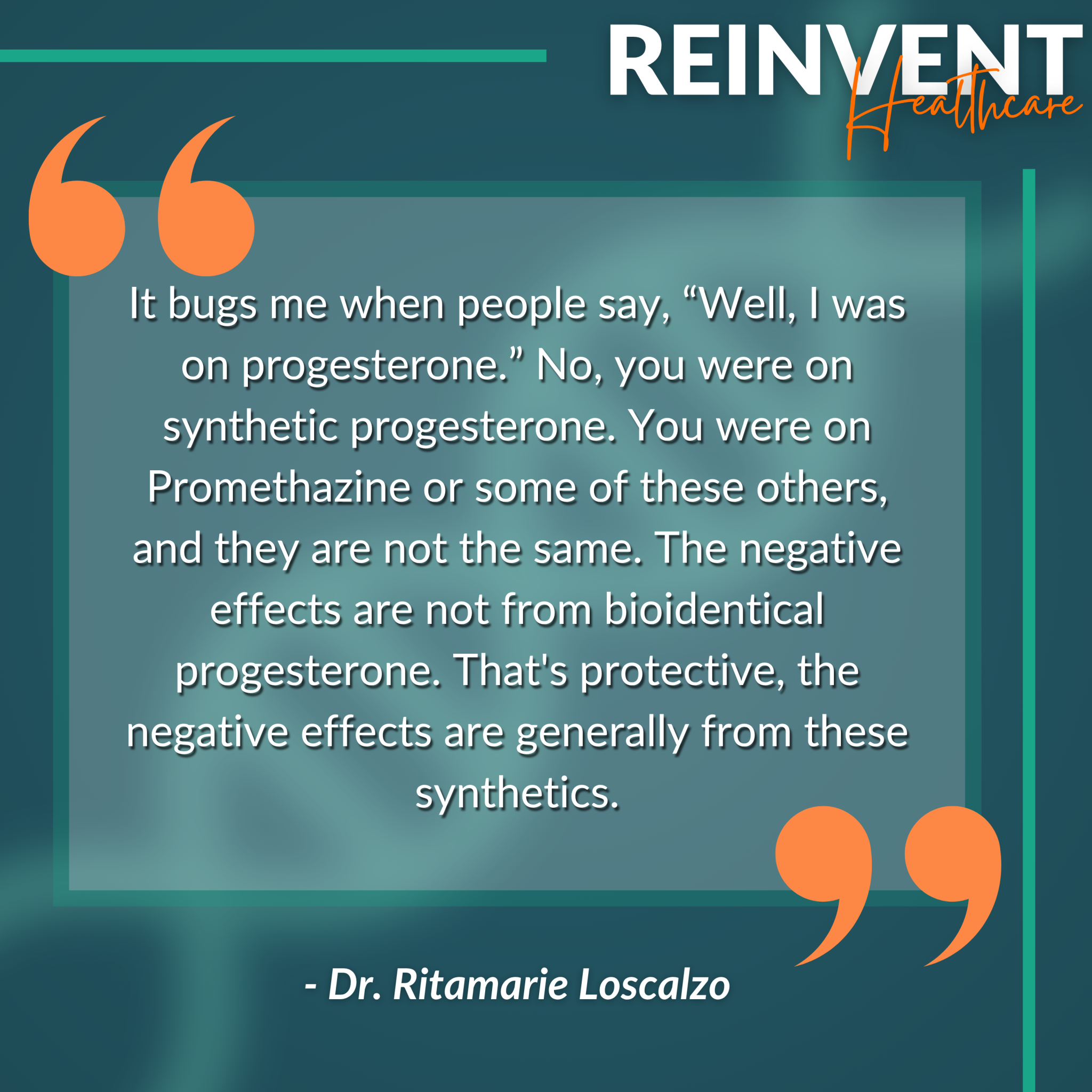
Because they're not told, and nobody reads all the fine print, because it's fine print. That's why it's really important for people to get that. What really bugs me sometimes is when people say, “Well, I was on progesterone.” No, you were on synthetic progesterone. You were on Promethazine or some of these others, and they are not the same. And the negative effects are not from progesterone bioidentical, that's protective, the negative effects are generally from these synthetics.
So that's where people really need to be aware, and your patients are going to come to you with those, hearing these myths, and hearing these stories, and they don't know what to believe.
Dr Devaki Lindsey Berkson (48:36)
I just had a patient come to me, her father's a pediatrician. She has a lot of health issues. She's very young, she's 17. And she said, she got a progesterone challenge at Johns Hopkins by a Johns Hopkins OBGYN trained doc, and she can never take progesterone. And I said, well, what exactly was this progesterone challenge?
They gave her a really high dose of Medroxyprogesterone acetate, which will make almost anybody sick. It's very nasty, in fact, we call that molecule in our hormone clan of intellectuals, the monster molecule. You just don't want to take that molecule. It's one of the causations of breast cancer.
When I was in school at Western States in Oregon, they were running studies there at the University of Oregon where they exposed rhesus monkeys to natural progesterone versus Medroxyprogesterone acetate, and it would cause vasospasm, and stroke, and adverse heart issues. Whereas, the natural progesterone doesn't cause any of those. It's a soothing calming hormone. It's so benign. The FDA allows progesterone to be in cosmetics and to be in everything. It's a very, very safe hormone, but not when you make it altered to make profit for a corporation.
Dr. Ritamarie Loscalzo (50:00)
Right, and that's the thing that people don't get. We can use the natural molecule, but you can't patent a natural molecule, so they have to put little side chains on it, which is chemistry. You can change one atom in certain formulas and go from a poison to a friend.
How could you think that putting these little side chains on a regular or organic, it doesn't make any sense. We have to think logically.
I really appreciate your perspective here, and we'll make sure we have all those links in the show notes. You said DrLindseyBerkson.com is where people can find you. Anything else you want to add to the conversation?
Dr Devaki Lindsey Berkson (50:46)
Quicksilver sells a lot of hormones OTC. And I think they just came out with an OTC version of GLP-1. I just heard about it. Dr. Shade runs that company, and when he launched his hormones, he had me fly to Denver and lecture for them for part of the launch. I was very impressed with him. I do think those products, and even the progesterone products are good.
Carol Peterson, who lectured for us on progesterone and everything hormones that I did with David Brownstein, she said that his progesterone product is extremely absorbable and really well done. She's looked at the chemistry.
There's some over the counter products, but you still need to work with a provider that can figure out how you silently reverse your age. No matter if you're in your 60s, 70s, are you becoming closer to a 30 year old version of yourself? That's what you want.
Dr. Ritamarie Loscalzo (51:36)
Yeah, that's what we want, right? I still say 35 when people ask me.
Dr Devaki Lindsey Berkson (52:42)
Let me see, I'm sure my muscles are here, right? I mean, I've got a lot of muscle, and I couldn't build that muscle, at least for me, maybe you've got that muscle. I don't know whether you're on hormones or not, but I've been on hormones. I had breast cancer. I love it when I can't remember exactly the years ago I had breast cancer, I guess about 33, and I've been on hormones now for about 30 years, because I had to have everything removed, and I was miserable.
Everyone told me I couldn't go on hormones, even my functional colleagues, everybody, but the science, that didn't make sense to me, because from 1980 to 2013, there were 25 human studies with women with ER positive breast cancer, anywhere from stage zero to stage three, kind of moderate, that were given estrogen replacement versus matched cohorts.
Women of similar age, similar tumor size, similar tumor stage, and there were 25 studies. One was 36 years, one was 30 years, one was 20 years, the shortest was 2 years. One of the studies was done by MD Anderson, and most of those studies, I think five showed that women with breast cancer, ER positive that went on estrogen, died less, had less recurrence, had less aggressive disease, if they did have recurrence. Not one study showed anyone worsening, not one study, not one study. And people constantly cite the Women's Health Initiative as showing that estrogen caused breast cancer. Well, every single reanalysis, and the final reanalysis by the original author said, it reduces your incidence, and you come out better even if you do get the disease.
The only other study was the Habit Study which had one group of women on estrogen after having breast cancer that had an increased incidence in the opposite breast. It turned out that they were the only group on an estrogen blocker on Tamoxifen. They were on estrogen, but their body couldn't use it. That study is cited, but if you really go into the belly of the study, there is no human trial showing that estrogen causes breast cancer, or if you already have a hormonally driven cancer, you can't take it.
Rebecca Glasser has done the biggest work of giving testosterone to breast cancer patients, and she didn't want a lecture at my conference in April, because we're pro estrogen, and she gives it with an estrogen blocker and aromatase inhibitor. But, because her work is so brilliant, testosterone levels are important to monitor in women, because testosterone helps you not get breast cancer, and one of the ways birth control pills make you a higher risk of breast cancer is they lower testosterone.
She's been able to prove that maleness protects femaleness. Our male hormones protect our female hormones. So she's going to be speaking for an hour and a half about all of her research. I've sent her a few patients now, and she has a partner, Demetra Kakas. I have some patients in Saudi Arabia that fly over to Greece to see him. She's in the Midwest.
It's exciting to see. She used to be a breast cancer surgeon and now she's transited into giving, but why does testosterone protect the breast? Because it signals the anti-estrogen receptor ER beta. The second estrogen receptor is like a treatment for cancer. It's an anti-proliferative, anti-inflammatory receptor, and testosterone breaks down and metabolizes signals of estrogen. That's how testosterone is protective. Is that crazy?
Dr. Ritamarie Loscalzo (55:43)
Soy, and there's so much controversy with soy, we could get into a whole other.
Dr Devaki Lindsey Berkson (55:48)
Okay, so soy. You have to completely dispel the controversy of soy. It's a piece of garbage, a piece of garbage. In fact, we used to say that the reason that Asians don't get as much cancer, there's many reasons, because they live a different lifestyle than we do, but they eat a lot of soy food and then they move to the West where they eat more processed foods, and their incidence of breast cancer rises. We've taken American people and said, hey, soy is only protective if you were born with it, if you were raised with it eating it from early on, but now we have actual science replicated where women with ER-positive breast cancer are given soy, and compared to women who were not given soy, and they have less recurrence.
It's just like estrogen, because it's a healthy estrogenic food. The oncologists that tell women to avoid soy, run the opposite direction, never go back to this oncologist. They haven't read any of the studies.
There's more research on soy protecting against getting breast cancer in the first place and then protecting you in the second place. In fact, the reason Tamoxifen works for breast cancer, is it signals the same receptor that soy signals. When a third of the women who take Tamoxifen, their estrogen levels raise. It's not like it's an estrogen, true estrogen blocker. It's a growth inhibitor, but it signals the Tamoxifen molecule.
It signals ER beta just like soy signals. I mean it's really fascinating when you start breaking this stuff down, but almost no one has. Almost no one has looked at this research. I have slept, lived, kayaked with this research.
I'm always thinking about it. Listening. I'm really wanting other women, my sisters of my heart, not to miss out, and I’m three years from 80. And I went dancing yesterday for almost three hours. I love to dance, and I didn't even get out of breath. I didn't even, I was just totally filled with life. And I want that for women that have been denied it.
And now Makary just gave a talk with a number of experts on testosterone. They say all men, their testosterone's under attack. And old men with heart disease can even take testosterone. Of course, we've known this for 40, 50 years, but the Traverse study just puts a stamp on it. They say even young men, young men have less testosterone. Every male patient, you should check their testosterone. But who do they say should miss out? Old women.
This timing hypothesis is nonsense. It's just nonsense. There's no reason old women should miss out. And women die more from heart disease than men do. And once they have an adverse heart issue, they tend to have more. Estrogen's heart protective, and when you don't have it on board, your heart's under attack. We've always died more since the Spanish war from heart disease than any other issue. And now it's about to be usurped from cancer.
We do measure spike protein from vaccines and from COVIDs in our patients. That's a whole other discussion, because the spike protein is carcinogenic. But hormones are safe. Hormones run the Wi-Fi of your physiology. They make all your cells get emails to tell your cells what to do.
If you open your computer in the morning, and your Wi-Fi doesn't work, it's so frustrating, you can't get anything done. Aging and disease are the freezing up of your Wi-Fi. So you can use hormones to keep your Wi-Fi going, not just spectrum.
Dr. Ritamarie Loscalzo (59:37)
There's a lot here. We started out with oxytocin, we went back to estrogen, we went back to oxytocin, now we got into testosterone. The thing is the world of hormones is fascinating.
Dr Devaki Lindsey Berkson (59:50)
If you’re asking your doctor about it. They haven't been trained with it. So they don't know about it. They're more likely to tell you, if my wife, I probably wouldn't do it. Because they don't know anything about it. They can't guide you.
Dr. Ritamarie Loscalzo (01:00)
They don't know. So there's a lot here. A couple of quick questions before we end here. You kept saying about testing testosterone. Is your favorite way to do it in the blood, or do you look at it on a dry urine, or a 24 hour urine, or saliva?
Dr Devaki Lindsey Berkson (01:01:20)
Testosterone is easily measured in the blood. David Rosensweet feels that only the 24 hour urine is really the way to go, because different people peak at different hours. But in the blood, you can look at FSH for a man, and you can look at sex hormone binding globulin. I have a lot of women who come in, and they say to me, I have way too much testosterone. I can't take testosterone.
And that's because their total testosterone is elevated, but it's only the free testosterone that delivers the emails. So then you look, and they have an elevated total, but their free is lower within range of an older person. And then they have elevated binding proteins, which are like the little Uber cars. Hormones can't drive through your bloodstream unaided. They have to have an Uber, and they get in the Uber and the more Ubers you have, the less they can open the door and get out. So that's important of all those things to measure, and you need to know those.
We don't have any doctors that you would go to your OBGYN, your urologist, your endocrinologist, these are the people who do hormones, right? In the allopathic world, but they're not trained in any of this, unfortunately.
It's human to be down on what you're not up on.
Dr. Ritamarie Loscalzo (01:01:40)
You don't know, and you don't want to get involved with. So it sounds like total testosterone, available testosterone, SHBG, sex hormone binding globulin, are important pieces, and FSH. I never thought about FSH. I just thought it goes up and then it just stays up. So interesting.
Dr Devaki Lindsey Berkson (01:01:55)
Because you know, high FSH gives you brain fog. High FSH turns off brown fat and turns on white fat. It makes you not be able to lose weight. High FSH makes your bones thin. High FSH drives aging in men and women both, just like low sex hormones. Your providers have got to monitor. Now you can monitor that. You can help people with that, but they're not going to get that when they go to a doc.
If the doc took my program, or Dr Rosensweet’s program, or BHRT, we're all telling the new providers, you should run FSH, you should run the binding proteins. They're trained in this, and I think ultimately, we'll get board certification programs in menopausal medicine and andropausal medicine.
Most of those societies are all sponsored by Big Pharma, and they're pushing the synthetic hormones. So I would stick with doctors trained from BHRT Academy, The Menopause Method, or my method, Everything Hormones. If you go to my website, there's an Everything Hormones right in the menu bar, and you could go down, and you can recommend it to your provider. They still can get 16 hours of CMEs for MDs, nurse practitioners, for NDs all throughout the country. And the new one will also be for pharmacists.
It also shows you the whole itinerary of everything they got in those 16 hours and all the bonus material. One of the things of the bonus material was abstracts of each of those 25 studies of women with breast cancer being given estrogen, but having better outcomes, not worse outcomes.
Dr. Ritamarie Loscalzo (01:03:27)
I was going to ask you about the testosterone, the FSH, the SHBG. Most people don't measure that. I do that all the time.
Dr Devaki Lindsey Berkson (01:03:41)
Aging elevates it. There's 60 causes of elevated sex hormone binding globulin, but pretty much when you start to get ill, it raises, and you start to get older, it raises, and then whatever hormone you have, you can't use it.
Dr. Ritamarie Loscalzo (01:03:55)
You can't use it, because it's stuck. So the question was with FSH, what levels, if it's above 10, we're thinking this person's heading into menopause, or in menopause,
Dr Devaki Lindsey Berkson (01:04:04)
You want it to be 25 or less in women, and about 11 to 13 less in men.
Dr. Ritamarie Loscalzo (01:04:08)
Okay, and if we do that?
Dr Devaki Lindsey Berkson (01:04:10)
Nobody, if you ask your regular doctor, they're going to poo poo this, because they've never learned it.
Dr. Ritamarie Loscalzo (01:04:14)
They've never learned it. But if you do that, then if somebody is on replacement, some kind of hormone replacement, and their FSH is still like a menopausal woman, we see it at 50, they're not on enough.
Dr Devaki Lindsey Berkson (01:05:27)
It's the estrogen that lowers it in women, the testosterone that lowers it in men. It's not the progesterone, it's not the DHEA, it's not the oxytocin, which you need all of these hormones. And it's really cool to learn how to use all of these hormones for the issues in your tissues. But, most doctors are not trained in this.
I hear a lot even from naturopaths. There's a naturopathic cancer expert, and I got called by the Spanish podcaster, because she said, at the last moment of her interview, she said to her, who should avoid hormones? And she said, everyone, no one should be on hormones. They only cause cancer, they only cause growth. So she wanted me to debate her on the air. But we haven't done that yet. Her audience was very open to hormones, and then this cancer expert said, nobody should be on hormones, which is inaccurate.
We even just had, our FDA, say other than antibiotics and vaccines, hormone replacement therapy is one of the safest, most important things a woman can do for health, and now we just did one for men. So he's on it.
There's a lot of people on Instagram, or giving courses, or wanting to be famous, that are not giving accurate information. It's good. I'm so grateful to have these conversations, so people can then go inside in your gut and see what feels right to you. And look at the messenger. There's a lot of people I lecture with, and I lecture a lot for continuing medical education courses, and look at the other women who are 70, 75, and what they look like, and sound like, and talk.
Look at the messenger too. I want you to do what's best for you, and so you want to have models that you can see that what they're recommending is working.
Dave Asprey just had an anti-aging conference here in Austin, and I hear the majority of speakers were young, vibrant wellness. Just had one, and I had dinner with a few docs that went there, and they said most of the speakers were in their 20s, 30s and 40s. I just hope that the A4M in Vegas at their longevity conference. I was the only speaker in my 70s, and the keynote was from Austin, too, and was 42, and I’ve got to tell you, all the influencers are listening to her, and she was shocking. She claims, I don't want to share her name at the moment, but she claims that you should eat one gram of animal protein per pound of ideal weight with 40 to 50 grams at breakfast, and that carbohydrates and fats aren't necessary, just protein.
Dr. Ritamarie Loscalzo (01:07:24)
I think I know who you're talking about, but I'll ask you later. Yes, I know it blows my mind.
Dr Devaki Lindsey Berkson (01:07:35)
Look at the messenger, and I didn't see any research. It was her opinion. I didn't see a large number of animal studies. I didn't see any research where half the animals were raised on this amount of protein per kilogram of body weight. I didn't see any of that, and I think that much protein is dangerous.
You've been in this field trying to do good and promote vegetables and plant food for so long, and for some reason, nutrition just attracts such controversy, right?
Dr. Ritamarie Loscalzo (01:08:05)
Gosh, yes. And it's my way or the highway at thinking as opposed to what you said over and over again throughout this, everybody's unique, and we have to find the right amount, and the right thing. There's people out there that are, as if there is one magic diet, or one magic supplement, or one magic way, to do things for everybody, and we're not. Some say, well, we're genetically all the same. Frickin' not.
I look at people's genetics all the time. There's such a diversity. And yes, it's only in that point five percent that there's diversity, but that point five percent makes you look like you, and me look like me, and somebody with hair growing out all over their face, look like them. Why doesn't it play the same for the biochemistry and the pathways?
So we're all different. Just as I can look at you, and distinguish that that's Lindsey Berkson. I know you, because your facial features are that much different than everybody else's, unless you have an identical twin floating around somewhere. I would love to have an identical twin, and a clone, so I can get more work done, and play more. Play, work, play, work. And I have time for both, way more time.
Thank you so much for being here. We have been listening to Dr. Lindsey Berkson . If you haven't figured that out by now, she's an amazing, powerhouse of information, and heart, and care. And I encourage you to go check out her website and check out her books.
Dr Devaki Lindsey Berkson (01:09:34)
I have a substack that I write in all the time called, Agile Thinking. And it's something that people should really check out, because I talk about what's going on in our country, and in the world, and nutrition, and hormones, and the environment. And I keep you up to date, and I write in it a number of mornings a week, and they can get a subscription for that. That's something, it's a tiger that has to be fed, but it also helps me keep up on everything.
Dr. Ritamarie Loscalzo (01:10:02)
Yes, you're forced to keep up with it. That's what this podcast does with me. We'll look, we'll have all those things listed in the show notes. So go check out the show notes. And, I encourage you to just keep feeding yourself, keep feeding yourself with great information and research. And her book, Oxytocin Medicine. Hopefully it's on audible? Is it on audible?
Dr Devaki Lindsey Berkson (01:10:22)
It's not on audible, yet. I've got to do that. And I haven't done that, yet.
Dr. Ritamarie Loscalzo (01:10:30)
I want it on Audible, because I like to multitask. So I combine exercise with listening to great books.
Dr Devaki Lindsey Berkson (01:10:36)
I've got to do that, and I haven't done it, yet, because now I I spent my whole holiday season doing the CME, to put together a CME course. It is very OCD, anal. You know, you have to do this whole spreadsheet, and you have to have all the learning objectives, and you have to have documented science. I have 15 speakers and world experts. So that took my whole holiday season when I was hoping I would do an audible, but I still went kayaking no matter what. I still go out.
Dr. Ritamarie Loscalzo (01:11:03)
Good. Your high priority, self-care, and exercise are the priority. Well, you're looking great. You're sounding great. And I appreciate you being here. And thank you all for being here on ReInvent Healthcare Podcast. And get out there and just really stay dedicated to helping people to get the support that they don't get from conventional medicine. And we have to reinvent the system, and it's us who get a chance to do that. So until next time, shine on.

Listen on your favorite podcast platform!





Share This Episode