
The Hidden Hormone Imbalance Before Menopause Hits with Mariza Synder
Hot flashes, mood swings, and brain fog. Too often, these symptoms are brushed off as inevitable signs of aging. What if these are your client’s early warning system of deeper hormonal chaos already underway?
In this episode of ReInvent Healthcare, Dr. Ritamarie sits down with hormone specialist and bestselling author Dr. Mariza Snyder to discuss the critical phase of perimenopause. Long before menopause sets in, subtle shifts in hormone function can disrupt mood, metabolism, sleep, and more.
If you’re only testing estrogen and progesterone, you’re missing the bigger picture. This conversation challenges outdated assumptions and exposes the hidden patterns that masquerade as anxiety, depression, and burnout, so you can catch the real root cause before it’s too late.
What You’ll Discover Inside:
The Silent Phase That Sets the Stage
Why the most critical hormonal changes start years before menopause and go unnoticed by most providers.
The Missing Piece in Hormone Testing
A key hormone marker that can reveal perimenopausal shifts early but is rarely measured.
When Stress Becomes the Master Hormone
How modern life drives the adrenal-hormone feedback loop and what to watch for in burned-out clients.
The Blood Sugar–Estrogen Link
Why metabolic balance is non-negotiable for hormonal balance and how to spot trouble before it spirals.
What Most Practitioners Miss About HRT Timing
The real risks of waiting too long and why “not yet” can be just as dangerous as “not at all.”
Resources and Links:
- See the Full Transcript here
- Download our FREE guides:
- Join the Next-Level Health Practitioner Facebook group here for free resources and community support
- Visit INEMethod.com for advanced health practitioner training and tools to elevate your clinical skills and grow your practice by getting life-changing results.
- Check out other podcast episodes here
Dr. Mariza Snyder’s Resources and Links:
- Visit Dr Mariza’s website: www.drmariza.com
- Check out her books here
- Grab her Free Hormone Quiz + Gifts: https://www.drmariza.com/hormone-quiz
- Listen to her podcast: Essentially You with Dr. Mariza Snyder
- Find her on social media platforms:
- Follow her on Instagram: @drmariza
- Facebook: @drmarizasnyder
- Insta: @drmariza
- YouTube
- Twitter: @drmariza
Guest Bio
Dr. Mariza Snyder is a powerhouse advocate for midlife women, leveraging 17+ years as a practitioner, author, and speaker to spark a massive movement for women in perimenopause and beyond. With her top-rated Energized with Dr. Mariza podcast (13 million downloads) and a passionate social media audience of over 400K and 8 million monthly views, she’s a trusted guide—offering science-backed solutions for perimenopause and metabolic health.
Her upcoming book, The Perimenopause Revolution (Hay House, October 2025), is the ultimate resource for women ready to take charge of their health and embrace perimenopause with resilience and confidence.
A sought-after speaker and educator, Dr. Mariza is changing lives, breaking myths, and ensuring women have all the tools and resources they need to thrive. Featured in Oprah Daily, Dr. Oz, Fox News Health, and MindBodyGreen, she’s a leading voice in women’s hormone health. Visit her website, drmariza.com, for evidence-based solutions to help you thrive.
Transcript
Dr Ritamarie
There's a stage of life where so many people feel like they just got hit by a bus, like their whole world has been turned around, and everything seems different. Their body shape, their sleep, their moods, the way they treat their loved ones. All of that seems to change at this time of life.
And today, I'm super, super excited to have with us a special guest, Dr. Mariza Snyder. And we're going to be talking about this stage of life, which is an area of expertise for her and an area of passion for her. She is a powerhouse advocate for women in midlife. She's got seven years plus as an author, practitioner, and speaker, and is excited about sharing this wisdom, so that women are not going through this stage with misery. It should be a powerful time of their life.
I'm super excited, because I've known Mariza for how long? Maybe over a decade. And I've just seen her just really take this women's hormone area with like a storm. She's super excited. She's super passionate. She produces a lot of content, and she has over 300,000 people on her social media and 13 million downloads on her podcast.
So I'm super excited that she's taking the time with us today to share her wisdom about perimenopause and health. And her Perimenopausal Revolution book, we'll tell you more about that later, is going to be coming out in October. So welcome, welcome, welcome, Marisa. I'm so excited to have you here.
Dr Mariza Snyder (02:03)
Thank you, Ritamarie. It's so wonderful to be here with you. Thanks for having me.
Dr Ritamarie (02:08)
So let's just jump in, because I think people are excited to hear this stuff, and every woman's different. I know I don't have the passion for teaching women about this area of life, because I went through it seamlessly. It was like, well, my period stopped. Well, good. I'm entering a new phase of life. And a fraction of women do go through it that way. And I do want to discuss why that might be so.
In your experience, what's going on? Like what are women experiencing during this? And we're going to get into lab testing and really looking at the hormones, but what's going on? What are people experiencing and why?
Dr Mariza Snyder (02:50)
Yeah, absolutely. Well, it is, I think of perimenopause, the transition into menopause, as a full body recalibration. It's a silent shift. It's an inevitability unless you go through premature menopause due to surgery or cancer or something like that, that inevitably we're going to go through a second puberty similar to our first puberty.
Except the difference, the main difference, is our first puberty, we were ascending into rhythmic hormones around our cycle that were very consistent, and we're going to run like clockwork. They did so for like 35, 30 years, give or take. And perimenopause is the opposite, is the descent of these hormones, particularly estrogen, progesterone, and testosterone.
And we know that these hormones are not just cell messengers. I know we always think about hormones as being cell messengers, but these hormones are more than that. And we're realizing that hormones in general are more than just a cell messenger. They are signalers, and more so, they're regulators. They are system-wide regulators. And so let's take estrogen, for example.
Estrogen is a regulator of bone. It helps to lay down bone. It helps to regulate muscle. It helps to stimulate muscle protein synthesis. It helps to support gut microbiome diversity in the gut. It is what I would consider to be the CEO and master regulator of the brain. And really estrogen, and a lot of these hormones, are our protective shield. And so as women start to navigate in perimenopause, they’re potentially keeping things, maybe managing symptoms pretty okay, before getting into perimenopause or not realizing that there's maybe something brewing underneath the surface that they didn't know anything about.
And so as these hormones begin to erratically decline, we lose that protective shield. And all of a sudden these symptoms, over 50 different symptoms in perimenopause, become more pronounced.
Or maybe that subtle shift in insulin resistance becomes a much bigger insulin resistance. And so I find that the shield really comes off, and we begin to experience a lot of different symptoms. Brain related symptoms are the most common.
When we think about perimenopause and menopause, we think hot flashes and night sweats. We think brain fog and memory lapses and lack of word recall, mood swings, rage, anxiety, depression, sleep issues. This is all brain related. And so it's no wonder when we have estrogen, who the brain has been reliably expecting to be like binding to those receptor sites every single month, all of a sudden stops.
It's kind of like when you expect an employee to come to work, and it's eight o'clock, and all of a sudden your employee doesn't show up until noon or 5pm. Or then they show up every day at 6am for many, many days and then don't show up again for like a week, and then shows up at 10 o'clock. So it's this inconsistent thing.
The one thing I think a lot of people don't know about estrogen, is that it is an immune system modulator. And so we do see an increase in neuroinflammation in the brain as we're going through this transition for many people. We know that there is a decrease in gray and white matter in the brain. We know that there is a kind of decrease, a 25% decrease in energy metabolism in the brain during perimenopause. And then we see neurotransmitters being profoundly affected. It becomes a mental health issue.
And so this transition, if we're not educated about it, we don't understand what's going on with it. It can really blindside a lot of women towards the point where we get to early menopause, and women have already lost up to 20% of their bone. They've already lost a percentage of their muscle. They're more insulin resistant. They're closer to being pre-diabetic, and they are experiencing some levels of inflammation in the brain.
And so my intention is to get out and really explain that this isn't about lost periods and no more menstrual cycle. This is so much more than that. This is a full body shift, and it's a metabolic shift for many women, particularly if they're already coming into perimenopause with some metabolic issues.
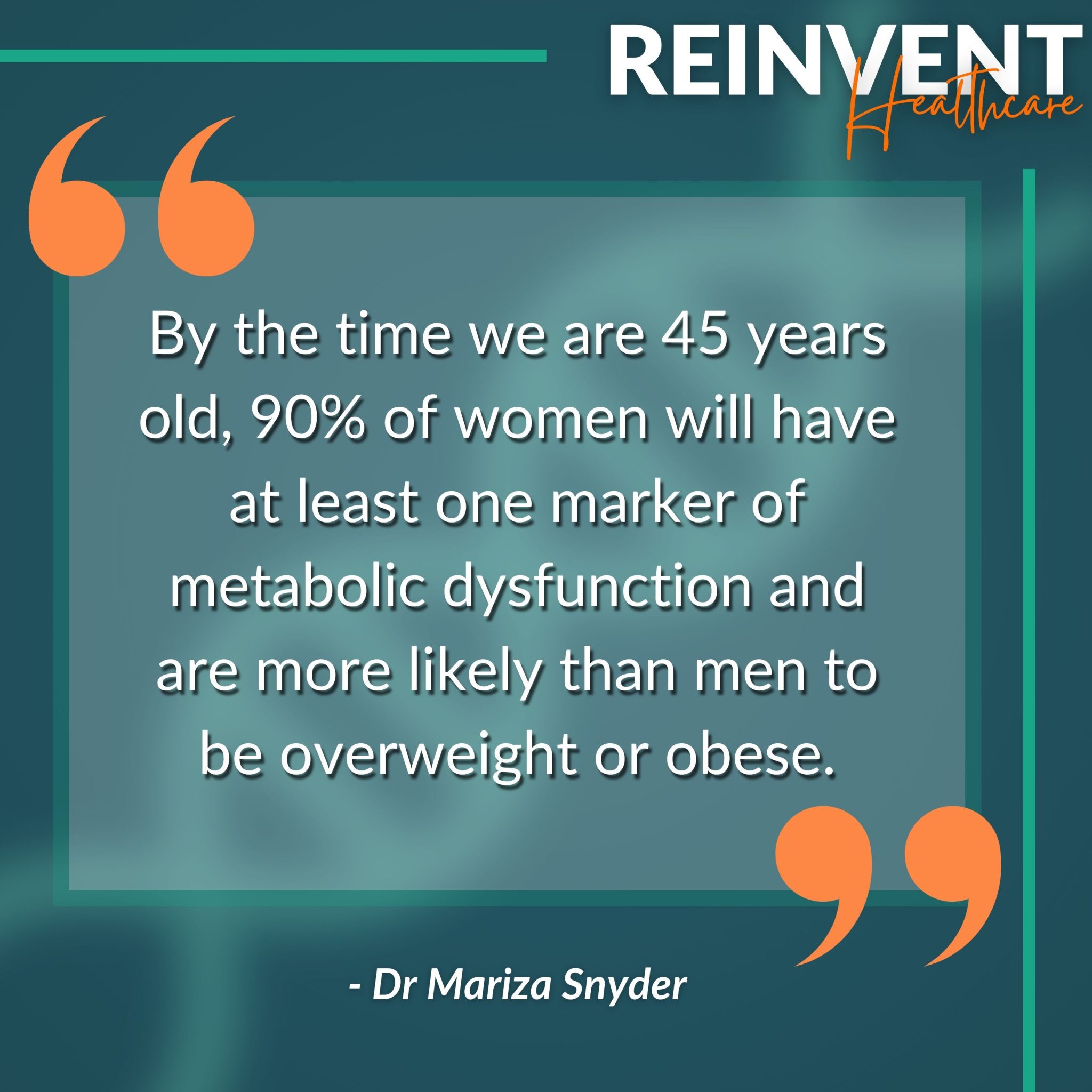
By the time we are 45 years old, 90% of women will have at least one marker of metabolic dysfunction and are more likely than men to be overweight or obese. So that's not even menopause. That's like halfway through for a lot of us. So it is definitely a window of vulnerability, but it's also a window of opportunity. As long as we understand what's happening, and we decide that we are going to take charge of what's going on.
Dr Ritamarie (07:42)
Absolutely. So I love your analogy with the worker coming in and out. You know, it really gives us that, you're expecting something, and you don't get it, and what that does to our psyche. But what inspired you to become such an advocate for women in midlife?
Dr Mariza Snyder (07:57)
So two things inspired me. One, I got to be a front row observer while I was very much involved in my mom's perimenopause journey. My mom had me at a very young age. She was 19 years old. And so by the time I was in clinical practice, my mom was in perimenopause, and it was like a nightmare unfolding. My mom was really struggling with a lot of the brain related symptoms. We're talking rage, depression, sleep issues, severe fatigue.
I could just tell this woman had been strong, stable. She was firing at all cylinders. I mean, this was a woman who could handle massive capacity. She was, in my eyes, a superwoman. And so when I watched her go through perimenopause, I was like, who is this woman? Like, I don't recognize this lady. And she didn't recognize herself.
I will say that when you've been operating at a high level, I feel like perimenopause can be the rug that gets pulled out from under any woman, but especially a woman who's high achieving. When you're feeling like I've always handled this. I've always been on top of this. Things have always felt not necessarily effortless, but I was able to always do them. And then all of a sudden things became insurmountable. And she was struggling. I remember she would tell me she would spend three to four days in her house by herself, because she was afraid she was going to run somebody over with her car. She got to the point where things were just so, so intense for her in terms of her mental well-being. And she felt like she was basically untethered and unhinged in her symptoms.
And I remember getting a call at 11 p.m. one night, and my mom, she sounded so scared. And she was like, Mariza, I'm really scared about how I'm feeling. And that was when I ultimately ended up taking over her care.
And it's not like she didn't go to the doctor. It's just, and some of them did validate what she was experiencing, but there were no solutions really offered. It was just like, this is just how it is. I'm just so sorry. There were no hormones offered. It was just therapy. I don't know. Antidepressants. Maybe she was recommended antidepressants. I don't remember, but I just remember there was nobody who was able to connect the dots of what she was going through to perimenopause and menopause. And this was really deeply more perimenopause than it was menopause.
It was like another four years, before she went into menopause. And I was so grateful I got to take over her care, because obviously the system just kept failing her left and right.
And so I remember two things. One, being so grateful to get to be there for my mom, but also wondering, is this coming for me? Is this a preview of what is coming in my journey? Is this what I'm going to get in peri? And I'm not going to pretend like it's been the easiest journey.
That's for sure. You know, I was two years out postpartum. My son was barely two. And I started to experience brain related symptoms. I started to experience it every month. I would start to experience this deep sense of dread. All of a sudden I found myself over-efforting when things used to not require so much effort from me. And I had noticed big time that I was losing my stress tolerance. That again things that would just slide off my back, not of concern, all of a sudden were just lighting me up. And I was like, ooh.
And then I started experiencing rage, and I was like, oh goodness, this is my mama's perimenopause all over again. So, and so yeah, I mean, there's a lot of things that can be affecting this, but we ultimately know that what ends up putting fuel on the fire is that these hormones begin to deregulate.
And if there's already sensitivity in the brain, maybe neurotransmitter sensitivity or hormone sensitivity, like some women are just more sensitive, right? We see that in severe PMS or PMDD. And although I hadn't really had any of that, gosh, when I got to perimenopause, things really started to come up for review for me.
That's why it's been such a passionate journey for me as I see so many women struggling with the mental health aspect, with the low stress tolerance, with the inability to handle what life is throwing at them, when just six months ago or a year ago, they were able to.
Dr Ritamarie (12:12)
Wow, and you know that your mom's case sounds really severe. Fortunately, you didn't have it as severe as she did. But what is it? Why is it that some women experience such a severe situation, others a mild one, and like me, I didn't experience anything. So what makes those differences?
Dr Mariza Snyder (12:32)
Absolutely. I think it's a number of things. Number one, stress. I think stress is a major player here. I think another thing, another root cause, is trauma. I think trauma. A lot of the research that's coming out right now in perimenopause. We know that the body keeps the score, and we can shove back trauma and stress
for a while, especially again, with stable hormones, we can do okay. We can kind of pretend like it never happened.
You know that. But then hormones begin to deregulate, and they're not binding to receptor sites. And we see a weird swing in dopamine and serotonin and GABA. It just kind of brings it all up. So I think things that hadn't been addressed are finally asking to be addressed.
Also, it's very clear, and this is a metabolic show, that right now we're close to 40% of our teenagers are pre-diabetic. I think it's like 37%, something like that's crazy. I think why we're seeing worsening symptoms of perimenopause, particularly in these generations, is one, we probably are coming in with some level of metabolic issues that, again, we have probably kept down. We probably have been managing up until a point, so more insulin resistance, more metabolic issues, more inflammation coming in already, environmental toxins, trauma, and stressors. I think it's the emotional stressors that are coming into perimenopause.
Also, we're having children late. A lot of us. We're going from postpartum straight to peri without a pit stop. I had four solid months and then it all started to crumble again. So I think that's a player here as well.
But I would say those are the biggest root causes and then probably gut issues as well. A loss of estrogen doesn't necessarily do us any favors when it comes to a healthy gut. We lose that diversity as estrogen begins to fall.
Dr Ritamarie (14:34)
Right, right. And an unhealthy gut affects the metabolism and the elimination of estrogen metabolites, right? So we end up with worsening of the estrogen symptoms. But what actually is going on? So for our practitioners who are listening and saying, I see women in all kinds of stages of this perimenopause, but what is actually happening to the hormones? Why are they so erratic at this point in our lives?
Dr Mariza Snyder (15:00)
Yeah, well, that's a great question. I don't know why our biology is set up where they are gradually declining. I don't understand why that isn't the case. Why can't we just gradually decline? It's very clear.
We know in the research that these hormones are not gradually declining. They are erratically declining without our permission. Like no one's like, hey, so I'm taking the order of erratic, chaotic hormones that are affecting everything in my body. I will sign up for that for 10 years. I know, nobody's signing up for that.
At the ovaries and the brain, there's cross wires, there's miscommunication, right? We only have so many eggs. We're born with so many eggs. By the time we're in puberty, we have 500,000 eggs and then we start to cycle them. Now remember, we prime up eggs every single month until we pick the magical one, right? We pick the magical egg that we're going to ovulate. But we're just moving through eggs every single month, trying to figure out which one is the highest quality candidate for conception. And by the time we get to 35 years old, we're in the maybe hundreds of thousands, tens of thousands. We're down, we're down to, I want to say we're up to like 5 to 6% reserve by 35.
And that's why we call it geriatric pregnancy, right? Because we know we're getting down to the low of the reserve that we have. And so then at that point, the ovaries really know that we're getting on that lower reserve. And not to say that we can't conceive between 35 and 40 women do it all the time, but there’s effort.
I know that I primed up for an entire year to get pregnant at 40 years old. I didn't think I was just going to sneeze and get pregnant. I wasn't 22 anymore. And so as these eggs are winding down, especially as we get to our late 30s, early 40s, the communication between our pituitary hormones and our ovaries begins to become a little bit more important, right?
We are having anovulatory cycles. So, we're going to be skipping ovulation. And I know that all the practitioners here know that ovulation is the main event. It's everything. I don't know why we call it a menstrual cycle. It's an ovulatory cycle. That's what it is. And it takes a lot of energy to run that cycle every single month. It's amazing to me that it's really miraculous that whether you want to get pregnant or not, your body is going to prime up for it, and it's going to use a lot of energy to do so.
And so you can imagine as we're getting closer, we're getting low on our egg supply, we're going to start to have faltered and anovulatory cycles. That throws a lot of things off between the brain and the ovaries where we start to see this mixed signal. We see, again, without ovulation, we don't make progesterone. Progesterone.
We need to ovulate and have that corpus luteum to release progesterone in the second half of our cycle. So then we have a situation where we're not always making progesterone and that's throwing things off as well. And so as we start to continue to wind into a kind of early perimenopause, we're having more anovulatory cycles, so less ovulatory cycles, and we're having a disruption in these hormones.
That connection between the brain and the ovaries starts to cause that hormonal disruption and starts to cause erratic hormones. Some months we have lower levels, some days we have higher levels, particularly with estrogen, because she's happening throughout the entire cycle. She becomes a little bit more inconsistent. And so this is what perimenopause is. Until we get to a place, I would say late perimenopause was where we're skipping periods at least every 60 days.
And this is what we thought perimenopause was up until I would say even the last decade or so, we thought, even the CDC right now currently says, that perimenopause starts at 47 years old. But for a lot of women, early peri is starting in our early 40s or even a little bit earlier, depending on when you're going through menopause. Natural menopause is between 45 and 55 years old. Ideally, if you've got good reproductive longevity, you make it to 55 years old, right? You get to ride it until the wheels fall off all the way to the end.
A lot of women are going into menopause earlier. And we think that has a lot to do with a lot of the root causes I talked about, the chemicals, the ultra processed foods, which are still chemicals, as far as I'm concerned, the amount of stress that we're dealing with, right? Maybe it’s alcohol consumption and smoking? Those are big players too for going into menopause earlier.
And there are definitely women in our population where that's very much true. Birth control could be playing a role as well. And so we know that there's a lot of factors up in the air that can be lending to some kind of earlier menopause, earlier perimenopause. Ultimately, I think of it as, at the root of all of it, metabolic health, or a decline in metabolic health due to a lot of these root causes that are coming through and ultimately impacting our reproductive longevity and our ovulatory longevity.
Dr Ritamarie (20:04)
Yeah, I would agree with that. And you said 90% of women in that age group. My research has said that 93% of the population, you're being a little generous there.
Dr Mariza Snyder (20:15)
Yeah, I was a little, I'm a little nervous there. I think when people hear 93, I think I need to get over this. I think when people hear 93, they're like, there's no way. I think that they can be online. And no, it's 93%. And where we're the most vulnerable is after the age of 45.
Dr Ritamarie (20:29)
And you mentioned the selection, the egg selection, and it reminded me of an interesting, cute little cartoon-like Instagram reel that I saw recently. I'll have to see if I can find the link to it, where it was this whole process of the, okay, we're getting ready, we're getting ready. And it was just a really cute process to exemplify the process that we go through to pick that one egg that's going to go down and meet the sperm.
Dr Mariza Snyder (20:56)
Yeah, and I always wonder is that like the egg that's got the most mitochondria in it? I always, mean, like, that's the egg I choose, like, which one's got the most metabolic reserve? Which one's got the most metabolic vitality? Yeah, it's miraculous the amount of mitochondria that is required to move us through that egg selection process and to release an egg every single month. It's mind blowing.
And so is it no surprise that one in five of us are struggling with polycystic ovarian syndrome that's impacting fertility? We think about a metabolic crisis. I think about a fertility crisis. And so if we've got all these women who one in five women are coming into perimenopause and menopause with things like PCOS. PCOS isn't just black and white, it's kind of a gradient, right?
And so maybe there's some level of metabolic issues going on or metabolic dysfunction going on, not to the degree that it's really showing up on labs, not to the degree that it's really pronounced, but then you get into perimenopause, and it all of a sudden, these subtle symptoms of metabolic syndrome, if you look, a lot of them are perimenopausal symptoms.
Dr Ritamarie (22:14)
And the point about metabolic dysfunction, so to speak, well in PCOS, that's what it is, right? It's an insulin resistance, and people don't recognize that. I mean, yes, it's an androgen dominance, and progesterone is low. It's a bunch of those hormones that are out of balance, but why? And the underlying reason is usually metabolic dysfunction, insulin resistance. And we really need to be looking at that early on. I always say as you said, it doesn't show in labs. Most of it will show in labs if you do the right labs.
Dr Mariza Snyder (22:51)
I'm talking about the labs that we normally run.
Dr Ritamarie (22:56)
We normally do Fasting insulin. “Fasting glucose is fine.” Fasting glucose is fine. And yes, it is until you're diabetic and then it's not. Whereas,if you're testing fasting insulin, and you're testing postprandial glucose the way you should with the CGM or a finger prick, those are the things that I think women should be taught early, men too, early in life, to get those things tested and to change the lifestyle, the diet, the exposures, et cetera early on and that would prevent the misery in perimenopause and beyond.
You mentioned earlier a little bit, you said early perimenopause, and I've heard you talk about stages of perimenopause. Can you elaborate on that a little bit for us?
Dr Mariza Snyder (23:39)
Absolutely. So there's officially two stages, but I think that there's a little bit more than that. I think that it's kind of end stage, kind of like towards the end of your reproductive years, where again, we'll start to see maybe a few anovulatory cycles. And you just, again, may not be making progesterone every single month, or you may not be making an adequate amount of progesterone. And so you may see a shift in PMS symptoms. It may just be a little bit more exacerbated. You may notice changes in your cycle. Maybe it's getting a little bit shorter. You're just noticing that something's shifting, but it does feel like the daily pain points of everyday life, except that it just feels a little bit different. Like it just isn't adding up. And that's really early, early peri.
Early peri menopause is where you said that statement, “Universe sends me a sign” and makes it impossible for me to miss. This is early, perimenopause. Like I feel like it's impossible to miss at this point.
For most women, it's going to be early to mid forties, like 42 or 43 is when women come to me, and they're like, I am falling off a cliff. You know, and so this is where we start to see again, still potentially regular menstrual cycles. Maybe you're skipping ovulation, and you don't know it.
Maybe your PMS symptoms, instead of being three days, are now like five days or six days. It all just starts to blend in together. And so where did that progesterone boost go on day 21? I don't know, she just disappeared. And so you'll notice that, but then also brain-related symptoms. So a lot of women start to experience, again, related to progesterone, but also estrogen as well, we start to see the brain fog, the lack of word recall, the cognitive stuff is coming in, the anxiousness, a little bit of depression, mood swings and rage.
A lot of why women are coming into the office is the mood related symptoms. All of a sudden they find themselves a bit untethered and unhinged, and their relationships are being impacted. I will tell you that that was my wake up call when I had rage three months in a row. I was like, peri-menopause, okay, and not you girl. And I'm like, okay, I’ve got to get this under control.
So that's early peri-menopause again, cycles are still again inconsistent. You're not skipping periods, yet. But you may be on a 26 day cycle when you were 28 days or maybe you're down to 25 days or maybe bleeding. Maybe it's lighter or even heavier, it's inconsistent.
So you'll notice that but still you're like I'm still cycling, and this is when you usually go to your doctor. Your doctor's like you're still cycling, you're not in peri-menopause, and this is where the gaslighting happens, which is unfair, because a lot of these symptoms can be happening that look like mom life, that look like you're too stressed, that look like you're not moving enough. Like we tend to, or it's just aging, or this is just the way it is. But just note that yes, things are shifting subtly. This is a journey. I remember seeing a meme recently where it said perimenopause is up to 10 years. And someone's like, that isn't a transition. That's a career. Like, no, just to give some sense to it.
It's a journey that we're talking about here. You're not just going to go from full hormones to all of a sudden they're dropping. It's going to be a process. So some of these symptoms are going to feel a bit subtle and others are not, it depends. And then late perimenopause is usually mid forties, late forties or into early fifties. Again, every woman's going to be a little bit different, but I would say usually around 46 is when I'll start to see women skipping periods where they're going more than 60 days without a period. And at this point, you're about three to four years out from menopause once you're in late perimenopause. And this is when we start to see the night sweats and the hot flashes and the insomnia and definitely the weight changes, the body composition changes.
If they hadn't started happening in early peri, they're definitely happening in late peri. It's really where you're kind of in the eye of the storm, because estrogen is really dropping at that point. Your protective shield is beginning to go away.
Dr Ritamarie (27:46)
The late peri I could relate to, is the periods now at 60 days, now it's 20 days, and then it would go like three to four months. I go I'm over and into it, and then it would come back, and then I remember the last one I had was a year after the prior one, and I thought okay, it's almost a year I must be through this, right? And boom got that period, and I'm like, no, is this starting all over again? What the heck's happening here?
Dr Mariza Snyder (28:13)
Right. Yeah, well, here's the thing. I think it's important that we know when we go into menopause, but it is a continuum. It's a continuum. Why do we have to have a specific date where a period hasn't happened for a year. Your hormone levels have been low.
Why do we need to wait for that magical moment? And I think that does a lot of women a big disservice. They're thinking, I can't do anything about this potentially until I get here, or that's what doctors will tell you as well. The thing is, by the time you are having a period every six months, and it disappears, and then it comes back, and it disappears, like you're in what I call the perpetual waiting room. Levels have been very low, they're very low. And at this point, you're at the greatest risk for bone loss, for muscle loss, for increased insulin resistance and pre-diabetes. This is the silent shift.
And so I always think that we have gotten, we don't wait until menopause. The window of opportunity is in peri as these hormones are declining. Do something about it when you still have them, even bring on hormones while you still have them so that there isn't this lag or this gap where you've gone without that protection, and it had a detrimental impact. Because whether women know it or not, our cardio metabolic health is on the line, our bone. One in two of us are going to have an osteoporotic fracture. Okay, one in two of us are going to have cardiovascular disease. 68% of us are going to have cognitive decline and dementia. This is all women. And it happens. The reason why these numbers become so great for us is the loss of these hormones don't necessarily set us up for winning if we just stay on a default path.
This isn't our grandmother's menopause or mother's menopause anymore, although I will say my mom is rocking menopause, so I can't really give her as an example. But it's not deep. This is not a default path. We have so many tools and so many things that we can do to future proof our health for the next 40 years or more. I just think a lot of the narrative was that, well, this is happening to me. I'm just getting older. This is just the way it is. None of that is true.
You know, if anything, if you want to feel amazing and have the freedom to do what you want in your 60s and your 70s, the 40s, that's the window of intervention. This is when the bed started. This is when we lose bone. This is when we start to lose our metabolic resilience due to muscle loss. And so what we do in this time period and continuing forward is going to set us up for better longevity in the years to come.
Dr Ritamarie (31:00)
Love it. I love it. I always say the time to start preparing for menopause is when you're in your 20s, because you don't want to get into that starting of decline.
But I want to ask you two questions. I really want to talk about what to do once you're there. Is there a test that can be done to tell whether whatever the symptoms are is actually perimenopause, whether you're 40 or 45 or 50?
Dr Mariza Snyder (31:23)
Well, there's no definitive test for perimenopause. Like we don't have a, here's your test, and you're in perimenopause. What we do, it's really based on symptoms. It's a clinical diagnosis based on symptoms. So there are three criteria that I'm always looking at. One, how old are you? That's going to give me a clue as to is this perimenopause? I'm 47 and all these things are happening. I'm like, oh yeah, girl. We didn't need to test you to know that you were in puberty. We don't need to test you to know that you're in perimenopause. Like we know, right?
Number two is cycle change, any tracking your cycle, anything happening in your cycle, that would give me indication. So it's cycle changes, any type of cycle changes, symptoms, and your age. I always ask, when did your mama go through menopause? Because that can often be an indicator for when, kind of a ballpark for when, we go into menopause as well.
Hopefully your mom didn't have a complete or partial hysterectomy so that she'll know. But usually I would say, the average age for menopause is 51, 52 years old, reverse engineer the next six to 10 years, and that's going to put you in perimenopause. But there are labs that can support and let us know what's happening, because in perimenopause, we do see things shifting.
I see lipids shifting. I see fasting insulin and fasting glucose and hemoglobin A1C is shifting. Highly sensitive CRP is shifting. Again, these are not shifting in the positive direction. They're shifting in the negative direction. Look at cortisol levels, looking at melatonin, looking at a full testosterone panel, a full thyroid panel. I'm looking at progesterone. I'm looking at estradiol.
So I'm testing in the second, you know, between seven days after ovulation or before your period, looking at all of those numbers. Sure, I'll look at an FSH and a luteinizing hormone between days two and four of your cycle, but usually they're not going to start shifting probably till late, late peri-menopause. At that point, you've been in the office. You've been asking what's going on, you know?
So I'm looking at all of it. looking at all the labs. I'm looking at APOB. I'm looking at a lipoprotein(a), I'm looking at homocysteine. I'm looking at sed rate. I'm looking at all the markers to get a sense of what's going on with you.
Because whether you're in perimenopause or not, I know that things are shifting in midlife for you. And I want that full picture. I want the baseline labs so that I can keep comparing, and ideally I want those baseline labs in your thirties, you know.
Dr Ritamarie (33:54)
But they're not normally done as part of a routine panel, unfortunately. Sadly. Hopefully that'll change. What's that? yeah, I get a baseline.
Dr Mariza Snyder (34:02)
I want a DEXA. I want you to go in and get a DEXA. I want to look at your bone density. I want to look at your adipose tissue and your visceral fat. And I want to look at your lean muscle, your lean mass. So I think that information is really mission critical. If we're losing bone, and we're losing muscle in our forties, or even as early as our thirties, when it comes to muscle and strength, I don't know why we're waiting till 65 to look at these numbers.
If we're making decisions about hormone replacement therapy in late perimenopause or menopause, wouldn't it be nice to know if you already have osteopenia? Because that would make a big reason for getting on estradiol. Just to maintain or just to preserve your bone where it's at.
I highly recommend a DEXA for women in their 40s.
Dr Ritamarie (34:57)
So when you say a DEXA, there's the standard DEXA that's done, which is your wrist and your hip and your spine, and they're looking for bone density. But you mentioned all those other compartments. So are you talking like a full body DEXA where it looks at your visceral fat? Because those are different, and they're not typically run when you just go into your regular doctor to have a DEXA done.
Dr Mariza Snyder (35:18)
Again, and most likely it's not going to be covered unless you give a reason for it. Like you're going to have to plead a case for that, but normally you're going to have to go to a facility.
Dr Ritamarie (35:27)
And they're not expensive. I had one done last year, and they're like $50, $60.
Yeah, so we're well worth the out of pocket expense. So let's talk about what we've been hinting at all along. What can women do? Number one, what can they do in their early 40s when they're starting to see this happening or not? They just want to prevent things from going awry. But also I want to talk about what you can do earlier on.
So tell me your approach when you have somebody come in, and you know that they're full in, whether it's early, mid, or late perimenopause, what kind of approaches, what do you advise them on, what do you do, what interventions can they take?
Dr Mariza Snyder (36:10)
Yeah, absolutely. Well, the first thing I think that's most important is optimizing our cellular energy. At the end of the day, that's everything. Your mitochondrial function is everything. And so that first step is knowing your numbers. I think it's important to know if someone is metabolically healthy or not. And how we define that is our metabolic biomarkers are in range without medication. And as we all know, those ranges are pretty big.
Fasting glucose needs to be under a hundred milligrams per deciliter to be considered metabolically healthy. Blood pressure under 130 over 80. Waist circumference under 35 inches for women. You know, I could never get away with that. I'm five foot two. There's no way I could have a waistline of 35 inches. And so again, these are based on averages, right?
HDLs over 40 deciliters per milliliter. Triglycerides, we want to have them under 150 milligrams per deciliter. So those are the metabolic numbers. I think it's important that these biomarkers women know about.
So the first thing I'm looking at is I'm looking at all these labs. I'm looking to see if a woman's even within these ranges, if she's a part of the 7% of adults that are metabolically healthy.
On top of that, I'm really teaching her how to optimize her blood glucose. So I'm a big proponent of putting continuous glucose monitors on all of my patients. I want them to understand how their lifestyle is impacting their cellular energy, their blood glucose levels, their sleep, their movement, what they're eating, what are their post-prandial levels after their big meals, and what's their fasting glucose every single morning. Also what's their fasting glucose before going to bed at night?
These are important markers to know consistently. Then I'm building a metabolically healthy meal plan that involves a lot of probiotic foods, a lot of micronutrient and antioxidant rich foods, a lot of omegas, a lot of fermented gut foods and fiber. Huge. Like again, I think when we're talking about what's going to help drive good metabolic health, it's reducing inflammation, it's balancing blood sugar, and it's ensuring that our gut microbiome is adequately supported and diverse. But also we need protein. So no matter how you get your protein, just get it.
Just get protein so that you can build muscle. Remember, if estrogen is a muscle stimulator, it is helping us to lay down muscle, and we are losing that critical hormone to do so, making sure that we are getting adequate enough protein to support those muscles, but then we're also, we're making sure that we're actually building muscle. So we are weight training. We are resistance training to hypertrophy, right? So we're training to failure in those muscles.
I also believe that we should build our life around movement, being physically active. When you look at all the Blue Zones, these people are moving all day long. They're not sitting for six hours in bed. You know what I'm saying? So that one big workout and then you sit on your booty all day isn't going to cut it. It's about building your life around movement all day long.
And I get that as practitioners listening to this, you're like, I can't even do that, let alone my patients, but I want you to be thinking about little bursts of movement.
So I'm a big proponent of exercise snacks. And I know everyone thinks that I'm talking about snacks. I'm not talking about food at all. And that has nothing to do with food. It has everything to do with movement. I have a buy-in for meetings and a buy-in for meals post and after, and it is 60 jump squats. I probably do 250 jump squats a day, give or take.
But it can be squats, it can be mountain climbers, it can be pushups, it can be going up and down your stairs, it can be jumping jacks, it can be jump squats. I'm talking 60 seconds, or maybe two to three minutes. And if you can punctuate those little exercise snacks throughout your day, my gosh, I will tell you, I have seen blood glucose levels and insulin levels go back into range, because your muscles are constantly being that metabolic sink, and your body is moving.
One of the first things we learned to do when we were one year old or maybe 11 months old is walk. We are meant to move. The reason why our biggest muscles are in the lower half of our body is we were never meant to sit. No. And so building, I would say building your life around movement. Ideally it's resistance training. It's walking and moving throughout the day. It's yoga, it's dance, it's getting where you fit in.
I want you to be thinking about how I can get in these micro movements throughout my day? I would love a 15 minute walk after every meal, but it's not always possible. But I can do a three minute exercise snack, you know, and so that's what I mean.
I'm a very busy mom. I just got my kid off to school before this meeting. I am in interviews for six hours today and in between, I'm going to be doing little mini exercise snacks all day long. And so that is another thing. And then the next thing is optimizing your circadian rhythm and your sleep. And so I think sleep consistency is something that we have been sleeping on way too long.
I think there's a new research study that just came out literally a week ago, 67% of women struggle with sleep issues in perimenopause and menopause. It's because of night sweats. It's because of a lack of progesterone. It's because of melatonin dropping. There's a number of reasons, but it's also lifestyle, right? We're in this blue light. We're looking at a TV screen. We're eating snacks.
You know, you were late night eating after seven o'clock, and so all this adds up. And so I say treat your sleep routine like it's a million dollar meeting, meaning nobody interrupts it unless they have a million dollars that they are hanging. That Netflix show, it is not a million dollar meeting. And so you’ve got to protect it. And so I consistently recommend being asleep or being in bed lights off by 10 o'clock, give or take and then consistently waking up at the same time in the morning.
Many of us, we experience social jet lag where we are consistent in the week, but then on the weekend, we go to bed at midnight. We don't get up until eight. And yes, you may be still clocking seven to eight hours, but it's the consistency that you've thrown off. And that consistency is everything. And so I think the more that we can be disciplined enough and consistent enough about that sleep consistency, it makes all the difference in the world.
And what sets us up for that consistency is making sure that we don't eat three hours prior to bed. Making sure we're not gulping gallons of water, before we go to bed, so we have to get up and pee at night. That we are not watching TV, or we're on our phones an hour before bed. All of these things add up and can mess with our circadian rhythm. And so really honoring our bodies.
And then the last thing I would say in this journey is really, it's community. Spending time with the women that you love that feel safe, being with people that you love.
I would say that of all the research, whether it's movement or blood sugar management or sleep, circadian rhythm optimization, all of that, the most compelling research I have seen is that you will live longer and more healthily if you were spending time with people in real life that you love.
Dr Ritamarie (43:40)
Yeah, I love everything that you said, and it's everything that I teach, and it's not just if you're 40, 45 and you're starting to go through peri-menopause. What Mariza just said is something that everybody should be living their lives as, because that's what's going to help prevent us from getting all the diseases, right? And we know perimenopause and the change in estrogens, and it predisposes us to osteoporosis and heart disease, but, cancer.
Well, we need to be looking at this as a lifestyle, not just like, I'm going through perimenopause, I'm going to do what Mariza says, you know? No, this is lifestyle, and this is going to prevent you from having that downward spiral. And I would like to say, that likely the reason I didn't have such difficulty during perimenopause is I was advocating, teaching, and doing the things that you're talking about for a very long time before that starting in my late 20s. I would have liked to do it before that, but I didn't know any better.
But you said a couple of things that I want to point out. You mentioned the definition of metabolic health. These are not definitions that necessarily Dr. Mariza or I believe are the definition of health, those are what is considered, you have to be within those ranges to be in the 7%.
So I believe that way less than 7% are actually optimally healthy, because those numbers were not optimal. They were barely, barely midline. I think fasting glucose should be in the 80s or below, right? I think that triglycerides should be 75-ish.
I think that the ratio of triglycerides to HDL should be around one to one. 75, 75, you're in good shape, right? All of those things. insulin should be, nobody tests for it, by the way. So that's something you usually have to ask for. I think it should be below 5.
Dr Mariza Snyder (45:38)
I would say below five. Yes, we got some work to do. I want that ratio at one, the triglycerides over HDL to be one. I agree. I want triglycerides under 80 milligrams per deciliter. I want a hemoglobin A1C under 5.2. So when we're looking at it, I want, obviously, blood pressure to be 120 over 80 or less. I want the measurement of your waistline at least to be half of your height.
Dr Ritamarie (46:14)
That's great. Yeah, that's a good way to look at it. Waist to hip ratio is often looked at. And for women, it needs to be 80% or less. Your waist is 80% of your hips or less. And men should be equal or less, right? So those are the things we can look at. And those are things we don't need to pay anybody to do testing for.
And as practitioners, you can tell people, pull out your tape measure, and let's look at that. Write those numbers down, and that's some of the markers that we can easily measure on the journey to see if you're getting better without having to go and run an expensive lab test.
Dr Mariza Snyder (46:47)
Absolutely. And Dr Ritamarie, all the labs that you just shared in your optimal levels. I go through what we consider to be the criteria from the American Heart Association, the ones that we went over that had diagnosed metabolic syndrome, but all the labs that you just gave and the reference numbers for optional labs in the book, I cover. I say under 80 milligrams per deciliter for triglycerides. I want you at 85 or less for a fasting glucose.
You know, I talk about that ratio, I go into CRP. So I just want women to be like, okay, what is functional and optimal for me versus what I'm being, because again, so many women are coming into the doctor's office in the exam room and it's normal. You know their fasting blood glucose is 98 milligrams per deciliter, and it's normal. One of the things that I offer in the book so that women can see it on paper, is what the levels should look like. These are the reference levels to look like. And I tell every patient one, measure your waist, go get your blood pressure done at a drug store or at your doctor's office, and just ask. Those three labs are on the basic panel that you can get. Depending on your insurance, at least get them annually at least, but probably even more than annually. And so it's very easy.
So I walk people through exactly how to get this information, because it's one thing to list off these numbers and to list off these biomarkers. And then women are like, well, how do I even composite this information for myself? Yeah. And so I think that that's important.
But also again, I have a whole massive section in the book about continuous glucose monitoring and how to use it, how to leverage it to your advantage when you wear one, how to get one, and what you're looking for.
In the morning when you're fasting. I really want it to be again, show me a sign, make it impossible for me to miss. That is how the book is built.
Dr Ritamarie (48:46)
That's great. And October 2025, so if you're listening to this afterwards, then it's already out on the shelves. And if you're listening to this before, maybe it'll be up for pre-order by the time. So we'll put all the information in the show notes, so that you can find that.
So I want to end with, this has been great and awesome. And I want to end with what are your three non-negotiable perimenopause hacks?
Dr Mariza Snyder (49:09)
Ooh, my first one I would say is, I shared earlier, move your body. Move your body as much as possible. I would say that that has been the biggest game changer for me.
I started doing exercise snacks last fall when I was writing the book, because I wasn't able to get outside as much. I love walking in nature. I think that that is one of the most incredible ways to support your body. It is the most underrated longevity hack out there. It is just being outside in nature and walking out in nature. But it just wasn't as feasible for me given the tight deadline that I had. And so I started implementing exercise snacks, and I wear CGMs on and off like every other month. And I was amazed at how optimal I was. All day long postprandial fasting, it was between 70, and I didn't even get above 100 after eating meals.
I ate, and mind you again, was eating metabolically healthy meals. I was eating for my blood sugar, but it was the movement consistently throughout the day that made everything so optimal, because I was constantly burning that fuel. I was constantly in this state of metabolic flexibility. And I was like, man, our bodies are really meant to move. Movement is life. So that would be number one.
Number two is booking that date with your besties. Booking the date with your besties, spending time with your friends in real life, moving with your friends. I have workout friends, I have walking friends. I don't think I do anything with my friends that doesn't involve movement at this point in my life, okay? So spending time with your friends, cultivating friendships, building community. I think it's so important and so non-negotiable.
And then I think the next one is really, this is the moment, this is the reckoning, this is the moment where we get to be discerning about what we want to put our energy towards, what our boundaries are. So if you had not been prioritizing yourself up until this point, this is the defining moment where it's time for you to prioritize yourself when the world has told you to prioritize everything and everyone else.
So those would be my big non-negotiables when it comes to stepping into the second half of your life.
Dr Ritamarie (51:30)
Those are awesome, and I love it. And the exercise reminds me that for me exercise, I love exercise, and I just recently came off of doing a three day live event and I was preparing and all, and I wasn't doing my full hour runs and half an hour to 45 minutes of weightlifting every day. And I was sitting a lot, and my blood sugar, wearing a CGM, my blood sugar has drifted up, so the exercise snacks are amazing.
How hard is it to go and do some elevated pushups or squats or all these things that you can just do in place, even if you're at your desk, desk-ercises, right? You just do them at your desk and keep those movement bursts going on throughout the day.
Thank you for that and thank you for the reminders of the connection, because it's so important. And oxytocin is one of the hormones. We didn't talk about that. Is that can impact it at menopause?
Dr Mariza Snyder (52:26)
Absolutely, yes, it gets impacted. And it's one of those hormones that when it's not showing up the way that it used to, it's not able to curtail cortisol. And so, yes.
Dr Ritamarie (52:36)
Yes, yes, so there you go. And cortisol leads to elevated blood sugar and pressure and all that kind of stuff.
So I really appreciate you being here and sharing all this wonderful information, but I think you have a gift for everybody listening. It's going to be in the show notes, but tell us a little about it.
Dr Mariza Snyder (52:52)
I do. So it's my thriving and peri-menopause survival guide. It's mostly a metabolic guide. Let's just call it. It's got a symptom tracker in there. It's got all of the labs I recommend that women take to their doctor and ask for, including a fasting insulin and uric acid and CRP and all of it, right? It's the full gamut. Women deserve to have these numbers. And then all of the most critical, research backed metabolic perimenopause hacks that women can start experiencing or start getting results from, including exercise snacks and recipes. I just want women to feel like they have a starting point to get results now, even on the hardest days.
Dr Ritamarie (53:29)
Thank you. Thank you. Thank you. And look out for her book coming out in October 2025, a guide for practitioners to be having access to be able to share with your patients and clients. So I really, really appreciate the work you're doing and how you're tying in the importance of metabolic health, because as you know, that's my passion. And that's something I've been talking about for decades, actually. So I really appreciate you being here. I appreciate you guys listening to this.
And as practitioners, the kind of practitioners that Dr. Mariza and I are, we're the future. We're the future of healthcare. We're unfortunately not the majority right now, but I see that as the way healthcare is moving. We're putting the care back into healthcare, and we're putting the health back into healthcare, because truly what we have right now is a disease care, a disease management system, actually, symptom management.
So we need to get away from the outdated focus on system suppression and just throw some hormones on this and throw some herbs on it. It's really a matter of rebuilding and helping people to rebuild their bodies to be as healthy as possible. So until next time, shine on.

Listen on your favorite podcast platform!





Share This Episode