
The Genetic Code Behind Insulin Resistance, Fatigue, and Weight Gain
Struggling to understand why someone’s metabolic health isn’t improving despite clean labs and healthy habits? The missing piece might be written in their DNA. In this episode of ReInvent Healthcare, we uncover how key genetic variants (SNPs) can help you identify hidden metabolic risks and choose the right lab tests to confirm them.
Discover how to combine genetic data with functional testing, and learn how to personalize your interventions with surgical precision.
What’s Inside This Episode?
- What metabolic health really means and where it goes wrong
- The SNPs linked to obesity, insulin resistance, and energy dysregulation
- Why normal labs can be misleading without a genetic lens
- How to pair key SNPs with targeted lab tests to get clearer answers
- Real-world examples of using DNA to uncover hidden dysfunction
- When to test beyond TSH and lipid panels and what to order instead
- The one genetic insight that could change your whole approach to weight loss and blood sugar
Resources and Links:
- Download our FREE Guide to Using Genetic Testing to Optimize Patient Outcomes
- Join the Next-Level Health Practitioner Facebook group here for free resources and community support
- Visit INEMethod.com for advanced health practitioner training and tools to elevate your clinical skills and grow your practice by getting life-changing results.
- Check out other podcast episodes here
Transcript
Dr Ritamarie
If you've been struggling to figure out why metabolic health isn't improving, the answer may lie in DNA. Let's explore how genetic insights can guide lab tests that can identify the underlying metabolic chaos and guide you to solve problems for good. Understanding genetic risk factors can unlock a whole new level of precision in metabolic health management.
In today's episodes, we're going to dig deep into how specific SNPs related to metabolic dysfunction can guide the lab tests that provide the clearest insights, helping you to design truly personalized healing plans. Stick with me and let's get into how you can elevate your practice and your results. I'm excited to get it.
Dr Ritamarie (01:15)
So let's start out with the basics. Metabolic health refers to how well the body converts food into energy and regulates blood sugar, manages fat storage, and balances hormones like insulin, leptin, and glucagon. When metabolic processes get disrupted, that's when we see conditions like insulin resistance, obesity, type 2 diabetes, and other conditions start to develop.
So what if I told you that genetics can play a major role in how well or how poorly these systems function?
Looking at the genetic blueprint can reveal predispositions to metabolic dysfunction that you can't always detect through history and traditional lab testing alone.
So in today's episode, we're going to break down key SNPs, or genetic variants, that are linked to metabolic health and how you can use this genetic data to guide the lab tests to offer deeper insights into metabolic function.
Let's start by talking about SNPs, single nucleotide polymorphisms. They influence metabolic health. So which are they? They're small changes in the DNA that can affect how the body processes glucose, fats, and even how it responds to certain foods.
Let's start with FTO, fat mass obesity associated gene. And guess what? It's called the fatso gene. That’s not very respectful, but if you remember that, you're going to remember that this SNP is associated with a higher risk of obesity and type 2 diabetes. People with a certain variant of the FTO gene may have a greater tendency to store fat and a harder time losing it. And fat in these people can actually cause them to gain fat. People with this genetic variant don't do well on a strict ketogenic diet where they're eating a lot of fat, because they just convert it to fat on their body. It's important to be especially diligent in testing the lipid levels in these people and their glucose tolerance. And that helps you to track how these people respond to both diet and exercise.
Dr Ritamarie (05:08.032)
In somebody with the FTO variant, I recommend that you not only test the glucose, A1C, and even insulin, but you also be looking more carefully at their lipid markers, not just the standard panel. And we'll get into more of that later.
Let's look at PPAR-Gamma. This gene helps regulate storage and insulin sensitivity. So variants of this gene have been linked to, guess what, obesity and insulin resistance.
If you notice a genetic predisposition to PPAR gamma variations, whether it's homozygous from both parents or heterozygous from just one parent, consider testing their insulin, which you can then use to calculate their HOMA IR score, which gives you an indirect measure of insulin resistance and then do a more comprehensive metabolic panel that might include not just glucose and insulin and A1C, but maybe even C-peptide and pro-insulin.
Another variant, AMPK, AMP-activated protein kinase, is an important one in metabolic health. It plays a crucial role in energy regulation and metabolism. And people with this genetic SNP who have malfunctioning AMPK, they may struggle with energy balance and fat metabolism.
So in this case, testing for things like basal metabolic rate, blood sugar regulation, and fat oxidation may be more telling than a standard lipid panel.
Dr Ritamarie (05:01)
TCF7L2, transcription factor 7L2. This gene is well known for its association with type 2 diabetes. People with certain variants of the TCF7L2 gene are at higher risk for developing insulin resistance and type 2 diabetes. So if you see this SNP in someone's genetic profile, running more specific tests like an oral glucose tolerance test, or checking fasting insulin levels will help uncover whether insulin resistance is already developing.
I'm just going to say this now, glucose tolerance tests are tough tests to get people to do, because they put a lot of strain on the body. Typically with a glucose tolerance test, people are asked to drink some glucose syrup, which is just like drinking Coke syrup. It's very highly processed, very, very concentrated. And then they measure, over the course of anywhere from two to six hours, depending on the type of test they're doing. And they check the insulin and also the glucose curves. I recommend that people start with doing that kind of test at home, because you can control what you're eating.
I recommend that when people do a glucose tolerance test at home, we give them very specific guidelines as to when to measure, but we also give them things they can eat that are going to stress the glucose system but are within the realm of what they might eat. Like what's the worst food you're ever going to eat? Somebody might say, well, occasionally I have a bagel, or I have a donut, or I have orange juice, or some of them might say Coca-Cola. So we have them eat that highly carbohydrate rich meal and then check over time with their glucose tolerance.
So these are just a few of the genes. There's a lot more. I have a handout that I created for people inside my nutritional endocrinology practitioner training. And we give it out at a lot of our events. It has a glucose SNP list that's about 16 pages long. So there's a lot of them. This is just a handful of the more common ones. But when you look at somebody's genetics, and you see a lot of these variants, you know that this is not a person that's going to be able to eat a lot of carbohydrates or take chances and not exercise and not sleep and not do the things that help improve insulin sensitivity. This is someone who has to be very, very careful. I'm one of these people. I have a lot of these SNPs, and I have to be careful. Pineapple without greens raises my sugar up to like 160, 180, but pineapple with greens might only raise it to 135, 140.
Still that's too high in my opinion, but it gives me the idea that if I'm going to eat pineapple, it's a little taste, and I eat a lot of greens with it.
So that's how having these bits of information can help you in creating personalized plans for your clients or for yourself. So it's really important that we understand that we need to look at this and also test more carefully in somebody with either a family history of diabetes, insulin resistance, or with some of these SNPs and then know what lab tests to use. I'll summarize those lab tests when we get towards the end.
Those are just a few examples. There are many, many others, like I said. They influence everything from fat metabolism to glucose regulation and the insulin receptors, the Glut4 receptors and all that.
So now that we've covered a few of the key SNPs associated with metabolic health, let's talk about how to use the genetic data to guide lab test selection. It can significantly influence which lab tests you prioritize. You may not need to get an expansive panel, which could cost money, because a lot of insurance companies don't cover it, for a person who really doesn't have the genetic tendency. But for someone who does, you really need to be testing a lot more thoroughly for two reasons.
One, to protect them. Number two is to influence and motivate them, because I find that when you test somebody's genes and they find that they have certain predispositions in their genes, they tend to take you more seriously with a lot of the suggestions you might have otherwise been suggesting, but now they're more motivated and inspired.
Dr Ritamarie (19:26)
So let's look at some of this. Let's look at some of the links between labs and genes.
So a client with an FTO gene variant, fat uptake variant, would benefit from a glucose tolerance test, like I mentioned, but I like to do the ones at home. And then looking at fasting insulin for sure and HOMA-IR score. And the HOMA-IR score is just a calculation from fasting glucose and fasting insulin.
Sadly, most practitioners that are conventionally trained do not do insulin, fasting insulin. Some of them only wait until somebody's diabetic, type 1 diabetic or type 2. Others don't even do them on their diabetics. I remember having a conversation with someone who had been in one of our programs, and I was talking to her about getting further help, and I asked her what her insulin score was. She told me she was type 1 diabetic. She goes, I haven't had that done in 15 years.
Like 15 years, you're a type one diabetic, they have you on insulin, and they're not testing to see where those numbers are. It's very sad and in my opinion, it's criminal. So I like to teach people to do the glucose tolerance test at home, so they don't have to subject themselves to drinking the glucose syrup. Because a lot of people have that downside after they do the traditional glucose tolerance test.
For lipid metabolism, I look at people with the PPAR gamma variants. They might come in and they have normal cholesterol levels, and they've been told that they're just fine, no problems. But we're going to look at them, and they have high triglycerides or low HDLs. So when we look at a detailed lipid panel, that includes ApoB and ApoA1, we can uncover a lot more about how their body is handling fats, even when the standard tests appear normal.
For people who have thyroid problems, right, that's part of this whole metabolic process.
Certain MTHFR variants may lead them to have impaired methylation. MTHFR people think it is related to folate metabolism and B9, but actually B2, riboflavin, is involved with that, as well as, magnesium and some other things. And that interferes with thyroid function, because we need B2 in the thyroid process.
So in these cases, when we test the thyroid, we don't just test the TSH like in the normal standard in Western medicine. We also want to test antibodies, and we want to test T4 and T3, Free and Total, and look at what the conversions are and what the binding is to see if they actually have action, activated hormone, that's in the system.
One of the things we can test for when it comes to thyroid, though, is receptor resistance and that impacts metabolic health tremendously if somebody's making plenty of thyroid, and they're converting adequately from T4 to T3, and the body is moving it from the total bound to protein into the free. If the thyroid receptors aren't working, you're likely to have symptoms of low thyroid, but the lab tests look normal.
This is something that we as functional practitioners need to be looking at in anybody that comes in with fatigue, can't lose weight, and any of those symptoms that relate to blood sugar imbalance and thyroid imbalance.
So it's really important to do the full testing, but also to think about some of the things that impact the receptors, like testing homocysteine. Because homocysteine is a problem with the receptors. When homocysteine is elevated, what we see is that people can't get the thyroid into the cells or into the nucleus of the cells. So homocysteine's an important one.
Vitamin A is another one that's important. So these are things that are important to be looking at and helping people to establish so that they can have better thyroid function. When you have someone who has poor thyroid function, they need to get that under control to get the blood sugar under control. When they have poor blood sugar function, they need to get the thyroid under control, and they need to get the blood sugar under control. So they kind of work hand in hand, and we can't do one without the other. There's a lot of overlap between them.
We want to look at all those things, and it's going to give us a full picture of the thyroid health rather than just testing TSH levels like conventionally taught.
Let's look at metabolic syndrome. And we know that metabolic syndrome is a combination of fat imbalances, blood pressure imbalances, plus the blood sugar, right? So insulin resistance with elevated triglycerides and out of balance lipids. And when we see somebody in that, that's the right before diabetes step, and we have to intervene there.
When we see that they have a variant in TCF7L2, they have a much higher risk factor for metabolic syndrome. And we want to look at those markers carefully. So when we look at blood lipids, we not only want to look at cholesterol and HDLs and LDLs, and when we look at blood testing, we want to look at glucose, A1C, and insulin.
We also want to look at some of those other markers for lipids, which we mentioned a few earlier, ApoB, ApoA1, and also particle sizes and lipoprotein little a, Lp(a). Those are all really important. And when we don't look at those, we're missing the boat. And a lot of these genetic factors can help us to determine.
If you have genetic data, and you have the right lab tests, and you do a symptom history with a person, and a family history for the person, how do you put it all together?
When you combine it all together, you have a complete picture, and you can be super effective at helping people to get in balance. So let's just say you have somebody with an FTO gene, and it's linked to obesity, and the traditional panel shows a normal range of things like blood sugar and lipids, because we just look at glucose, and we we think, well there's nothing going on here.
We have to look at fasting insulin and calculate their HOMA-IR and look to see if they have early signs of insulin resistance. I kind of look at it as pre-insulin resistance, whereas insulin resistance is diagnosable once the fasting glucose goes above 100. But people can have fasting glucose in the 90s or even 80s but still have pre-insulin resistance. And so it's really important to be looking at their postprandial, but also their insulin levels.
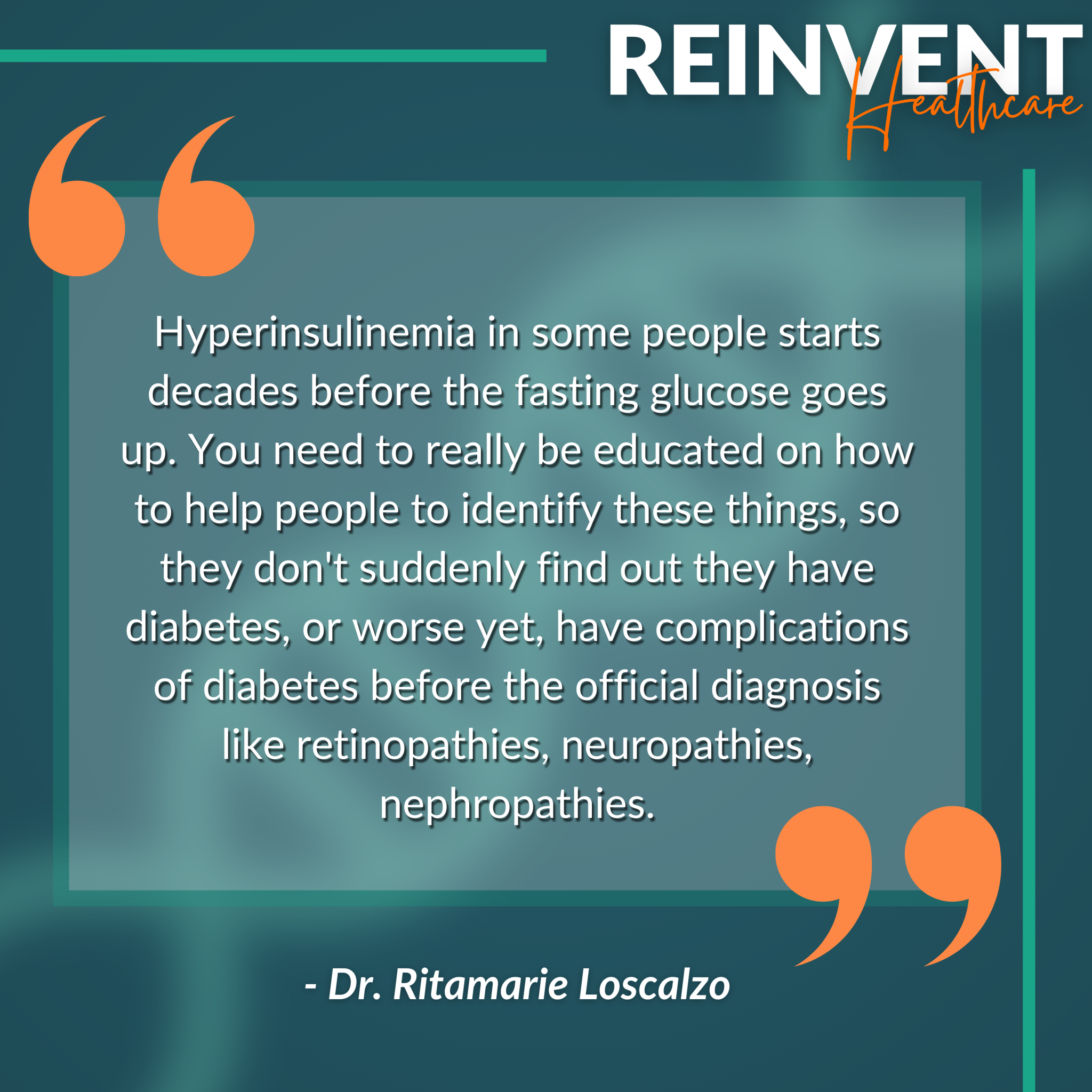
Hyperinsulinemia in a lot of people starts decades before the fasting glucose goes up. So you need to really be educated on how to help people to identify these things, so they don't suddenly find out they have diabetes, or worse yet, have complications of diabetes before the official diagnosis like retinopathies, neuropathies, nephropathies.
Dr Ritamarie (16:21)
We'll have some other episodes in this series on nephropathies and on kidney problems, that's the nephropathies, the neuropathies, and retinopathies. So stay tuned for those.
By using genetic insights alongside all this functional lab data, you can tailor interventions more precisely, whether it be dietary modifications, supplementation, lifestyle, or all of the above, which is what's usually done.
Let's look at a couple of cases to show you how this works in the process.
Let's say client A has an FTO gene variant, and they present with high body fat percentage despite following a balanced diet, or what they think is a balanced diet, but maybe not a balanced diet for them. Their blood work shows slightly elevated triglycerides, glucose levels are normal. Now, again, we have to look at what's normal and what's functionally optimal.
Fasting glucose is considered normal if it goes all the way up to 99. But we think functionally optimal is in the low 80s or in the 70s, right? So we have to really look at, are they optimal, or are they normal? Because normal, in my opinion, is usually pre-insulin resistance.
When they have that genetic predisposition, you're going to be wanting to run a fasting insulin test. And quite frankly, I run fasting insulin on anybody that comes into my practice, because they have some issues, they have some problems, and so many times the insulin is elevated in people who have difficulty losing weight, low energy, brain fog, and they don't know why. So I always run it. But assuming that you don't, they have the FTO, you should be running it.
Now, you can easily intervene with strategies aimed at improving the insulin sensitivity, getting them on a diet that doesn't require the secretion of a lot of insulin.
Dr Ritamarie (18:14)
We put people on a 30 day metabolic reset, because we find that in 30 days, if you're not aggravating the insulin system, if you're not eating things and doing things that are causing you to need more insulin, then what happens is that we don't produce as much and those cells, the receptors on the cells get much more sensitive to insulin. And that can happen in 21 days, some studies show, but 30 days at the max. So as long as people are sticking with the program.
We want to improve the sensitivity before serious metabolic problems happen. High levels of insulin are a key factor in sudden death from heart disease, one of the most important factors there. It increases blood pressure, it increases the viscosity, it increases endothelial inflammation. So all of these things need to be put under control. So that's case one.
Let's take another one, client B, let's say, has the TCF7L2 variant. It's associated with higher risk for type 2 diabetes. Their glucose levels are normal, but they have elevated triglycerides and low HDL. And we know that the triglyceride:HDL ratio is a good marker, an early marker, for insulin resistance way before the glucose goes up.
So you order a full lipid panel, and you include APOA1, APOB, Lp(a), lipoprotein little a, and the particle sizes plus the fasting insulin. So even though their glucose is fine, their lipid profile and fasting insulin can point to a metabolic dysfunction. And that gives you the clue that you need to be helping this person get their metabolic health under control. before they develop diabetes.
Now, I'm just going to tell you something. I'm going to be a devil's advocate here. If you don't run any tests at all, say the person does not have much money, and they don't want to do the testing. You can just give them a metabolic reset to get them started. And what you will see is dramatic changes. Now you won't be able to show them the dramatic changes unless you just do glucose with a glucometer. That's very inexpensive, right? You buy a $15 glucometer, and you get the strips, and you do it that way. Most people don't like to do it, because their fingers get sore.
That's a way, you know, a poor man's version of it, a glucose meter is a more inexpensive way to do it. And doing the testing pre and post is a good way to do it. But not everybody can do it, and not everybody needs to do it, because I want you to get so good at doing a clinical history, and looking at whatever labs they've had in the past, and being able to see metabolic function a mile away.
You can see it from their waist hip ratio oftentimes, from their waist:height ratio oftentimes. And these are very inexpensive ways to assess.
So I want you to think these are the tests you can do. This is the way you can put their genetics together with their lab tests, but you don't have to have it to help people, right?
We don't need to get people to spend a lot of money on testing to help them dramatically, right? And if you have a group coaching program where you take them through as a group, and then do some coaching where people get individual insights along the way, you can at least get them started.
Yes, you need to personalize it somewhat to people. Not everybody responds the same, but you can get 80% of people better when you know how to do that and when you know how to do a metabolic reset.
So as you can see, like genetic testing and lab tests, they do work hand in hand. And by understanding genetic risks, you can choose the right tests and interpret the results in a way that uncovers these hidden metabolic imbalances early on and allows you to design personalized targeted health strategies that truly work. So they are good things to do. They're not crucial or critical.
When people really just don't have the money, or they have an aversion to doing the testing, they can't get it done through their insurance, and they don't want to pay out of pocket, you can still help them by doing the right history, asking the right questions, and kind of assuming what some of their genes are and some of their lab test results are going to be.
I personally have been doing this for 33 years. So I can usually tell by talking to somebody, by doing a diet history, and asking them the right questions, I can usually predict what some of their genetics are. Can I predict it 100%? Absolutely not. I am not clairvoyant, but I can predict it with a lot of certainty, and I can predict what their labs are going to be.
There are some people who are very, very different, right? They're doing all the right things and not getting well. That's where the genes and the labs have the most impact. But if you do these things, you can help people to get motivated and inspired to make the changes and sometimes it's the changes you knew they had to do anyway.
So genetics is one piece of the puzzle, but when you combine it with functional lab testing and a phenomenal history taking ability, it’s a powerful tool for uncovering the root causes of metabolic imbalance and creating the most effective personalized plans.
Why do I say personalized plans? There's a lot of commonality, but when you've been in practice as long as I have, you've seen enough people that maybe don't respond the way you expect them to respond. And you have to tweak it and look at what's really going on for them. But for 80% of the population, most of this works.
We've covered some really powerful insights today on how genetics can revolutionize the way we approach metabolic health and guide our lab testing choices. We don't have to use all the same labs on everybody. We can determine what we think the most bang for the buck is going to be in terms of labs based on their genetics.
The ability to personalize care based on genetics is truly a game changer and empowers us as practitioners to create more precise, effective strategies for our clients and our patients.
And this is just the tip of the iceberg. I showed you maybe five or six different SNPs today. There's so much more to explore when it comes to using genetic testing to optimize clinical outcomes. And I want to help take you to the next level.
I created a free guide that you can get by clicking the link in the show notes or in the description below. And it's called Using Genetic Testing to Optimize Patient Outcomes. I highly recommend it, it's totally free. It's a comprehensive resource that'll show you how to integrate genetic testing into your practice and allow you to unlock even more opportunities to transform your client's health.
People are excited about genetic testing these days. There's a lot of direct to consumer companies out there, and people are getting excited. Not all of them are as good as others, right? Some of them are offering, “We’ll make you a personalized plan just based on your genetics,” and I run away from those, because that's not true. You've got to integrate all of it into a plan. You can't just look at their genes and say what they need to take.
I once did one of these quizzes and it said, you upload your genes, and they'll give you a supplement plan. And I did that, and it came back with a 10 page report of all the supplements I needed. And here I am feeling great. I don't have any symptoms, but they're recommending like 10 pages and very expensive supplementation. We don't want to do that. We want to minimize the supplementation to the minimum effective dose of each supplement and also the minimum number of supplements. That increases compliance.
Let's get a lot of this done with lifestyle, food, herbs, concentrated food supplements and things like that. So click the link, and you can get that. Grab the free guide. Start using genetics to take your practice to the next level. People are excited about it, and they're really excited to come in and see you when they know you're going to be looking at their genes.
We covered a lot today on the intersection of genetics and metabolic health and how you can use this knowledge to optimize your outcomes. And remember, the more we understand about people's genetic makeup, and their prior history, and their food choices, the more empowered we are to help them create lasting transformative health changes. That's what we're here for, right?
So as always, I'm here to guide you on the journey to put the care back into healthcare. And if you're ready to take your practice to the next level and want more resources, head over to our website, inemethod.com and find out what powerful tools and trainings we have for you. Check out the show notes for some other trainings. Like I said, download the free guide to genetics.
So together, let's continue to revolutionize health care one breakthrough at a time. And until next time, shine on.

Listen on your favorite podcast platform!





Share This Episode