Metabolic Readiness: Why the Same Protocol Fails in One Client and Succeeds in Another
If you’ve practiced long enough, you’ve seen this pattern. Two clients present with nearly identical labs. You design the same protocol expecting similar progress, and the outcomes couldn’t be more different. One improves quickly. The other barely moves.
In this episode, Dr. Ritamarie dives into metabolic readiness, why some protocols work beautifully for some clients and don’t move the needle for others. She explains how metabolic chaos (not dysfunction), and the body's readiness to respond to interventions, are the real game-changers.
This episode is a must-listen if you’ve ever been puzzled by why the "right" protocol fails despite clear lab data. Discover how shifting from reactive to readiness-based thinking can transform your clinical outcomes.
What’s Inside This Episode?
- Why sequencing plans is more important than just following lab data
- The critical gap between identifying dysfunction and understanding readiness
- How metabolic chaos creates resistance, while readiness fosters response
- Why the same protocol can have opposite effects depending on the body’s stress, inflammation, and signaling status
- The order that must come before progress happens
- How metabolic readiness shifts clinical thinking from chasing markers to stabilizing systems
Resources and Links:
- Download the full transcript here
- Download our FREE Metabolic Health Guide here.
- Join the Next-Level Health Practitioner Facebook group here for free resources and community support
- Visit INEMethod.com for advanced health practitioner training and tools to elevate your clinical skills and grow your practice by getting life-changing results.
- Check out other podcast episodes here
Transcript
Dr Ritamarie Loscalzo
Two clients, same medical diagnosis, similar lab patterns, identical plan put in place. One improves quickly, the other stalls, and sometimes even regresses. So the question isn’t whether the protocol was well designed. The question is, was the body really ready?
Today, we’re talking about metabolic readiness and why restoring readiness is the prerequisite for getting good results, because until a system is ready, even the right interventions can create friction instead of healing.
Today we’re defining metabolic readiness and why the same protocol or plan can succeed in one client and fail in another. So let’s define metabolic readiness clearly. Metabolic readiness is the system’s capacity to respond appropriately to an intervention. It’s not simply the presence or absence of abnormal lab values. It reflects whether the organism, the body, is regulated enough to be able to adapt.
Readiness is determined by integration, by insulin signaling, by cortisol tone, by thyroid conversion, by metabolic capacity, by mitochondrial capacity, by inflammatory burden, and also the autonomic nervous system balance. It’s also related to nutrient sufficiency. When all these systems are aligned, the body is responsive. But when they’re chaotic, the body resists change.
And that’s where many protocols appear to give inconsistent results. Because most of the clients we see, they’re not metabolically broken, they’re metabolically chaotic. Our job is to not force results, it is to restore metabolic readiness and resilience so that they can actually heal.
So let’s look at how this plays out clinically. Let’s take an example of insulin resistance.
If insulin receptors are downregulated, and the inflammatory signaling is high, and mitochondrial output is low energy, lowering carbohydrate intake may improve glucose numbers temporarily, but that doesn’t mean that insulin sensitivity has been restored. If the deeper signaling pathways are still impaired, the system is not ready. It’s not ready for the changes.
Or, consider protein intake. In a metabolically ready system, one with stable cortisol and adequate mitochondrial capacity, increasing protein can support the rate of muscle repair and the metabolic rate. In a system operating under chronic stress, though, that same protein can increase gluconeogenesis, making more glucose from the protein, elevate cortisol, and disrupt sleep.
Same intervention, but different readiness states and opposite outcome. Or even take fasting, which can be incredibly healing in a stable, regulated physiology.
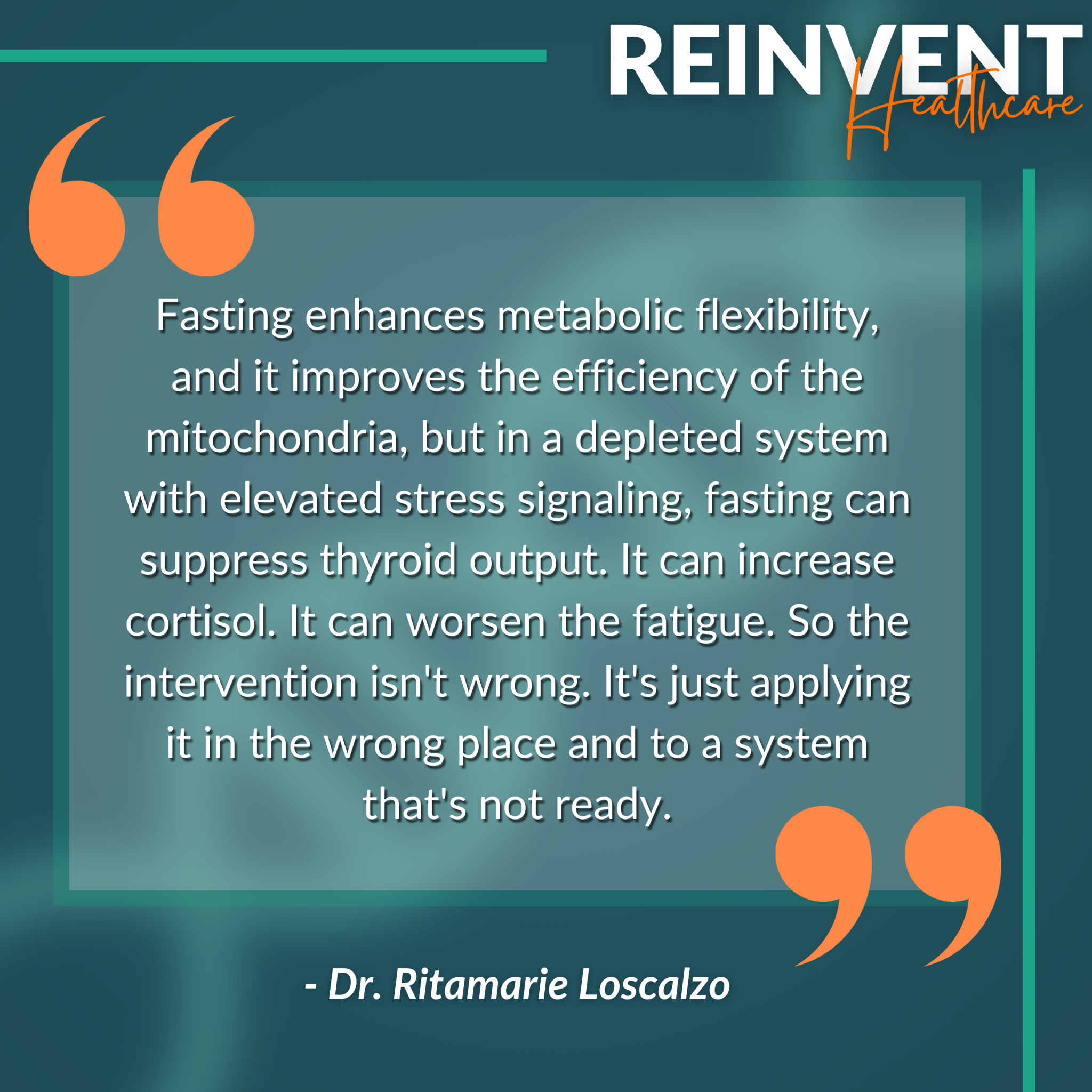
Fasting enhances metabolic flexibility, and it improves the efficiency of the mitochondria, but in a depleted system with elevated stress signaling, fasting can suppress thyroid output. It can increase cortisol. It can worsen the fatigue. So the intervention isn’t wrong. It’s just applying it in the wrong place and to a system that’s not ready. So sequencing matters, because readiness is hierarchical.
Safety precedes flexibility, regulation precedes optimization, responsiveness precedes performance, and if the autonomic nervous system is locked in sympathetic dominance, pushing aggressive metabolic strategies can increase strain.
If inflammatory burden is high, stimulating thyroid conversion can produce minimal clinical change. If nutrient reserves are depleted, restrictive protocols can deepen the stress physiology rather than restore balance.
Readiness determines tolerance, and tolerance determines outcome. So instead of asking what intervention matches this lab value, we start to ask things like, is this body metabolically ready for this intervention? It’s a different level of clinical reasoning. It shifts from chasing markers to restoring regulation. From layering protocols to building capacity, that’s what we really need to be doing.
When I talk to clients about this, when I say, “Look, no. It’s not a matter of what additional supplements to take.” I may be taking supplements away, right? I may be adding foods that they’ve previously thought they needed to remove, maybe changing things and giving them things that help them to regulate their system, help them to improve their stress response, improve the cortisol signaling, improve the functioning of the parasympathetic nervous system.
Once you restore functioning of the parasympathetic nervous system, then the healing can happen. If somebody stays in sympathetic dominance, and they’re not doing things to regulate their nervous system, and they’re worried about what supplements to take, and they’re worried about how this food is going to affect them, healing stalls.
So we need to shift our thinking from reacting to the labs and giving them a whole boatload of supplements to take to balance out deficiencies, to actually stabilizing their physiology first. Once you start thinking in terms of readiness, in terms of what this body can handle, the variability stops being surprising. The variability of the protocols working or not working, because it’s not random.
It’s just the physiology expressing its current state and letting you know what it’s ready for. A system that’s ready, it adapts. A system that’s chaotic resists the change. That brings this entire art together.
The macros are inputs, protocols are structured interventions, metabolic readiness determines outcome, and when we restore metabolic readiness, the body responds. When we ignore readiness, progress stalls. That’s systems-based healthcare.
And that’s what we need to be focusing on to help people truly heal and get well.
So those of us who refuse to reduce complex physiology to trends in macros and isolated lab markers, we’re the future of healthcare. This is where it’s going. And those of us who understand how the body is not broken, it’s adaptive, and it’s intelligent. When we can restore order to metabolic chaos, resilience follows.
Today we explored metabolic readiness, because the work we do is not about forcing results. It’s about restoring the system, so the body can respond the way it was designed to respond. This is the level of thinking that transforms practices and lives. It’s the work I’ve dedicated my career to, and it’s why I’m so committed to building a community of practitioners who think in systems and lead differently.
If you’re listening and thinking, that’s how I want to practice, then you belong here.
Go visit INEMethod.com and see how we train practitioners to restore metabolic readiness in even the most complex cases. And if this conversation resonated, head over to the show notes for additional tools and resources. Together, we’re reinventing healthcare.
Until next time, shine on.

Listen on your favorite podcast platform!





Share This Episode