Beyond Health Coaching: What It Really Takes to Help Complex Clients
What if your patient’s “normal labs” were hiding a serious disease? What if protocols were making them worse, and you didn’t know?
In this episode, Dr. Ritamarie Loscalzo sits down with functional nutrition experts and NEPT grads Steph Jackson and Jennifer Whitmire to challenge the shallow training and one-size-fits-all approaches flooding the health coaching industry.
You’ll hear raw stories of autoimmune recovery, near-missed diagnoses, and the tools practitioners need to truly help the clients that conventional medicine and standard health coaching fails.
This episode will change how you approach your role as a practitioner.
What’s Inside This Episode?
- Why most health coaching certifications miss the mark (and what real clinical depth looks like)
- The role of deep health histories, not just symptom lists
- The dangers of relying on single tests alone and the overlooked signs of disease
- How one practitioner uncovered colon cancer by refusing to accept “normal” labs
- Why gut health is the center of many illnesses and why personalization is everything
Resources and Links:
- Download our FREE Guide to Supporting a Healthy and Balanced Immune System
- Join the Next-Level Health Practitioner Facebook group here for free resources and community support
- Join the 3 Day 2025 Reinvent HealthCare Online Intensive [RHOI]
- Visit INEMethod.com for advanced health practitioner training and tools to elevate your clinical skills and grow your practice by getting life-changing results.
- Check out other podcast episodes here
Guest Resources and Links
Steph Jackson
Jennifer Whitmire
- Find Jennifer at www.wholsiticjen.com
- Join the Culinary Healing Circle
Guest Bio
If you are ready to go deep with your digestive health and you need more than slippery elm, you will enjoy working with Nutritional Endocrinology coach, Steph Jackson. Steph loves customizing balancing programs for the micro biome, working with fermented foods, and looking at how the body systems work together. After finding and clearing the root cause of her severe physical pain and exhaustion, Steph has gone on to help others to do the same. She is also the proud founder of Crave Conscious, a non-dairy yogurt company based in Vancouver, British Columbia.
Jennifer Whitmire
On a mission to save body parts, Jennifer Whitmire is a culinary coach, health educator, and master herbalist specializing in autoimmune and thyroid health. Since 2017, she’s taught women how to heal with food by restoring energy, balancing hormones, and repairing the gut through science-backed, whole food plant-based cooking and kitchen-based strategies.
Transcript
Dr Ritamarie
What is it that practitioners need to be focused on to truly help these people in need? Cases are complex these days. People are really suffering. And there's a lot of folks out there who are claiming to be practitioners, health practitioners, health coaches that maybe don't have as much training as they need to really help people with these complex cases. That's what this episode's about.
I am super, super excited today to have as guests, Jackson and Jennifer Whitmire. And a little bit about them, they are graduates of our nutritional endocrinology practitioner training. And they are both out there with passion and love and compassion to help people and with skills that can help people.
They don't just look at people and say, drink more greens and eat less gluten or whatever, which is great advice. But for most people, we need to do more and we need to learn more.
So what I want to do is have a conversation here, a really frank and honest conversation about what we need to be able to do and understand as health practitioners to truly help the people in need today.
I'm going to just state a rant. There are lots of health coaching schools out there, and a lot of these people are putting out programs that are substandard. Hey, join my 30 day program, and you'll become certified as a health and nutrition coach, and it's $97. I mean, I'm not judging it by its $97 price tag so much as what kind of quality can you be putting together to create something and as a health practitioner, somebody is going to just trust to help them with their most precious gift, their health. And they've had 30 days of training for $97, right?
Would you go to a brain surgeon who did a weekend workshop for $97? Not on my brain, right? Would you do that with a heart surgeon? Well, your health, your biochemistry, your nutrition, your life, all of these things are what cause you to be able to be healthy. And that's what we as health practitioners need to be focused on is how we can provide the best possible care.
We don't want the $97 brain surgeon. We don't want the $97 health coach. We want people who truly care, who truly are doing this because they care, but also have a deep understanding of how this body works.
Steph Jackson specializes in microbiome and the genetics related to the microbiome and how that all fits with the whole body and truly helps people to get to the heart of it. She healed herself from an autoimmune disease where she was laying on the couch in her twenties, right? It was my thirties, early thirties. She was laying on the couch and couldn't get up, and she was in a lot of pain. She was able to help herself, because nobody else was able to help her.
And Jennifer had an autoimmune disease. She didn't know it, but she's always been interested in health and nutrition. But the advice she was getting was like conventional medicine, eat your four food groups and eat lots of meat and lots of, you know, dairy and all this. And she wasn't well. And she found out she had an autoimmune thyroid condition. And unfortunately, before she learned better, she had her thyroid irradiated. So now she has to be relying on thyroid medication. But in spite of all that, she's turned her health around. And how did she do it? With the power of food, food as medicine, and with the power of lifestyle, of stress management. So she specializes in helping people with autoimmune diseases and to use food as medicine, to use food for breaking down inflammation. She's also an herbalist and all this.
So we are uniquely qualified, I think, to address this. I've been in practice 33 years as a functional health practitioner. Before the word functional health practitioner, functional medicine even existed. That's what I was doing. And focusing on food and lifestyle and attitude and all the other things that make it. So what do you need if you're a health practitioner listening or you want to be a health practitioner, you're helping yourself and you really want to get into this field, what do you need to know?
So what I want to do is I want to ask each of these wonderful practitioners, like what would they have needed or wanted from a practitioner when they were sick, like that they didn't get, that they now provide? So who wants to start?
Jennifer Whitmire (05:00)
Well, it was funny in the beginning when you said, would you go to a brain surgeon or a heart surgeon or something that only studied for 30 days or a weekend workshop or something? And I think that we don't take nutrition and food seriously. We don't realize how much that affects the body. And we think that, well, you always talk about personalized nutrition and personalizing it. And so something can be a fabulous food, very nutritious, but it could be harmful for you.
And so we want to make sure that we are learning about the different foods. So we're not just learning about, like I learned about the food groups, which I now had to unlearn, but we're learning about all these foods that, maybe they need to be prepared in a special way for you, right? My point is, we discount nutrition. We also need to know more about nutrition, not just about the food, we need to know how it affects the body, it's broken down, how it's absorbed, how we get the nutrients, it's not just what you're putting in your body, which Steph can tell you all about.
Dr Ritamarie (06:12)
And then there's the genetic factors, right? So you have to understand that somebody may not process vitamin D properly because of some genetic factors, and you're just showing a vitamin D deficiency even though they're taking plenty of vitamin D and medicine just discounts that, right? It's just like, oh, they're taking plenty of vitamin D. Why should they be having a D deficiency? Right.
Steph Jackson (06:30)
Or the advice is take this much or take that much, not how much are you absorbing? How much are you able to convert? And how are you? Right. Yeah. It just doesn't make any sense when you think about it.
It's so important for autoimmune and for gut health as well.
Dr Ritamarie (06:46)
And autoimmune, like both of these women had autoimmune diseases, and they were able to reverse them, right? And autoimmune diseases are considered a life sentence by Western medicine, right? You just have it, and you have it for the rest of your life. You can take various medications to slow down the process or decrease the inflammation, but that it's not able to be reversed. And we see it all the time in our practices and with personal experience.
That it can be reversed, and it can be, you know, maybe it is put in remission. I don't care about how the terminology you say is. Because some people say, well, it's not really gone. If you go back and do the same things that caused it, it's going to get reactivated. Sure. You have a weakness in your body that you're going to, but if you break your leg by falling down the stairs and then it heals, and then you fall down the stairs again and break your leg, you're not going to say that, the first time you really didn't heal it. No, it's just you went back and fell down the stairs again right? We do that with our bodies all the time.
So what do you wish you knew when you started, when you were laying on the couch, and you were told you have this autoimmune condition, and you're going to have it for the rest of your life. I'm like 30 years old. What the heck?
Steph Jackson (08:00)
I don't know. To be fair, I already sort of knew ,because I had been through other things health wise before, and I had even been to sort of the more natural practitioners that would say, you're sensitive to blah, just don't eat blah, and you'll be fine. And really that's not taking into account the complex communication system that our immune system really is. And so I knew that I had to do it myself. And the signs that I saw when I went to try to get help, because, you know, I was tired. I had a young child, and I wanted help, really.
I want someone to fix me. That'd be great. If someone could do the stuff for me, I would really like that. So the signs I saw are that I went to see an allergist, just like a prick test kind of style. I was like, maybe there's just something that I can avoid, and he said, well, you want it to be a food, because that would be easy to control. I was like, you think food is easy control? You jerk.
But also on his wall, he had, that's not the word I used at the time, but that's a nice word for this podcast. So then at the time he also had this little sign that he printed up from his computer and had stuck with sticky tape to his wall, and it was like crooked and faded. And it was from one of those old printers that had the dots on the side. And so it was just a janky sign. And it said, we are not responsible for any changes in symptoms that occur following your visit. And I was like, what? My doctor's not responsible for any change in the symptoms that occur following my visit. So I left there. OK, and then I went to my rheumatologist a few days later, and she was like, well, if you're not happy, you're going to be sick. And she was like, that's why I'm quitting this job. Okay, I received this message loud and clear, and I need to go do something myself.
Right, wow. That was the message. It's something only I can do.
Dr Ritamarie (10:10)
It's true, like I have this really cool poster. I should put a picture of it in the show notes. It‘s this cat sitting on the couch, and it's got the pizza box and the TV remote and all. And it says there's nothing the doctor can do that will overcome what the patient will not. Right?
It's really as health practitioners, it's our job to empower people to do the things. Our job is to help them identify the things that are out of balance, because they're not in a position to be able to do that. And we can, if we have the right training, and we have the right understanding, and we have the right compassion and heart set, right? Because we really have to care.
If they won't do it, if we say, you know, really we find that you're gluten intolerant, or you're dairy intolerant, or you're eating too much sugar, or you know the processed foods from the boxes with all that fat and processed fat is not good for you. You need to stop, and they say, “No. What else can I do?” I've gotten to the point, and you know after 33 years of doing this and saying I hear you, and I don't have anything in my magic box. I don't have a magic box. I don't have a magic wand that can say to you that you can defy the laws of nature, defy the rule of gravity, right? And still get well.
This is what I know. I don't have anything. So you'd be better off trying to find somebody who can find something else, because this is all I have. Right. And all I have is I have is an ability to teach someone and guide them step by step through a process to personalize what their body is missing. What their body is over-taxed with and what they need to do to fix it. Right.
But what they need to do to fix it, I'm not fixing them, but also I'm not going to say, well, this is this, this is the protocol. You followed the protocol. Hmm. Are you sure you followed the protocol? And well, I don't know what else to do. Right. Just follow the protocol longer.
Somebody said that. You just keep doing it longer, and it'll stick in. Well, it hurts. It means it's working. Oh, right. It hurts. It means it's working. If you're telling people, oh yeah, you're going to feel worse, before you feel better. Sometimes that's true as a body's eliminating toxins, but it's your job to find a way to make them comfortable through that process, so that they don't quit. We need them to see it through. But the other thing is I don't like the word protocols.
And my colleagues, they have a protocol and say, of course you have a protocol. You don't have a protocol? Each person is unique. So I can say there's a protocol for hot flashes. And if the protocol for hot flashes doesn't work for you, it doesn't mean that there's something wrong with the protocol. It means the protocol isn't the right protocol for you. It's a plan for each individual. And it's got to be a personalized plan. Right. And maybe 80% of the people will do better with this particular protocol, but you have to be able to help that other 20%, because most people can help the 80%. You’ve got to be able to help the 20%. That's the important piece, because those people are suffering. Nobody's given them their due diligence.
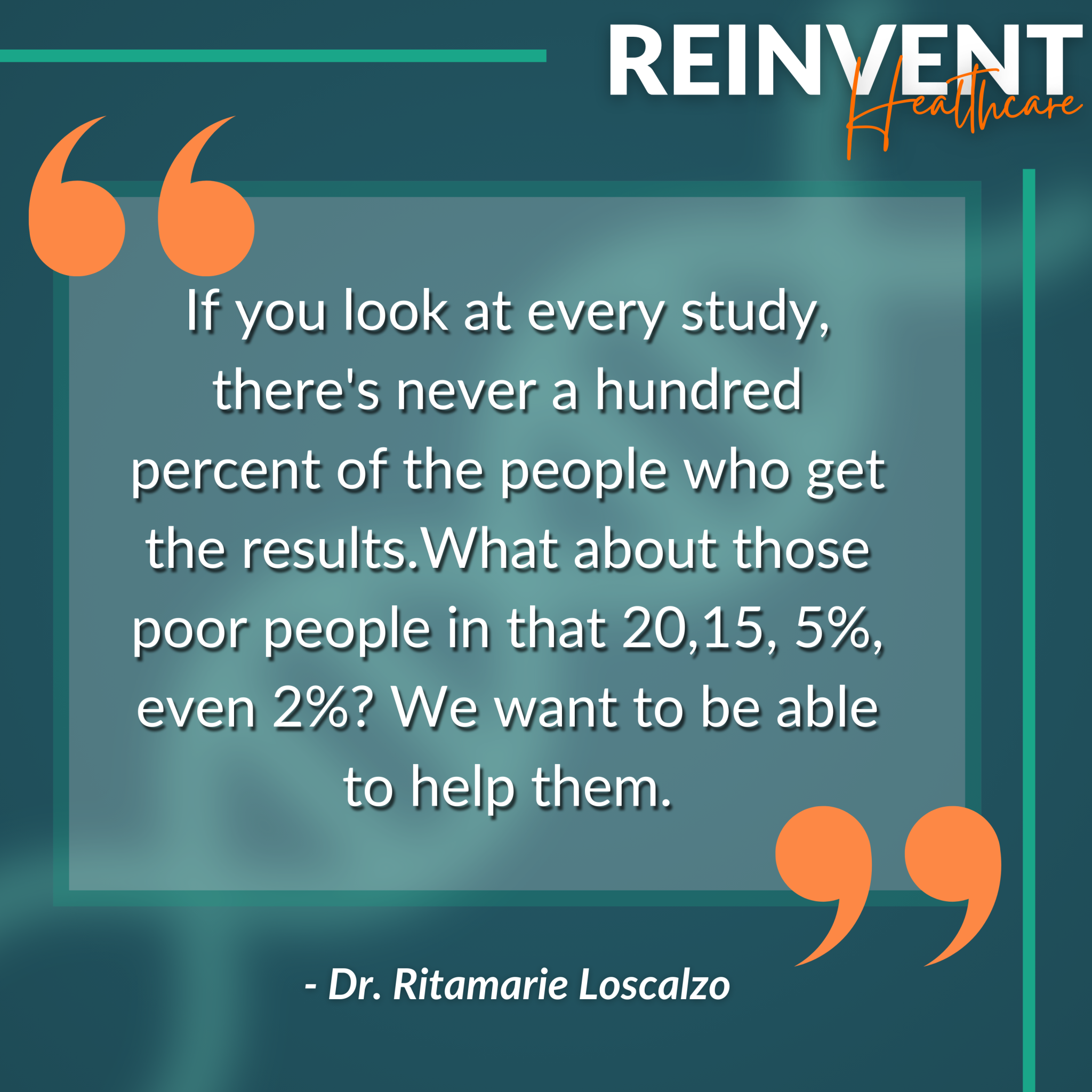
A lot of folks are relying on and even posting all over social media. There's a study that showed that if you look at every study, there's never a hundred percent of the people who get the results.
What about those poor people in that, whatever, 20, 15, 5% even, 2%? We want to be able to help them. And when you blanketly say, whole grains are great, and it keeps your blood sugar steady, and it helps your heart. Sure, maybe it does for 80% of the people, but how are you going to help that 20% where it doesn't, when you understand what's going on for them, right? And those are the things we need to do. So what are the tools you wish you had?
What are the tools you think practitioners need to have in order to help?
Steph Jackson (14:10)
That 80% they can kind of go online, do some searches, they can read their own studies, and they can go do those things, and they might start to feel better. What about that 20%? Right.
Jennifer Whitmire (14:20)
We have to dig in deeper like we were talking about before. We have to do that health history and really dig in and really go all the way back, because childhood, even before you were born. We had different things which is why we were all so unique. You came from very different beginnings and then were raised differently. And so it's really doing that very thorough health history of everything.
What's going on, what went on with your mouth when you were a child.
Dr Ritamarie (14:52)
And that's it. That's the connection. People aren't even looking. Now we're starting to look at it more, but the connection between cardiovascular disease and mouth health. And how many of you, like me, had a mouthful of fillings by the time you were 10 and root canals by the time you were 20. And nobody's really looking at that as a risk factor for autoimmune disease, cardiac disease, even brain dysfunction, right? We're not looking at that. We need to, right?
And is there a mold environment? Did you grow up in the Northwest where it's very wet and mold is predominating or Houston or Florida or wherever, right? And looking at that and no, I don't want to go on this bandwagon of everybody has mold disease, or everybody has Lyme and that's the answer. No, it's going through and doing that thorough history.
I remember doing a class, it was a five day challenge. And I was teaching practitioners how to really dig into history, and I was like, one of the questions which we all should be asking is when was the last time you really felt well? And for some people they'll say, when I was 23, and it happened. And you can find an answer, like a reason.
For others, they'll say, I don't remember ever feeling well. I was a miserably sick kid. So that's where you're digging. And one person who was doing this, I remember her specifically came back, and she did the tests, like I gave them homework, and she did this thing with her husband, and her husband went back, and they figured out what was going on, and why some of his problems had emerged. Right? She went back and he finally said to her, Okay, you know this health stuff you're doing, I'm ready for you to help me.
So we have to have people feel comfortable with you. Right. But you have to, when you ask the questions, I hear this all the time. People say to me, nobody ever asked me that question before. Yeah. What a great question. And then we unlock prior sexual abuse, abandonment issues, or deaths in the family that everybody else glossed over, that they lost their parents, and then they lost a grandmother, and then their body just shut down. Right? So health history is a really important one. Right. What else?
Steph Jackson (17:04)
Well, testing, I hesitate to say testing, because it's such a chasm that we might fall into here, but testing, and retesting, right? Like protocol, do something and then test it. and see how it did, or how much it worked, or just try to take a more logical approach.
Jennifer Whitmire (17:25)
Or even digging in deeper. Like it's one thing to understand some different factors on somebody's blood tests but understanding how they all work together.
I can't just look at one lab, which is what I used to do when I was trying to self take care of myself. You know, I would do piece by piece. This one thing is out of range and then just try to fix that one. Instead of understanding that they're all in there.
Dr Ritamarie (17:57)
Okay. So you told me a story recently about a guy who you started digging into the history in the labs. Tell us about that one.
Steph Jackson (18:07)
He was the first client that I worked with, and it was I think our second meeting and we were going over I think three of his labs, one of which he had just had done. And I was looking at some of his iron markers, not were they within range, because the only thing that was out of range was his hemoglobin, and his blood iron levels were low.
And they had been getting low. I should see anemia. He's like, well, that's what he said. He's like, well, I really want help with this anemia. And I looked at that among some of his other markers. It was just just a CBC or Canadian CBC, which is okay. Can I say piss poor? That's my word. So it's like two thirds of one page. It's so limited. Looking at those markers and listening to him talk, I said maybe it would be good for you to go do a screening for colon cancer.
And it turned out that he did have stage three colon cancer. And he goes every two weeks to the doctor, and they missed it. Having all these tests, and they were like, you're getting anemic. It’s just they were looking at that one thing. one thing.
Dr Ritamarie (19:17)
And your questions in addition to that.
Steph Jackson (19:21)
So I knew the pattern too, right? Of the ferritin getting higher and there's some more and more inflammation and then there were some gut things. Yeah, I'm asking questions.
Dr Ritamarie (19:31)
You're asking questions, right?. The power of questions. You cannot underestimate the power of questions.
The kind of medical model we have gotten to is the short visits. I know in the UK, one of our graduates was a doctor in the UK for 20 years, before she came and studied functional nutrition and nutritional endocrinology with us. And for her, it was nine minute visits. Literally nine minutes, and they were timed. And she had her hand slapped quite a number of times for her visits going over.
How do you really connect with the person, make them feel safe, because safety is a critical component of healing, and then find out what's really going on, and then help them, give them some action steps, right? How do you do that in nine minutes?
Steph Jackson (20:18
Well, I don't. I'm so sorry. I don't think that's the goal. Especially when you're only supposed to address one issue at a time. Like what's your one issue? Right. That's not a thing. Right. So you can come and say, I have a runny nose.
Dr Ritamarie (20:38)
Well, why do you have a runny nose? Right. You always have to ask why and keep digging to why. Well, why is that?
And why is that? Until you get to the basement. Yes. Right? Just keep asking why. Why? Until there's something that can't have any more variables.So that causes this. And that's how you get to the cause.
I know root causes are overused these days, but there's no one root cause now, ever. It's usually multiple root causes. The root causes may be gone right now, but the symptoms and the damage that was done internally from those root causes can still exist. So that's what our goal is to find out what those root causes are, make sure that whatever those conditions are that led to that are gone, and then work out damage control.
What's out of balance that we can help them put back in balance? And it's a matter of synergy, a relationship between practitioner and client or patient, however you call it, whatever your licensure is.
You're making some suggestions. They're telling you yes or no, why they can't. If the why they can't is usually excuses or whatever, then your goal is to really coach them, and be there and encourage them to do the best things. And then if they say, I'm going to do that, it's to help them with how, and be very encouraging when they do it. Yay, we did it. And celebrate the wins.
So there's a lot of little nuances here that I'm sorry, but I don't think you can learn in a 30 day $97 health coach certificate.
Steph Jackson (22:12)
I really don't think so. I mean, even in four year programs, they're still doing what I like to call root cause mistakes, right? Where they think there is a root cause first of all, right? And that if you take that out, that it's fixed, right? Kill the bug. Even with, yeah, like get rid of this bacteria in your small intestine, and that'll be fine, or get rid of this, whatever. And there's some kind of signaling even immune system wise, it just will continue.
Yes. Unless the pattern changes. Right. Not you take out gluten, and you're healed. There's a lot more than that. And there's a lot of that.
Dr Ritamarie (22:50)
And, we do see miraculous results sometimes when people take out gluten or dairy or sugar, whatever, you take out those pieces and sometimes we don't, but it depends on how many thorns are in the foot.
So Dr. Bredesen talks about Alzheimer's like the fault of medicine is looking for the cause and the cure. And they try this medication and that medication, and none of the medications work, because he said there's 37 holes in the roof. And if you just try to fix one, there's still going to be rain coming through. And that's what happens when I try to address one cause of a very complex situation.
And so I don't want to discourage you from your role as a health practitioner or making it, oh, that's too hard. I don't want to do it. But yeah, it is hard. And yeah, you need to understand this, all of these pieces, and to be good at connecting with people. That's a big fault in Western medicine. A lot of times people say, well, I go to the doctor, and they dismiss you.
My husband had that situation with this Achilles thing. And he was wanting to go deeper. Like it's still there, and the doctor is like, it's just an Achilles tendonitis, just go do physical therapy. And he felt so discounted. And he's like, are you sure it's not something? I read about this particular type of tumor or this particular kind of thing? I want to know, are you going to do some imaging on it? It's just an Achilles sprain. Right? And he felt the bedside manner was missing. He was like, I'm just trying to figure it out. I don't want something to bite me in the butt in a couple of years and find out that I've been treating it as an Achilles tendonitis and it's really a tumor that we could have caught early, you know?
So those are the sorts of things. We have to listen to people, listening and questioning, listening and questioning, and making them feel honored with their symptoms.
Steph Jackson (24:37)
And if it's on brand too, instead of treating things as if there's something that happened to the person, empowering the person to change the patterns that are happening every day in their body.
So instead of like, this all happened, because you were exposed to H. pylori on your vacation or whatever. It's still there, still with the root cause. There's still a little bit of it.
It happened to me. It's a little, I don't want to say victim, because that's not what I mean, but it's really disempowering. It's disempowering. This thing happened, and it made all these things happen. Bad things happen to me instead of what is my body doing right now? How can I work with it to be as healthy as I can be?
And that takes internship, that takes practice, that takes learning.
Dr Ritamarie (25:22)
It's not something you'd learn in a 30 day health coaching program for $97. I mean, I wish it was easy. If it was easy, there'd be a lot more people feeling a lot better, but it's not. It's really a complex relationship that you have to be able to develop with the person, with them, with their emotions, and be able to understand that all of that factors in. And how are you going to help and be the one?
People call me a miracle worker, and I always say, no, I'm not a miracle worker. Your body is a miracle worker. I'm just here to facilitate that miracle that's in you and empower you to get in touch with it and do the actions you need to do.
Steph Jackson (25:57)
It's the only thing that ever heals. Right. The band-aid's not fixing.
Dr Ritamarie (26:06)
The band-aid didn't fix the cut, right? The cast did not heal the arm that's broken. It's the healing. It's just the band-aid or the cast or whatever just keeps us from further injuring it.
Right? The body can heal itself. Right. Yes. And if you take out a tumor, sure, the tumor isn't there, but what about the cause of why you developed that tumor? You didn't fix that if you just took out the tumor. There's a lot more to do. Yes. Sometimes you need surgery, and you need to take out the tumor or you need chemotherapy or whatever you need for a life-saving situation, but what are you going to do to prevent it?
Dr. Lodi says, stop making cancer. What do you do to teach your body to stop making cancer? Because it's just going to come back. We know that. We know that if you just deal with it, it comes back. What? 98% of the case? I don't know the numbers exactly. I'd have to look those up. But in a large percentage of the cases, you just remove the thing, and it comes back, because you didn't remove the underlying cause. Or the environment. Or the environment that made it happen, that made it easy.
So let's talk about autoimmune disease a little bit.
Jennifer Whitmire (27:15)
Well, in a lot of cases, like I had my thyroid irradiated, but a lot of my clients, they have their thymus removed. Right. And so we have a lot of immune system things there. And so that doesn't reverse your autoimmune disease. That doesn't take the autoimmune disease away. It's just removing whatever's being targeted at the time. And so it doesn't stop any inflammation. It really doesn't get down to the reason. It wasn't because all of a sudden the thymus was out of control or the thyroid was out of control. It's something else that created the situation to begin with.
Dr Ritamarie (27:51)
So what do you think would be different now if you knew then what you know now? What would have happened differently?
Jennifer Whitmire (28:00)
I totally would have changed what I was eating. And I would have… Well, I don't know if I would have at the time, hopefully I would have tuned into meditation and things like that. All the different pillars, your freedom pillars. I would have known to go through those. And really hone in on what, where am I missing something? We're missing pieces. Right.
Dr Ritamarie (28:27)
Do you think you could have avoided it? I mean, we can't. Do you think you could have?
Jennifer Whitmire (28:31)
I think I could have avoided it.
Dr Ritamarie (28:32)
I mean, we've seen a lot of autoimmune diseases reverse themselves when you hit it early enough, right? You can't do it after 30 years of having your thyroid antibodies killing your thyroid. Maybe it's too late.
Jennifer Whitmire (28:42)
Yeah. And it just switches you from one autoimmune disease to another autoimmune disease.
Dr Ritamarie (28:47)
And that's a really good thing to remember as a practitioner. Somebody comes in with one autoimmune disease, they've been diagnosed. Likely there are two or three others that are either brewing and are going to manifest and be diagnosable shortly if they don't change what caused the first one.
Or that they're already there. They just haven't been tested for it, they're not symptomatic yet.
What I see sometimes is I see people, I do thyroid antibodies on everybody, thorough full thyroid panel, not just TSH, because where they got that idea that TSH was the epitome of it. TSH is a hormone, as you should know, It is produced in the pituitary, and it stimulates the thyroid, thyroid stimulating hormone. And if the thyroid's not responding properly and producing enough thyroid hormone, it goes up and up and up and up and up, because it's like, we need to make it. But that's all that Western medicine looks at.
Sometimes the TSH doesn't go up or down. yet the thyroid hormones themselves are out of balance. Or a couple of things, and this is just a little tidbit clinically that you should know about thyroid is that a lot of folks have difficulty converting T4 to T3 inactive to active, mostly active form of the thyroid. What's the cause of that?
Stress and cortisol elevations and lack of certain nutrients and all that. But also the thing that they're missing is the receptor resistance. Like every cell in the body needs to be able to say, thyroid hormone, let me take that. And if it can't because of receptor resistance, and there's a bunch of things that go into that, we teach it in our third classes, but there people aren't looking at that. And that's kind of an occult cause. Because there's no test for it. Let's do the test for thyroid resistance. There is none. Right? It's like we did all this, we did all this. And yet they're still showing signs of thyroid being low. Your blood can be perfectly fine. Right? But your body is going, I don't have enough thyroid hormone.
Those are all the things that as a practitioner, you need to be able to be astute about and be able to look at. And that goes back to you saying the testing, the right testing, not just like I tested TSH, and it was fine.
I've seen a lot of people who we test the thyroid antibodies, and they don't show signs of thyroid imbalance, but their antibodies are elevated. That's a great time to catch them. Right.
Steph Jackson (31:14)
TSH is, again in Canada, one of these, it's the only thing we can get. And like it's a zinc dependent feedback loop. So the pituitary won't really know if we have enough active thyroid hormone without zinc. And how many of us are deficient or have the most common deficiency. So should we just supplement with zinc? No, thank you. We need to do better testing. I'm like, yes. Right.
Dr Ritamarie (31:40)
Do better testing. Right. So you're hearing this. You may be hearing this and thinking, well, you know, I'm a medical doctor, and I never learned this stuff in medical school. Right. That's the problem. Right. We have a medical education that is very pharmaceutical oriented, right? And if there's a medication for it, we're going to diagnose it, right?
And I'll give you an example, lipoprotein (a). It's just now becoming on the market where people are going, I've got to get that tested. Why? Because the drug companies are this close to releasing a drug to lower it.
But up till now, they didn't even have a drug. We're all just getting smarter. No, we're not. They're just talking about it more, because there's a drug that's on the market, on the horizon. It's in clinical trials right now. And once that's there, everybody's going to want to test Lp(a), because we can treat it. We test for things in Western medicine that we can treat, that we have a drug or a surgical procedure or some kind of procedure to treat it. As a functional practitioners, we look for imbalances in the body and though some of those imbalances are going to indicate imbalances now, that could be diseases later. And I always say to people, do you want to get knowledge about something going on in your body that's already a disease or do you want to find out that there's some imbalances that could be leading to a disease further down the road?
Everybody without fail says, of course I want to know beforehand, I don't want to have a disease that has to be treated. Right. Yeah. Right. So those are the things.
So if you could give our listening audience advice, whether you're a medical doctor, a nurse, a health coach, an osteopath, a chiropractor, a naturopath, we have podiatrists, I'm thinking of all the different practitioners that come and do our programs with us, herbalists, chef, culinary whole foods chef, whatever your background is, I take it that you got into this profession, and you're listening to podcasts, because you want to be the best you can. And you really want to help people, and you're feeling like some of the tools you have in your toolbox are not quite adequate.
So what could you say to folks that are in that situation and are listening?
Jennifer Whitmire (34:02)
Recognize that every person that you see is a completely different person than the one you saw before. They may have the same symptoms, but it could be a completely different case. And so it really is digging into the history and looking at them as an individual.
What'd you say?
Steph Jackson (34:19)
I would say help people to learn about their own body one step at a time. Right. And yeah, there is no one root cause.
Dr Ritamarie (34:31)
There's no one root cause.
Right. And there's no one magic supplement. And I will say, most people out there, what they really want, is education. They're going to blogs, they're going to podcasts, they're going to summits, and they're getting confused, because everybody has a slightly different plan, and everybody has the answer. Right.
If people are telling you they have the answer, turn away. Everybody needs…, as soon as someone says needs, that Everybody needs this supplement, or this powder, or this detox. Everybody needs to go through this particular type of detox program. Or we all need to eat broccoli. And I think it's a great food. But some people right now do not have the mechanisms to break down broccoli. Maybe they're oxalate sensitive and maybe they're, I don't know if it's FOD MAPs or nightshade sensitive. Or I don't know, whatever. They might have problems in their body with really utilizing that food. And we can't just tell everybody that that's the food for them. We have to go through. And I personally think we should be looking at why they don't tolerate that particular food, and how we can help them to rebuild so that they can. But temporarily avoiding foods that you're sensitive to, we're big on. Do an elimination diet, figure it out, heal the gut.
The last thing I wanted to say, I know we could talk for hours. We could be here for hours with you guys, but we're going to cut it shorter. What's the role of the gut in inflammation and autoimmune disease? Coming back full circle, so you both started out with autoimmune disease that got you interested in this line of questioning. What would you say? What's the role of the gut?
Steph Jackson (36:10)
I would say the gut is the communication center for where we take food from the outside world and bring it into our bodies. And our immune system and the bacteria and the post-biotics, the things that live in there, and the foods that we bring in, it's all chemical signaling between our immune system and those things via the bacteria or the food. And this helps us to know whether we're safe, whether we must up-regulate or down-regulate certain inflammatory signaling. And yeah, whether we're building or whatever we're doing with our gut lining.
It is really, really important to think about what we're putting in our bodies and maybe to move a little bit away from our defense system protecting us against bad things that happen to us and more toward optimizing the digestive environment for health. It's doing its job.
Dr Ritamarie (37:05)
Your immune system is doing its job in autoimmune disease. You just have to figure out what it's fighting against. Right. What's going wrong? And what’s going on?
What would you say?
Jennifer Whitmire (37:12)
Well, with autoimmune, I immediately think of a leaky gut. I don't know if it's a hundred percent or not, but we need to look at the gut and need to ask about bowel habits. Just in our investigating, and we get down and dirty. Get down and dirty. Yeah. We need to find out what's going on, right? Because if we do have damage in the gut, then we're not absorbing the nutrients. And I can be giving someone all the supplements in the world, and they're not helping their body at all.
Dr Ritamarie (37:40)
And so it's a key place to start. And a lot of people don't, right?
If somebody goes to a conventional MD, and they get a diagnosis of lupus, what are they doing? They're looking at anti-inflammatory medication, right? They're not looking at what's going on in your gut, right? There's a process. I have a framework for going through all the things that need to be balanced to help somebody with an autoimmune disease. And it starts with the gut, the stress, external stressors, physical stressors and mental emotional stressors.
Right? What's going on with that? How's the blood sugar? Right? How's the thyroid functioning? All of this stuff needs to be looked at. So it's a thorough investigation, not just to what do I do for hot flashes? What do I do for autoimmune? There's no one protocol for the condition. It's a plan that you put together for the person.
There’s so much we could talk about, but let's just end with one word of advice,
that you would give a practitioner who's either in medicine, trying to bridge the gap and do things more holistically, functionally, or a health coach who's been trained in a pretty narrow range of stuff. What would you say?
Jennifer Whitmire (38:54)
Keep asking why. Keep asking why.
Steph Jackson (38:57)
Yeah, mine was listen.
Dr Ritamarie (39:00)
If it's one word, let's do it. Ask why and listen. Right.
So those go together, right? You're asking why, then you have to listen. The way that Steph listens to this guy with colon cancer. He had seen all these doctors, and nobody picked it up, and he did turn out to have colon cancer.
So also trust your instincts. Trust your instincts.
I'm dedicated to helping change this paradigm of medicine, right? To make it so that everybody out there, everybody who's a health practitioner of some sort is out there looking for root causes and helping each person and empowering each person to go beyond that, and to make changes in their diet, lifestyle, attitudes, everything, habits, so that they can be the best version of themselves.
So just a shameless plug, both of these people are graduates of our Nutritional Endocrinology Institute, so you're welcome to go out and check that out. And the show notes will have more resources. Check out the work that they're doing, because they have some amazing resources to offer people between the Culinary Healing Circle and The Friendly Flora Collective. It’s her microbiome membership, where people learn how to actually get their flora, their gut microbiomes, back in balance using delicious foods.
So thank you for your being here. Take your job seriously as practitioners, because we're focused on looking for root causes and finding functional imbalances. We're the future of health care and know that and until next time, shine on.

Listen on your favorite podcast platform!





Share This Episode