The Neuro-Spicy Brain: Autism, Sensory Overload, and the Genetics Behind It
Why do some people experience sound, light, stress, and even social interactions so differently?
In this episode of ReInvent Healthcare, Dr. Ritamarie sits down with functional practitioner Dr. Sam Shay to explore what he calls the “neuro-spicy brain.” They unpack how genetics, sensory processing, and nervous system signaling shape the way neurodivergent individuals experience the world.
You’ll hear why many neurodivergent people are misunderstood in clinical settings, how sensory overload can drive chronic stress and health challenges, and what practitioners can do differently to create safer, more effective care.
This conversation offers a fresh lens on neurodiversity, communication, and the biology behind why some brains respond to the world in profoundly different ways.
What’s Inside This Episode?
- The question most practitioners never ask when someone feels constantly overwhelmed by everyday stimuli
- Why some brains experience sound, light, stress, and social environments so intensely
- What “neuro-spicy” really means and how genetics shape sensory processing
- Why neurodiverse people are frequently misunderstood in healthcare
- The clues that a patient or client may be experiencing sensory overload
- How practitioners can shift communication and care to better support neurodivergent patients
Resources and Links:
- Download the transcript here
- Download our FREE Metabolic Health Guide here.
- Join the Next-Level Health Practitioner Facebook group here for free resources and community support
- Visit INEMethod.com for advanced health practitioner training and tools to elevate your clinical skills and grow your practice by getting life-changing results.
- Check out other podcast episodes here
Guest Resources and Links
- Guest Resources and Links
Visit Dr. Sam Shay’s websites here: www.FitgenesUSA.com and
www.DrSamShay.com - Connect with Dr. Sam on social media:
Facebook
Instagram
YouTube - Access Dr. Sam’s gift and practitioner genetics resources here
Guest Bio
Dr. Sam Shay, DC, IFMCP is a functional medicine expert, speaker, and stand-up comic who helps practitioners unlock their client's ideal diet, reduce inflammation, and reclaim energy through simple genetic testing.
Dr. Sam Shay started www.FitgenesUSA.com to help licensed practitioners and certified health professionals integrate powerful functional genetics to improve their practice outcomes.
Dr. Sam’s mission is to make personalized genetic testing easy, effective, and actionable. He’s known for making cutting-edge science relatable and actionable, giving practitioners and their clients the tools to turn DNA into a blueprint for better health.
Whether supporting exhausted parents, health-conscious professionals, or individuals seeking sustainable transformation, Dr. Sam makes cutting-edge science feel human, hopeful, and empowering. Featured on over 200 podcasts and summits, he delivers each conversation with insight, warmth, and a dose of sharp humor—helping audiences turn their genetic blueprint into a roadmap for thriving.
Transcript
Dr Ritamarie
In our functional medicine practices, are we concerned about being politically correct, about using the right terminology with certain sections of the population or with people in general? And I think that that's a question that we're going to explore today, a little bit different than usual.
I'm really excited to be sharing with you a guest today, and a topic that I don't usually explore, on this podcast. And that's about the spectrum, and working with clients and patients that are on the spectrum, and being able to identify them, and to be able to make them feel comfortable, and for you to feel like you understand that there's some behaviors and ways that you can use, that's going to make them feel more comfortable in getting their problems solved.
Today I have a special guest, Dr. Sam Shay. Let me tell you a little bit about him and then we'll jump right in. So let me get this going.
Dr. Sam Shay is a functional medicine expert, a speaker, and a standup comic. When was the last time I had a standup comic on the show? And he helps practitioners unlock their clients' ideal diet, reduce inflammation, and reclaim energy through simple genetic testing. He started out with Fitness USA to help licensed practitioners and certified health professionals integrate powerful functional genetics to improve their practice outcomes, and we are going to touch on genetics today, but we have a bigger mission today.
His mission is to help to make genetics testing easier. He's known for making cutting-edge science relatable and actionable, giving practitioners and their clients the tools to turn DNA into a blueprint for better health. And those of you who've been listening to my podcast and watching YouTube for a while know I'm passionate about genetics.
What we're here to talk about today is not just about genetics, but it's going to be specific genetics. And I want to talk about the genetics of some of the quote unquote neurodivergent activities that we see, or the neurodivergent behaviors that we see, and where those genetics come from, but better and more important, how do we make people feel comfortable by helping to communicate with them in a way that helps us both be successful.
So he's really a standup comic, which I think is amazing. I've watched a bunch of his videos, and it just really helps to take complicated science and make it into understandable language and to make you laugh about it. So welcome Dr. Sam Shay. Nice to have you here.
DrSamShay.com (03:16)
Thank you. It's great to be here. Thank you.
Dr Ritamarie (03:19)
I would like to start with the languaging, because there's so much talk these days about being politically correct and talking about, or with, certain people, populations, being right. And I used the term neurodivergent earlier, and you said, that's not technically politically correct.
DrSamShay.com (03:42)
It's not. It's more like it's not that neurodivergent isn’t the appropriate term. It's just, personally, I find it offensive. And the sense is that some people listening to this is like, come on. It's just what it is. That's what it's called. The reality is that we have to balance accuracy with dignity. And I'll give you an example of someone.
The terms are neuro-typical for normative brain structures and then neurodivergent for those like me that have diagnosed Asperger's syndrome. Even that's now on the outs, because it's been renamed ASD, mild ASD, autism spectrum disorder. And it just becomes this giant word salad. I want the two variables. We want to balance accuracy and dignity. That's really what nomenclature is about. Can we balance those two?
And we go too far on accuracy at the expense of dignity, it's insulting, degrading, dehumanizing. If we go too far on the dignity at the expense of accuracy, it becomes confusing, vague, or possibly enabling. If someone is an addict, and we rename, like a genuine addict in the sense that they are just destructive to themselves and others in the name of their vice, and they can't stop. And we just kind of soften it to some sort of vague little thing, like they're just enthusiastic about their hobby. That is enabling. It's enabling, and it's counterproductive. And so we have to balance these two.
So we have several terms thrown out there. And I'll give you an example. My comedy show, which I did a one hour show. It's available for free on YouTube, because I do advocacy for those on the spectrum using comedy for my first show, and it's called, Neuro Spicy, Love Life, and Comedy on the Spectrum.
Neuro Spicy is a word that many people who are in the neurodiverse community really have embraced, because it's endearing, it's fun, it could be a little flirty. Like it's intriguing, it's engaging. It's an invitation to learn about that person and also giving some breathing space for that person to express their neuro spiciness as opposed to neurodivergent, which the term divergent has a negative valence to it.
Neurotypical has a positive valence. Well, the opposite is neuro-atypical or neurodivergent, which feels uncomfortable, which feels insulting. And I would prefer things like neuro-spicy, neuro-distinct as two different variables. Even the term, and I address this in the show, the term Asperger's syndrome has fallen out of favor simply because of the problematic proposed allegiances of Dr. Asperger who identified Asperger syndrome in the 1940s. They were replaced, they've subsumed it in the DSM, as ASD, autism spectrum disorder.
Now, personally, I find the term disorder offensive. I'm not disordered in my opinion. In fact, I have highly ordered thinking, in my opinion. It's kind of a cultural meme.
Then when you look at very popular individuals, very highly recognizable pop culture individuals, such as Spock or Data, literally a cyborg, they're both depicting people who have Asperger's syndrome, and they're highly ordered in their thinking, and yet they're called a disorder. It's just problematic as in attaching a negative valence to someone's brain makeup that they have not a huge amount of control over, because there's many, many, many, many proposed mechanisms as to what is causal or contributing to someone having a different brain neuro type. It's just problematic.
So, what I'm proposing is that people look at the term neuro distinct, neuro spicy,
as possible alternatives to neurodivergent. I don't have a problem with neurodiverse. I have a problem with neurodivergent. I know it's kind of a subtlety, but it's there.
Dr Ritamarie (08:25)
Yes, it is, but it's important to note that. It's a tiny little shift in the word, but the meaning is really different. Divergent versus diverse.
DrSamShay.com (08:32)
I mean, we already know we're on the outside. We don't need to be reminded of how different we are from everyone else. It's unnecessary.
Dr Ritamarie (08:42)
Right. When you say those two words, I never thought about this before, but divergent means you're going away from maybe the center line or whatever that norm is. But diverse is just let's have a diverse group of people, a diverse set of ideas. Diverse has a more positive connotation. I like that.
And so I wanted to get back to if I heard you and I would meet you in public and not know that you're neurodiverse, neuro spicy, whatever you want to call it. But how do we, as practitioners, right? We're in the office, people come in, how are we able to distinguish them? Why is it important? Another question to distinguish.
DrSamShay.com (09:32)
Sure. The people who have been around a lot of neurodiverse individuals, they would pick it up that I'm on the spectrum. Most others won't, because I'm in my mid 40s, and I have studied human behavior like an anthropologist which is a sign of someone who's on the spectrum, because they have to study. They're basically looking at the world like it's a reverse zoo. Like we're trapped in these bars, and we're having to observe all the other people around us to figure out what's going on, because, you want to think of neurodiversity as like the pie and neuro distinction is the slice of the pie that an individual occupies. From my particular slice of the pie, I wasn't really born with social software. So I had to build social software from the ground up, from first principles.
I watched sitcoms as a child for years and had to learn about human behavior through television. Now that didn't always work out, because you're trying to understand, trying to learn about family dynamics and human behavior, from Married with Children and trying to learn psychology from Beavis and Butthead. So not all shows were a great example. Things like Full House was a great example.
I really loved watching Carl Winslow and Urkel in that particular sitcom, because Urkel was on the spectrum, and there was a hilarious, yet functional, loving family that ran into problems and resolved them. And I really glued on to that show, because I didn't, back then, it was just the term nerd.
The term ASD, or Asperger's, wasn't really in circles. It wasn’t more publicly acknowledged until really the 90s when it started to come out and especially when the DSM acknowledged it. I think it was 93 when it was officially invoked into it. I'd have to go back and check my dates there.
But what are you looking for as a clinician? One is kind of more of a monotone, or flat affects, the term is called prosody. And I have less prosody issues than other people on the spectrum for two reasons. One, I have a lot of singing background, lots of singing training, lots of singing in my life in the past. And, also, I'm a standup comic, which means I've gone through a lot of vocal training and learning how to vary my tone and modulations and all the rest of it.
When you look at someone like Spock and Data, those are two very, very easy to grok individuals in popular culture, particularly for clinicians who are over the age of 35. And especially over the age of 40, hopefully those two figures are still in their consciousness. They're like Data. “No, sir.” It's kind of a staccato speech. There's not a lot of variation.
Well, if you look at AI, and you look at how it responds, hi, happy to help. Let me give you a 37 bullet point list of all the things you asked about, because I'm super helpful and super organized, and I have tons of information, and I love sharing. Who programmed AI? Bunch of nerds, people on the spectrum.
Dr Ritamarie (13:03)
It totally makes sense.
DrSamShay.com (13:07)
It's externalized Asperger's. That's what AI is. So when you're looking at that, how do you recognize it?
First off, there's a wonderful book, at least with Asperger's called The Complete Guide to Asperger's Syndrome by Dr. Tony Atwood. And he wrote the book, and I listened to it, and it's kind of eerie to have someone read back blueprint of your entire life and affect back to you when this person's never met you. It's very uncanny.
So a couple of things. One, special interests that you'll notice that an individual is really fixated and super niche and super brilliant in like three, maybe five things. And that's all they want to talk about. They will overshare massively, and they're not trying to be rude.
They're excited about the thing, and/or they're socially awkward. So they want to feel like they have some sort of agency and value in a social situation. So they're sharing about the thing that they're genuinely good at. Now it can come off as awkward, didn't read the room, arrogant, insufferable, whatever it is. And those things may have some truth to it.
There is this dance between society at large becoming more welcoming, accepting, and more open to people on the spectrum. And it's also people on the spectrum to live in the world they're born into and learn how to navigate and adapt as best they can while not erasing themselves, living under a permanent mask. The term masking is a huge word within the spectrum community, which is basically living inauthentically just to blend in or a chameleoning. And I do not recommend that people on the spectrum just mask up, so they can adapt and navigate. You should have the ability to mask. That should be a choice. You should know, for example, it's like martial arts.
I trained a lot in martial arts. I don't walk around knocking people out simply because I can. It's a skillset that I have. If needed, I could summon it at a moment's notice. So it's the same thing.
I also have found that in certain communities and situations, it's appropriate to mask. Try walking through airport security completely unfiltered. See how that goes, right? And that's true of anybody, regardless, if you're on the spectrum. So there's times where it's appropriate to mask up, but if it becomes crushing, oppressive, or you're numbing out, or you're losing yourself, then that becomes problematic.
You've got people on the spectrum, they have interesting sensory overwhelms. For me, on my comedy special, again, titled Neuro Spicy, Love Life, and Comedy on the Spectrum, it's free on YouTube, I have three minutes of my show out of a 60 minute show, going to say the most aspy thing ever. That's 5% of my show.
The three minutes of my show is just devoted to sound sensitivity and just how invisibly oppressive this thing is. I can't go to most music events. I can't be in loud restaurants. Someone clattering silverware. It's like I have a full on shock pain response.
Being around small children is incredibly stressful, because their voices, the pitch is so piercing. It's like having a kidney stone go off in my skull. And the thing is it's invisible. There's no blood leaking out of my ears. There's no black eye. There's no visible wound, and people view sound sense, that they just brush it off. It's like, sorry. And they don't realize just how unbelievably painful that was.
And, also, I'm developing hearing damage. So I have the worst of both worlds. It's like I can't be around a lot of sound. And I'm also losing my hearing, because the sound is so piercing that it's damaging my ears. And I went to a medical audiologist, and she diagnosed me with having a 40 decibel handicap at higher pitches, 20 decibels at lower pitches, which means that she described that most people experience physical pain from sound when it's at 80 decibels.
And for me, at 80 decibels of a high pitch, it's not 80 decibels, it's 40. So I have a 40 decibel handicap, which explains why growing up, everyone thought I was so weird, which then provoked social predation on the part of bullies, where something loud would happen, and I covered my ears, and double over in pain, and sometimes cry out, and they thought it was funny.
And so they would do more of it, but they didn't realize that it's just so painful, and I couldn't control it. And this is part of the cruelty of not having proper education and also parental and adult oversight in something like a school system. I mean, the schools today, I believe, are meaningfully more accepting and protective of those that are neuro-distinct, back then, not at all.
It frankly, was abusive, to be really frank. I personally, if I were to ever have children, I would never send them to a school. I would only homeschool them, because I found school to be, frankly, and I mean this quite legally, abusive to people like myself. And it's just one incident.
That's just one thing of the sound sensitivity.
The other is looking at social awkwardness and taking things literally that again, back to school. And then later on you meet adults who have aversive personalities, whether they're sociopaths, psychopaths, narcissists, or whatever. The people on the spectrum, like myself, we take people at their word. Lying is confusing to us. It doesn't make sense. Why would you lie? But people who have not a very high moral bar, they lie.
As a child growing up, there were the things like bullies in school would trick me into doing things, because they would say, if you do this, this is totally fun. This would be great. And I was like, okay. And I'm just trying, I'm just so desperately lonely and want friends. And then they would get me into trouble or make me say or do things that were completely inappropriate. But I didn't know, because I just wanted friends.
Dr Ritamarie (20:21)
You're trusting them, right? And you're trusting, .
DrSamShay.com (20:23)
And I trust them. And then I'm the one that gets into trouble, not the bullies that put me up to it, even though I plead my case. The people that I most blame are not actually the kids that were bullies. It's actually the failures of the adults in the room to properly maintain an environment that was safe and dignified for all children.
So when we're coming to a practitioner interaction, a clinical interaction, we want the same thing. Now we want to create an environment that's welcoming and dignified. And so there's some very specific things that can be done.
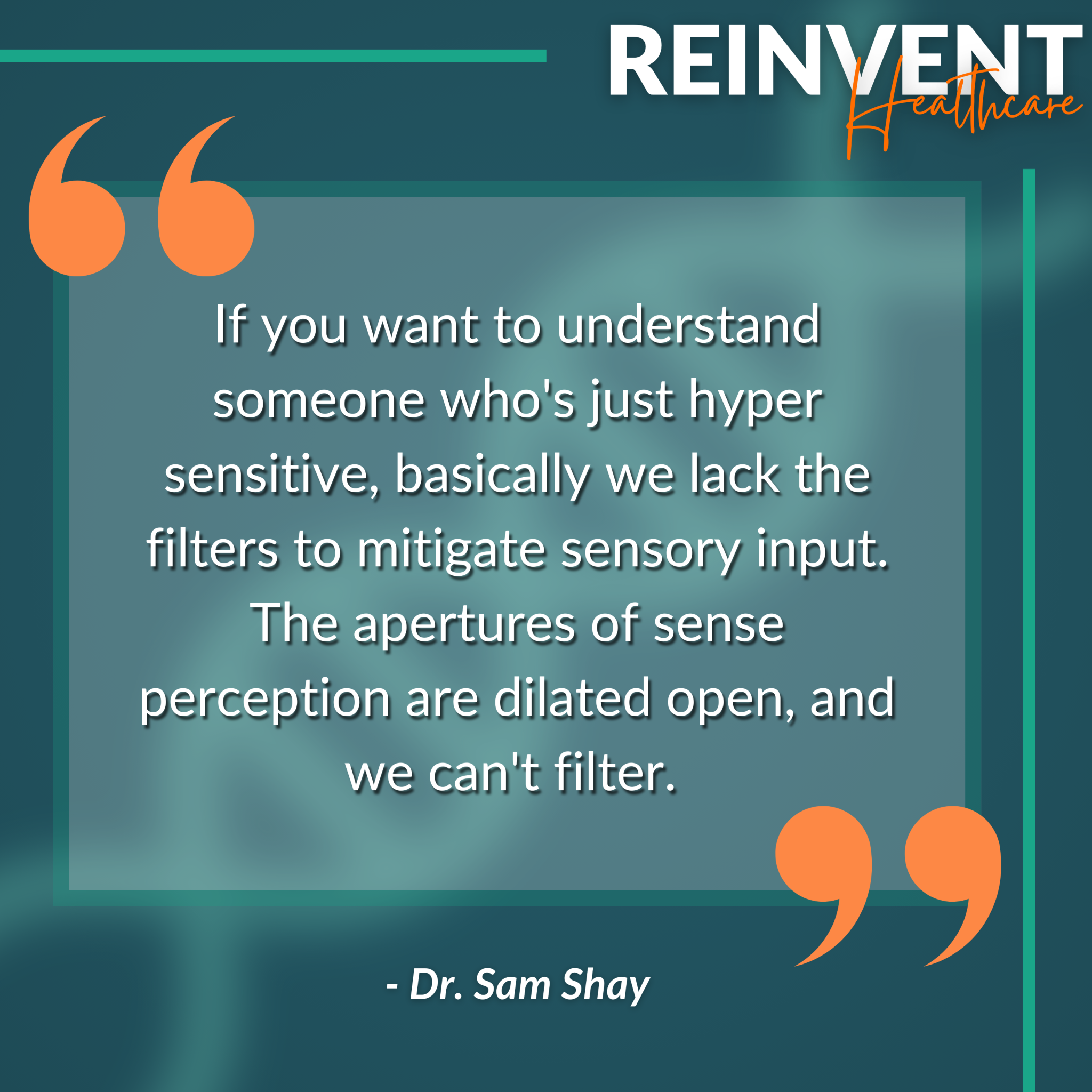
So we'll just talk about the sensory overwhelm. For me, my kryptonite is sound, but I'm also sensitive to bright lights, smells, everything is much more acute, and it's correlated back to the neurology. If you want to understand someone who's just hyper sensitive, basically we lack the filters to mitigate sensory input. The apertures of sense perception are dilated open, and we can't filter. So like everything is brighter, everything is louder, everything smells stronger, tastes stronger, emotions are received as much stronger.
There's some theories neurologically that we lack some of the synaptic pruning. So, the same trivial bit of information, instead of it getting filtered through, I'm just going to pick a number, like five major bundles of neurons, it's now magnified through 50 bundles of neurons. So it's this magnification of that the people who
have a normative brain type, don't experience things as magnified.
Like I experienced sound at a 40 decibel handicap, because everything is just louder to me, but normal to everyone else. So if you're in a clinical setting, try not to have these horrifically bright fluorescent lights that are just so jarring. Making sure that everyone in the office is not wearing perfumes, because it may smell nice to you, but it is a gas cloud to us.
That loud pinging, loud pinging, sudden noises. The sudden loud sharp sounds are the worst. That's like an ice pick to the skull. Machines that give off really loud, sudden noises. If there's any other type of having a variety of textures in the waiting room, like a soft blanket as opposed to these ice cold stiff kind of inhumane chairs, that there's a box of things, fidgety toys, and for adults, too. There's a lot of social anxiety, so things to fidget with.
And then there's also looking at one's affect as a clinician. Are you looking down at me, because I'm broken, because I'm so sensitive? Or, do you also presume that because I'm hypersensitive, I'm somehow dumb and not observant? I would beg to differ that I'm hyper observant, because I'm hyper vigilant, because of all the different sensory overwhelms.
So talking, if I meet someone on the spectrum, I never talk down to them like they're a puppy or a child. And if I'm talking to a child, I don't really hang out around children anyway, but if I meet someone who has a neurodiverse child, I never talk down to them like, no, no, no. I talk to them like I'm talking to an adult, because their minds can be so far technically verbally advanced, but they're treated like little zoo animals.
And if they have an interest, one way to build rapport is to engage with their interests and also to see if you can spot the difference. I'm not interested in hearing about trains. Like, you talk about something that interests you. How did you get so interested in trains? And listen for like 30 seconds to a minute and then say, you know what? I really love how excited you are about that. Can we bookmark this conversation and engage with it maybe later when I'm in a better space to receive it? Right now, I've got to attend to some other things, and thank you so much for sharing.
How about that? How about that? Is that so hard?
Dr Ritamarie (25:26)
It's a habit though, right? It's a habit. You're either going to space out, and not make eye contact, and show that you're bored, and don't want to talk about it, which is the passive aggressive approach, right? Or you're going to just come around and say, you know, this is boring out, or I got to go. Right. So as opposed to just being honest and open and allowing the person to receive that maybe this isn't the right time for this conversation, et cetera.
DrSamShay.com (25:51)
And the phrase bookmark is such a gentle, kind way. That's one phrase I could offer to people. I go off on my one thing. Some people would argue that's what I've done for the past 15 minutes. I can go off on my one thing I know really well. There is this issue of the person on the spectrum reading the room, and people who have a more normative brain type, you don't have to sit there and quote “suffer.”
So this term bookmark really acknowledges that person's interest and also acknowledges that you've kind of hit your limit.
A couple of things I'd recommend for the office is having sunglasses available. You can go onto Amazon and literally get for five bucks these kinds of safety glasses, granny glasses, that they're yellow or orange. And that's enough. They're so cheap. And they wrap around glasses. And if they're into the X-Men, say, you can be Cyclops. You put them on. And providing sunglasses, also providing noise canceling headphones for people in your office. It doesn't mean that they're not going to be able to hear you, but the sound can just be mitigated.
I always have concert earplugs on me at all times and several types so that I can navigate social spaces, or if I'm in transit, and I'm allowed.
So the other thing to do for your clients, or your patients, is use literal concrete languages. Don't use idioms, metaphors, and do not use sarcasm. Do not do it. If you think you're funny by being sarcastic, number one, from a professional comic, you're not. You're not funny, sorry. I'm just telling you straight, sarcasm is not funny. It's a sign of intellectual laziness. You're actually displaying how intellectually lazy you are. And if that comes off as strong, good. Sarcasm is not appropriate, especially for people. No sarcasm.
If you're detecting like, wow, that was a really strong response, it is because sarcasm was weaponized against me specifically. And the problem with sarcasm is that if someone on the spectrum doesn't read it and takes it literally, it's taken the person tries to lean on this blamelessness. I was just being sarcastic.
And it's further humiliating that we missed reading the room. Telling someone on the spectrum to do a figurative reading class is a form of entrapment. Like metaphors, idioms, these things, they're not these nominal things. They're very difficult. Speak directly to your patient, address them respectfully, allow them processing time. So, like a pause when you deliver something. If they're not looking at you in the eyes, they may not be distracted. They may be overwhelmed, and they're looking away, so they can minimize the amount of inputs, so they can actually hear what you're saying.
When I've talked to individuals on the spectrum, particularly I've had parents bring me their adult kids, teenagers, I'm talking to them, and they're looking away from me. I just keep engaging without shifting my tone or demanding they look back at me or whatever. I also pause if they look away. It's an intuition thing. Do you want me to continue, or do you need time to integrate what I just said?
That's another phrase. Like, do you need time to integrate what I just said? Do you want me to continue?
Dr Ritamarie (30:11)
Integrate. Okay, so bookmark and integrate. I like it. That's not typically how we speak, right? So that's a thing to learn, and I wanted to get back to what you had just said about the sarcasm, and it made me think about when you're speaking to someone who speaks a different language, you know, Spanish, Japanese, whatever, and their second language is English, and you're speaking to them, the sarcasm falls completely flat.
DrSamShay.com (30:37)
Right. And noise or speaking louder doesn't work.
Dr Ritamarie (30:42)
Right? Because they don't get it. It doesn't help. No, it doesn't help. So sarcasm, we need to be careful about it.
I also want to go back to two things. One, you said that as a child, you noticed these things, and you tried to adapt and all that. But also you told me that you've really realized that you are on the spectrum in 2019. So just six years ago.
What was that transition like to suddenly go, was there, something's not the same? I'm not the same as these other people? Or what was that?
DrSamShay.com (31:15)
Sure, happy to share. I would love to just quickly tie a bow around how to make the office. There's a couple more nuances in the office and then I'm happy to jump to this. Which by the way, is another verbal thing you can do, as another verbal tool.
Happy to talk about that. Let me just tie up. That's another phrase that's very gentle and accurate and direct and kind. To be able to redirect a conversation to finish something and then come back to the next thing.
If you want the overall affect of how to approach someone, it is kindness. It's kindness. If people say love is the answer, I don't think that's the answer at all. I think it's kindness. Just look at the premise of Game of Thrones, what they did in the name of love. Like all the Trojan War was in the name of love. Like all this other stuff in the name of love. How about that? You never see, I'm sure there's some perverse example out there somewhere. You never see something in the name of kindness. I'm sure there's some perverse example someone can dig up, but nowhere near the name in the name of love.
So in your office, here's a couple recommendations. Number one, if you know that your patient has sensory overwhelm or is on the spectrum, offer them the first or last appointments, so there's fewer people in the office. Offer telehealth options. Some people can get so overwhelmed in an in-person setting.
You can minimize wait times. Offer them an option to wait in the car before coming in through a crowded space. The white coat thing, not good. The white coat thing can be super triggering.
For staff training and demeanor, please inform your staff that there can be some facial expression and eye contact issues with someone on the spectrum that they may either be avoidant, or they may just be hyper staring into the camera and being look at me being super attentive.
And if they're social, their ability to calculate proper social distance is off by like a factor of three and either away or too close, and they're just not reading the room.
There are some other things you can do like have pre-visit consultations.
So for example, there can be something in your form, or have one of your staff contact ahead of time of the in-person appointment. Are there any particular accommodations that may make your visit more comfortable and easeful?
They may request, is there a time of day where there's no one there, or can there be? Can I bring my fidget thing? Do you have sunglasses? Can I wear sunglasses? Can I wear etc. Also warn before touching, which you should be doing anyway, because some people get very triggered and over stimulated from touch, because just like sound can be overwhelming, a simple touch can be overwhelming.
Yes-no questions are preferred, because otherwise if you ask an open ended question, you may get a thesis. There's plenty of websites out there, also. People want to search out for different tools. There's a couple.
I'll just name a couple right here. The Autism Healthcare Accommodations Tool or the Aspire's Health Kit Tool, Aaspire's spelled with a double A, A-A-S-P-I-R-E. These are additional resources to help practitioners with navigating their office setting.
So now going to your question on how did I find out that I was on the spectrum? My father.
So Dr. Asperger in the 40s saw that there was a 25% correlation of a first order relative also having Asperger's syndrome. And that is certainly true of my father. I talk about my father in my comedy special and just briefly, like I'm on the spectrum, he's the bookend. Like he's farther down the spectrum for me than I am from normies, which is a way to stay neuro-typical. And if people are offended by the term normie, cool. Welcome to us being offended by the term disorder or neurodivergent. So, this can go both ways.
So my father, he's got two doctorates, and he almost got a third, but he didn't bother with his dissertation. So he's a medical doctor, PhD in Psychiatry. He's also a published neuroscientist, published two books, got a MacArthur Genius Award, and he just exists. All he is is a brain. He has no perception of his body whatsoever.
My stepmother, they've been married for over 30 years, has asked him, how are you feeling? And he literally says, how am I supposed to know? He’s kind of a caricature. He also had all those things. He's literal, monotone language. He was better than most simply because he had a lot of public speaking with his work in his book, the speaking tour about his books. And he also got training from a theater coach who also led musical plays and was an estranged singer.
So she helped him quite a bit with his tones and inflections. He had three things he was interested in and that's all he wanted to talk about. And that was my whole life with him. And what happened was I thought, before I found out he had Asperger's, I thought he was a narcissist. He was just so absorbed in his thing and was just not interested in engaging with his son or frankly the rest of his children. And he would say things that were very dismissive and all just, it got to go on and on and on. And then I was complaining about my father to a dear friend of mine who was also a clinician. And he said, Sam, is your father narcissistic or does he have Asperger's syndrome?
And I said, what are you talking about? He said, well, let me describe my father. And he described his father who was a literal carbon copy of all the behaviors, except in a different field. And then I looked up on, you can literally type this in, differences between narcissism and Asperger's. You can type this in and there's a couple really great articles out there where there's a side-by-side list or a running listicle or whatever it is.
I'll give you an example. Someone who is deeply unattuned and is on the spectrum, they are avoidant, because they're socially awkward, and they're wanting to do their favorite things on their three things. Whereas a narcissist is avoidant as an emotional manipulation to control you, but both come off as avoidant, and the damage is the same.
There's tons of behaviors that don't cross over, but the intention is different. A narcissist can be cold and reserved, because they're trying to punish you; whereas, someone on the spectrum doesn't have social skills, and they're just talking like a robot, and it can still feel cold and reserved, but there's different intentions behind it.
When I read this comparative list, it not only explained why I thought he was a narcissist, but he actually wasn't. His intention and his direction in life was very different, but some of the behaviors were quite challenging. It also explained all of the behaviors I had with him growing up. So naturally, I thought, okay, am I just a watered down version of his brain type? And the answer is yes. That's what I talk about in the show. I go through all these different types of mannerisms. I mean, honestly, people want a true education on what it's like to engage with someone who's on the spectrum, just watch my comedy show. That's why I made it. The comedy show was 60 minutes long.
If I saw my own show 30 years ago, to better understand my brain and how to navigate a neurotypical world, a normie world, and the show itself, there's no cursing, there's no politics, there's no cheap body fluid jokes. It's clean, observational, and extremely educational. And I would say it is very funny. I've gotten over 40 reviews when I premiered it in 2024.
My intention is to bring the spectrum community and the non-spectrum community together. I would say it's PG-13, not because there's like off-color words or anything. The topic can be a bit heady for people under the age of 13. So that's when I perform it, that's what I put up the age rating as.
When I figured out that I had Asperger's also, I went through this period of time, it was about three days, where I had this pretty, relentless recasting of all my memories. And “that explains that,” “that explains why that happens.” And it was, at times, it was kind of traumatizing, because I was reliving all of the painful moments of my past where I had missed the social cues, or was taken advantage of, or whatever it might be. And then it's like, oh, now I understand why that was. And I also have a piece in the comedy show of how can you identify if someone's a narcissist, psychopath or sociopath? Because there's psychopaths who can control sociopaths who can control narcissists who can control aspys, people on the spectrum.
And then, as a service, I distilled down the behaviors of identifying aversive personalities, because those are the people that those of us on the spectrum are most vulnerable to. Now, the good news is, people on the spectrum are expert pattern recognizers, and that's from an evolutionary, psychology standpoint, what is the point of having someone, people on the spectrum?
And that's a very brutal question to ask, but know, nature isn't kind. It's only interested about preserving the lineage. So people on the spectrum were master pattern recognizers, and we think outside the box, and we are the people who have driven the vast, vast majority of all technological advances. And there's books written about this of people, Leonardo da Vinci, Michelangelo, Einstein,
Oppenheimer, Turing, the bulk of Silicon Valley, all the technological advances, not all, but nearly all the technological advances were pushed forward by people on the spectrum, because it takes someone who has a different brain to see how to do things in a different way, taking in different patterns, and putting things together.
You talked about AI earlier, AI is literally your aspy on demand. So that's how I figured it out. It also explains my own story, why I'm in functional medicine, and it explains why I'm uniquely good at it, and I'm also uniquely good at teaching it, because I'm able to hold a thousand metabolites in my brain simultaneously.
Look at genetics. I'm able to just piece together all these different pieces around genetics together. Then, because I had to build things from first principles, I'm able to teach. And now I'm able to teach, for example, genetics. I teach other practitioners, other clinicians, how to actually run genetics and interpret in a way that's easy, straightforward and effective, because I had to figure all this stuff out myself and had the brain and engineering mind, even though I'm in medicine, I have an engineering mind to be able to put things in a predictable order for predictable outcome each time. And that's what an engineer is.
Dr Ritamarie (45:27)
Wow, a lot to unpack here, and I think that thinking in terms of these brilliant minds being on the spectrum, because we think about this like, it's a handicap, but I would like you to address that.
DrSamShay.com (44:46)
It's a superpower. Here's what I say to that. That's a great point. It's not a handicap. It's a mixture of superpowers and kryptonites. So my kryptonites. It's a mixture. So, I have a specific set of superpowers at a buffet of kryptonites.
For example, my hearing sensitivity is an example of a kryptonite. I'll give you an example of how the kryptonite also can become a superpower in one sense.
I was on an international flight, and this is a flight where all the bathrooms are concentrated in this massive part of the plane. And I’m three rows away from the bathrooms, and I'm talking to two gentlemen who actually happen to be stewards for another plane. They're just being transported to another thing. And I'm talking to them, and I hear, “Help! Someone help me, help, someone help me.” And they clearly don't hear this, and they're trained, airline personnel. And I'm hearing this, and they're not. And I say, excuse me for a second. And I walk, and I'm three rows in. I walk towards the sound to the bathrooms, and it turned out to be a child who had accidentally locked himself into one of the bathrooms, and nobody heard it except me.
So I called, “Are you stuck in there?” “I'm stuck, help me.” It's like, no problem, we'll get you out. One second. Don't worry, we'll be right back. And I went and got someone, and they opened the thing. It's all good. And so it's like, yes, I have kryptonite, and sometimes it can come in handy. It's a package deal.
Someone who is on the spectrum, someone who has a non-normative brain type, it's a package deal. The ability to be hyper-absorbent of all sensory input, it's the same thing as being hyper-absorbent of information. It's the same thing. Being, quote, super smart, but also being utterly overwhelmed by light, sound, smell, touch, et cetera, emotions.
It's the same thing. It's a package deal. That's why it's kryptonites and superpowers.
Dr Ritamarie (48:13)
I like using that terminology, right? That kryptonite and the superpowers versus making there be something wrong with it, right? Something negative. We all have our stuff, right? We all have good stuff. We all have stuff that's not so good. And to put it that way, right? So there's superpowers, but it comes with some baggage.
Let's just say that living in the world as it is noisy and fumed and all that visually overstimulating can be very uncomfortable, I mean, to say the least, right? So I love that story.
The other thing I was thinking about as you were speaking was sensory integration problems, right? We think about people who have the tags on the shirt and the touch, you mentioned about the touch, right? Is there an overlap here? It sounds like there's a huge overlap.
DrSamShay.com (49:07)
That is what sensory integration issues are, is that integration, sensory integration. My understanding is you're taking all the sensory input and putting it into a model that is making sense of the world without dysregulating you, so you're not vulnerable. I mean, look, we're hunter-gatherers in modern society. We can't function in the wilderness if some little thing is bothering us and making us not paying attention to everything around us, so sensory integration is that there's a bit of a stimulus, a bit of trivial stimuli, that is overwhelming our senses. The best way to describe what sensory overwhelm is.
You know how urgent itching is? It's like you have got to scratch that thing, and you have to attend to it, because it's so overwhelming, and it's going to drive you crazy. Imagine the auditory equivalent of itching. Imagine the visual equivalent of itching. Imagine the smell equivalent of itching. Imagine, just imagine everything as absolutely maddening as itching, but it's now in every sense of your, or your sphere in every sense and just how emergent and overwhelming and all-consuming. And sometimes you can start to thrash and lash out. Just to be technical, because I was a functional neurologist for eight years, itching travels on the same C-fiber as pain.
So when you look at what happens with itching, people guard the area and start grabbing and rubbing. It's very similar to a pain response. You bump your elbow, you grab it and rub it. It's the same thing. You're doing the same gate.You're trying to gate the neurological response by using large-diameter afferent neurons to gate itching as you do with pain. It travels on the same nerve. So you gate and guard pain. You do the same thing with sound.
You do the same thing with light. You guard, and you try to just do something else and get out of the situation. And for people who don't understand what it's like to live in this hypersensitive world, this hypersensitive vessel we're in, it can look exaggerated. I've been accused of attention seeking. I've been accused of being disruptive, I've been accused of being intentional, and by my own parents, and just the level of shaming that was just absolutely crushing.
It's one reason why I made this special. I cannot undo what happened to me, but what I can do is educate the gatekeepers and the adults in the room, of which clinicians are included.
I can educate using comedy as the Trojan horse for truth and also podcasts like this. Comedy to me is the best vehicle to educate at scale. I keynoted at the American Academy of Therapeutic Humor this past May, and it's the same conference that Patch Adams spoke at. And not the time I was there, but in a previous conference. And I performed my entire show to over 200 clinicians and then had a breakout session to go over the specifics of akin to what we were describing today on how do you change your office and your affect to better receive people on the spectrum. And how, if you are going to run genetics, what are the genes you look for? Not to say, with these genes, you're doomed. Okay, you've got these vulnerabilities to inflammation, vitamin D absorption, free radical damage, methylation, et cetera. Here's what you do from a lifestyle, diet, nutrition standpoint in order to help increase the resilience, keyword, resilience of someone who is sensory overwhelmed at any given time.
So when you're working with people in the spectrum clinically, you want to increase their capacity, and their resilience, and remove as much noxious stimuli as possible like inflammatory-based pain, like blood sugar dysregulation, like immunological overload.
So there's many things you can do as a clinician to help their internal physiology that increases their social resilience. So this is not just about behavior change. You can actually, as a clinician, do meaningful, meaningful, meaningful changes for someone on the spectrum by correcting their physiology. So now they're not dealing with both an internal overwhelm as well as the external sensory overwhelm.
So they have more capacity, or we use the term, we have more spoons. That's a term you'll hear. I don't have the spoons for this. I should really look up the history, but it's a phrase you'll hear. I'm out of spoons. I don't have the spoons for this. I have two spoons left. So that's like five minutes. I have no idea where this came from, but it's jargon within the Spectrum community.
Dr Ritamarie (54:50)
I love it. I love it. And the other thing is I always talk about it in terms of toxins, but we have a bucket. And what we're trying to do here, if you're working on the physiology, is keeping that bucket from being over the top or close to the top, before that stimuli comes in. So it's just less.
DrSamShay.com (55:15)
Very similar. I like this. I absolutely agree. And I think the metaphor is appropriate. We just have much smaller buckets.
Dr Ritamarie (55:16)
Exactly, smaller buckets. So you want to minimize how much you're filling it.
So tell us about some of those genes that we should be aware of, the detoxification genes, the methylation genes, the inflammatory. Tell us more.
DrSamShay.com (55:32)
Sure. A couple of things about some big picture stuff about genetics. There is a myth floating around that all these quote “health genes” are of equal importance. They're not. Health genes are in a hierarchy. Methylation is not number one. It is not. The inflammatory genes control the methylation genes and methylation genes are at best bidirectional with the free radical scavenging genes of the mitochondria, the VDR genes, and liver detox genes.
And there's also certain genes within these categories that also are in a hierarchy. There's hundreds of genes that are directly or indirectly related to inflammation, but there's only like 15 or so that are the most important that you need to focus on.
When you're looking at liver detox genes, there are tons of them, but there's like eight or so that are the most important, and so you'd want to work with genetics in a way that is prioritized and organized and not just careen towards the celebrity status of MTHFR. MTHFR is not even in my top five most important genes. It's not. So I know it's a celebrity gene. I don't want to go into individuals who are on a lot of famous podcasts bragging about their five precious methylation genes.
And if people are really wanting a more deep dive on my stance on methylation, and I have all the research to back it up, you can just put in Dr. Sam Shay methylation into any podcast player. I put out three separate podcasts showing my homework.
The actual genes to really pay attention to are our number one, the VDR genes, vitamin D receptor genes, VDR, VDR1 and VDR2 are in my opinion, the single most important genes related to health we have, because vitamin D controls 3 to 5% of your human genome. And most of it's related to controlling inflammation in the immune system.
Yes, there's bone density, hooray. It's not the most important thing vitamin D does. We're not talking about synthesizing vitamin D from sunlight. That's about six separate genes. And you can get vitamin D from food supplements and sunlight, but getting vitamin D from the bloodstream into the cells is a completely different matter. That's the VDR genes.
So VDR genes are two, in my opinion, the most important ones. The reason why is because when I analyzed genetics, and hundreds and hundreds of people, and also correlated who had chronic illness, and who didn't, every single person that I ever saw that I ran genetics that had chronic disease had variants in their VDR genes with only one exception. Only one person ever had a double green with chronic disease. And that person had horrific, meaningful, formative, chronic stress of a type I will not mention.
That exception proved the rule that if you're under enough duress, you're going to break down physiologically anyway.
So VDR genes, then I would look at two of the biggest pro-inflammatory genes, interleukin-6 and TNF-alpha. Now there'll be some nerds out there saying interleukin-6 is not pro-inflammatory on specific high-intensity interval training, I get that, that's a separate conversation, but interleukin-6 and TNF-alpha, those are really the keystone pro-inflammatory genes if they've got variants.
And then looking at the interleukin-10s, interleukin-10-1, -2, and -3, those are the anti-inflammatory genes. The way I like to describe this to clients is that if someone's got a green dot in their interleukin 10s, they have a fire truck to put out the fire of inflammation. But if they've got a yellow or red dot, they've got squirt guns. So if you have really strong interleukin 10s, your capacity to put out inflammation is really great.
In my opinion and clinical observation, I would argue that interleukin 10s are more important than the interleukin 6 and TNF-alpha. Because if you can put out inflammation, that's really important. If you have a lot of inflammation, but you can really put it out quickly, that's not as bad as being just chronically inflamed all the time and not being able to really put it out.
Then you've got the three genes that control free radical scavenging in the mitochondria. Now that's very important, because the mitochondria generate 95% of all the free radicals. And now the way I like to describe it, when you're building a campfire, you put wood, you light a fire in the presence of oxygen, and you make it for light and heat, but you also get sparks. Okay, your mitochondria are burning fuel. In this case, it's protein, fat, or carbs in the presence of oxygen. That's why we breathe is to bring oxygen to mitochondria, and you create heat, thermogenesis and you create energy, ATP, but you also make sparks called free radicals.
So the sparks, 95% of the sparks, are made where you're burning the fuel in the mitochondria. So you need janitors to run around to put out the sparks. Those janitors are MnSOD, GPX-1 and CAT.
MnSOD, who I like to lovingly name Mr. SOD, Mr. SOD is the head janitor, and he can put out millions of free radicals, because he's an enzyme. Unlike singular things like vitamin C, which is just one to one.
So it's the enzymes that really, really do the grunt work of dealing with the free radicals in the mitochondria, not the singular antioxidants. So if those genes have variations, then the janitors aren't fast enough to put out the sparks. And then your mitochondria gets damaged and catches on fire and that's called inflammation. Those genes are related based on the research to higher propensity people on the spectrum.
You've got higher levels of homocysteine issues. This is where you can look at all the methylation genes, not just MTHFR, there's also MTHFR2, there's MTR, MTRR, TCN2, PEMT, the CBS, COMT. COMT is a huge one. The trans-sulfuration pathway, the CBS gene is massive, because that's where you can convert homocysteine into, amongst other things, glutathione.
I mean, CBS and COMT in particular are, I think, really, really important. So those are the top genes related to spectrum, specifically. Then there's additional genes to consider, like your genetic vulnerability to histamines, your genetic vulnerability to gluten, your genetic vulnerability to lactose, your genetic vulnerability to caffeine which I have.
If your CYP1A2, or your ADORA2A genes, have variants in them, then you can get what's called caffeine induced anxiety and depression. And particularly, if it's coupled with a COMPT gene, as well. And you’ve got the hat trick, those three, those three genes mean caffeine is bad news and chocolate.
If you're working with someone on the spectrum, it is critical to identify genes that affect their tolerance to certain foods. Then there's additional genes that are very, very difficult to find.
Selfless plug here. Basically, I have the only company here in the States that really does this. The AMY1 copy number, not the variation, but the duplicates of this gene. This is the gene that tells you the number of copies of the amylase producing gene for your saliva. The more copies of this you have, the more capable you are breaking down carbs. The fewer number you have, the less capable we are of breaking down carbs. It also relates to the acceleration of your insulin spiking in your blood. How is this significant?
Imagine your digestion is a fort, and you've got these carbs charging the fort like the Visigoths in the medieval times, wherever. You've got your amylase number of duplicates of your amylase genes is the number of cannons lining your fort. It's not the version of the cannon that matters. Green, yellow, red dot that the variation between green and red dot is very trivial. It's the number of cannons that matter. Just for numbers, if I have a green cannon, green dot, and it shoots out a hundred bullets per unit of time, but a red dot is 90, and a yellow is 95. I'd rather have 10 red dots, 10 red cannons than one green cannon. It's a difference between a hundred and 900.
My ability to mow down these carbs coming at my digestion is way, way more determined by the number. So what does that mean?
If someone has a low copy number, like I do, you can have up to 20 copies, 20 cannons. I have two. Second lowest as possible.
So I was eating an organic, local, Mediterranean diet, and Mediterranean diets are like six, seven, eight. I was having triple to quadruple the amount of carbs I could tolerate, and I was having mood, energy, and digestive variations rapidly fluctuating through the day.
So when I changed my diet to my carb capacity, my mood, energy, and digestion leveled out. Now, can you imagine the impact of that for every meal you eat for the rest of your life, particularly someone who's hypersensitive, like someone on the spectrum?
So to understand your carb tolerance number is absolutely critical for physiological regulation, energy, blood sugar, all the rest of it. Statistically, the people with the lowest number of copy numbers are the people with the highest rates of diabetes. So, who had the highest rates of diabetes? Aborigines, Maori, Pacific Islanders, Native American, Inuit. And they have the lowest copy numbers statistically, because they did not grow up from the evolutionary bottleneck around long farm agriculture. Whereas if you look in China, their average copy number is an eight. Europe, its average is a six. Now, why is China eight and Europe is average as a six is because rice actually inhibits amylase for whatever reason it inhibits amylase. So there's this, I figured this out when looking at the statistics, if rice inhibits amylase, then there was this genetic bottleneck to create additional copies of amylase in order to compensate for the suppression of amylase production per copy number of the gene..
Now, you can identify, this is not something you can get from 23andMe, because it's not a variation test. It's actually a separate swab, with separate lab, separate machine, because you're counting the duplicates of a gene, the type, not as a green, yellow, red dot.
So for people on the spectrum, whatever you can do to regulate their physiology is helpful. Whatever you can do to lower the amount of static, whether from the inside or from the outside, and the reason why I love genetics is that someone on the spectrum can really grasp genetics, because they’re hardwired, and we can do something about it. We can pick genes that have very clear epigenetic recommendations to improve the expression of the gene. The red and yellow dots will never become green dots, but they can behave green if we have applied consistent lifestyle.
The Amy1 genes. Okay, well, here's our parameters of what our limits are in terms of what type of diet, keto, paleo, Mediterranean, or higher carb. We can now genetically determine that.
Genetics testing is also the highest value test for your patients and clients, because they need to just do it once, and they've got the data for life.
I'm a big fan of these other functional tests. I do them all the time, but the value of them decays exponentially after three, six, nine, 12 months, depending on the test. And you have to redo it, which is fine, because that's the nature of that test. But from a patient value standpoint, genetics testing is the single highest value you can do. And you can figure out what type of nutritional realities they need for the rest of their life.
So for me, I had chronic debilitating joint pain in my thirties, like an 80 year old man, and I've been doing functional medicine. I'm taking my gram of fish oil. I ate organic. This wasn't going away. Ran my genetics and realized I was a hyper-inflamer. Remember those 15 inflammatory genes are as mentioned. I have 13 out of 15. I have red or yellow dots. That's insane. No wonder I was constantly inflamed.
Then I realized from the epigenetic recommendations from the genetics, I just changed a couple of things. A couple of months later, joint pain completely went away. It’s never come back.
Dr Ritamarie (01:09:04)
What did you change?
DrSamShay.com (01:09:08)
Diet, nutrients, lifestyle. So just a quick, one example, is that there's a difference between nutritional dosing and nutrigenomic dosing of supplements.
Fish oil. One gram of fish oil is like throwing widgets into the machinery. Great. Over two grams of EPA, DHA combined changes the machinery. That's nutrigenomic.
Nutrigenomics is where you give the nutrition that actually changes the genetic expression. I went way beyond two grams, but my body never developed a single bruise or anything like that. For me personally, I generally start with people who are clearly inflamed and have these variations, meaningful variations across these inflammatory genes. I start them on 3 1/2 to 4 grams of fish oil, to change their genetic machinery, to become globally anti-inflammatory.
And that's one example. What I've done in the genetics reports is actually simplified all the analysis to how do you know, based on the preponderance of evidence of these different clusters of genes, what do you focus on? So what I've simplified for practitioners is what's the one page summary?
Dr Ritamarie (01:10:08)
And that's when you see these large numbers of inflammatory genes. .
DrSamShay.com (01:10:11)
Here are the things for their diet. Here's their top prioritized supplements. Here's how they should exercise based on their genes, and start there. And just how to really make genetics straightforward and winnable and easy to explain and easy for a patient or a client to take action.
Dr Ritamarie (01:10:51)
Well, so do you have a specific test that you like to run? What test gives you the number of amylase genes?
DrSamShay.com (01:10:59)
So it's called FitGenes USA. This is where you can. It's called FitGenes USA, fitgenesusa.com. It's called the CarbChoice test, CarbChoice Blueprint. CarbChoice. That's the name of it. That's the brand name of the test. But the technical side of it, it's a copy one, it's an Amy1 copy number variation.
So FitGenes USA, that's where I train, that's where practitioners go if they want to actually learn how to run these tests and get access to these tests and my reports and all my trainings. And that's how I also want to contribute to supporting people on the spectrum is to give other clinicians, scale out to other clinicians, to give them the tools to help us. Please help us.
Dr Ritamarie (01:11:40)
Yes. Well, this has been fabulous. I really have enjoyed this conversation. We've been all over, and I feel like you've opened up a lot of doors for me and a lot of insights. So I really appreciate it. And maybe we can have you back again to talk genetics.
DrSamShay.com (01:11:59)
I would love to. There's so much there to share, and I'm more than happy to go into as much nerdy detail as you want. I am just being on brand, just being super on brand here.
Dr Ritamarie (01:12:12)
Nerdy details, I love nerdy details.
I love it. I love it. I love it. So thank you. Thank you so much.
We've been talking to Dr. Sam Shay. All of his information is in the show notes. You'll make sure that we have all those links and everything. And make sure you check out his YouTube, and it's called NeuroSpicy. What's the name of the channel?
DrSamShay.com (01:12:27)
So if you put in Dr. Sam Shay Neuro Spicy, my hour show will show up. If you want more information on how I teach functional medicine or how I teach genetics, you can just put Dr. Sam Shay genetics into any podcast player or my YouTube channel.
Dr Ritamarie (01:12:45)
Awesome. Thank you so much for this enlightening and fascinating conversation. I really appreciate you. And I appreciate your openness about talking about this, because that's what needs to happen for this somewhat stigma to go away to say, wait? We're all diverse. Let's use the right word.
We're all diverse in this world. And how do we communicate and understand people who don't think like us. I think it's just fascinating.
So thank you so much for being here. And Dr. Sam is part of this audience of us who are really into root cause analysis and helping people to really dig in and understand and change the way that health is practiced, because our medical system is kind of broken. It's not really a healthcare system. It's a medical management system, and we're the ones that get to change it and to truly help people.
So I appreciate you being here and until next time, shine on.
If insulin receptors are downregulated, and the inflammatory signaling is high, and mitochondrial output is low energy, lowering carbohydrate intake may improve glucose numbers temporarily, but that doesn't mean that insulin sensitivity has been restored. If the deeper signaling pathways are still impaired, the system is not ready. It's not ready for the changes.
Or, consider protein intake. In a metabolically ready system, one with stable cortisol and adequate mitochondrial capacity, increasing protein can support the rate of muscle repair and the metabolic rate. In a system operating under chronic stress, though, that same protein can increase gluconeogenesis, making more glucose from the protein, elevate cortisol, and disrupt sleep.
Same intervention, but different readiness states and opposite outcome. Or even take fasting, which can be incredibly healing in a stable, regulated physiology.
Fasting enhances metabolic flexibility, and it improves the efficiency of the mitochondria, but in a depleted system with elevated stress signaling, fasting can suppress thyroid output. It can increase cortisol. It can worsen the fatigue. So the intervention isn't wrong. It's just applying it in the wrong place and to a system that's not ready. So sequencing matters, because readiness is hierarchical.
Safety precedes flexibility, regulation precedes optimization, responsiveness precedes performance, and if the autonomic nervous system is locked in sympathetic dominance, pushing aggressive metabolic strategies can increase strain.
If inflammatory burden is high, stimulating thyroid conversion can produce minimal clinical change. If nutrient reserves are depleted, restrictive protocols can deepen the stress physiology rather than restore balance.
Readiness determines tolerance, and tolerance determines outcome. So instead of asking what intervention matches this lab value, we start to ask things like, is this body metabolically ready for this intervention? It's a different level of clinical reasoning. It shifts from chasing markers to restoring regulation. From layering protocols to building capacity, that's what we really need to be doing.
When I talk to clients about this, when I say, “Look, no. It's not a matter of what additional supplements to take.” I may be taking supplements away, right? I may be adding foods that they've previously thought they needed to remove, maybe changing things and giving them things that help them to regulate their system, help them to improve their stress response, improve the cortisol signaling, improve the functioning of the parasympathetic nervous system.
Once you restore functioning of the parasympathetic nervous system, then the healing can happen. If somebody stays in sympathetic dominance, and they're not doing things to regulate their nervous system, and they're worried about what supplements to take, and they're worried about how this food is going to affect them, healing stalls.
So we need to shift our thinking from reacting to the labs and giving them a whole boatload of supplements to take to balance out deficiencies, to actually stabilizing their physiology first. Once you start thinking in terms of readiness, in terms of what this body can handle, the variability stops being surprising. The variability of the protocols working or not working, because it's not random.
It's just the physiology expressing its current state and letting you know what it's ready for. A system that's ready, it adapts. A system that's chaotic resists the change. That brings this entire art together.
The macros are inputs, protocols are structured interventions, metabolic readiness determines outcome, and when we restore metabolic readiness, the body responds. When we ignore readiness, progress stalls. That's systems-based healthcare.
And that's what we need to be focusing on to help people truly heal and get well.
So those of us who refuse to reduce complex physiology to trends in macros and isolated lab markers, we're the future of healthcare. This is where it's going. And those of us who understand how the body is not broken, it's adaptive, and it's intelligent. When we can restore order to metabolic chaos, resilience follows.
Today we explored metabolic readiness, because the work we do is not about forcing results. It's about restoring the system, so the body can respond the way it was designed to respond. This is the level of thinking that transforms practices and lives. It's the work I've dedicated my career to, and it's why I'm so committed to building a community of practitioners who think in systems and lead differently.
If you're listening and thinking, that's how I want to practice, then you belong here.
Go visit INEMethod.com and see how we train practitioners to restore metabolic readiness in even the most complex cases. And if this conversation resonated, head over to the show notes for additional tools and resources. Together, we're reinventing healthcare.
Until next time, shine on.

Listen on your favorite podcast platform!





Share This Episode