
Genetics and Supplement Forms: When Activated Nutrients Actually Matter
Activated forms. Methylated forms. Chelated minerals. The supplement world often implies that newer or “activated” means better, but does it?
In this episode, Dr. Ritamarie continues the supplementation conversation, this time through the lens of genetics, enzyme efficiency, and precision forms. She breaks down when activated nutrients truly matter, when they don’t, and why choosing the wrong form can stall progress just as much as choosing the wrong supplement.
You’ll also learn how excipients, binders, and delivery systems can influence tolerance and outcomes, especially in sensitive people.
If you’ve ever wondered whether you’re using the right form or just following a trend, this episode will help you think more precisely and prescribe more effectively.
What’s Inside This Episode?
- Activated forms: when they matter and when they don’t
- Genetic variants: how they affect enzyme efficiency (not just deficiency)
- Bottlenecks: why the limiting step, not the nutrient, guides decisions
- Functional deficiency: when labs look normal but pathways aren’t
- Absorption vs activation: why form doesn’t fix every problem
- Excipients: what’s really in the capsule and when it matters
- Delivery systems: powders, capsules, liquids, and what to consider
- Overcorrection: how “more” and “activated” can create new imbalances
Resources and Links:
-
- Download the full transcript here
- Download our FREE Smart Supplementation Matrix
- Join the Next-Level Health Practitioner Facebook group here for free resources and community support
- Visit INEMethod.com for advanced health practitioner training and tools to elevate your clinical skills and grow your practice by getting life-changing results.
- Check out our other podcast episodes here
Transcript
Dr. Ritamarie Loscalzo
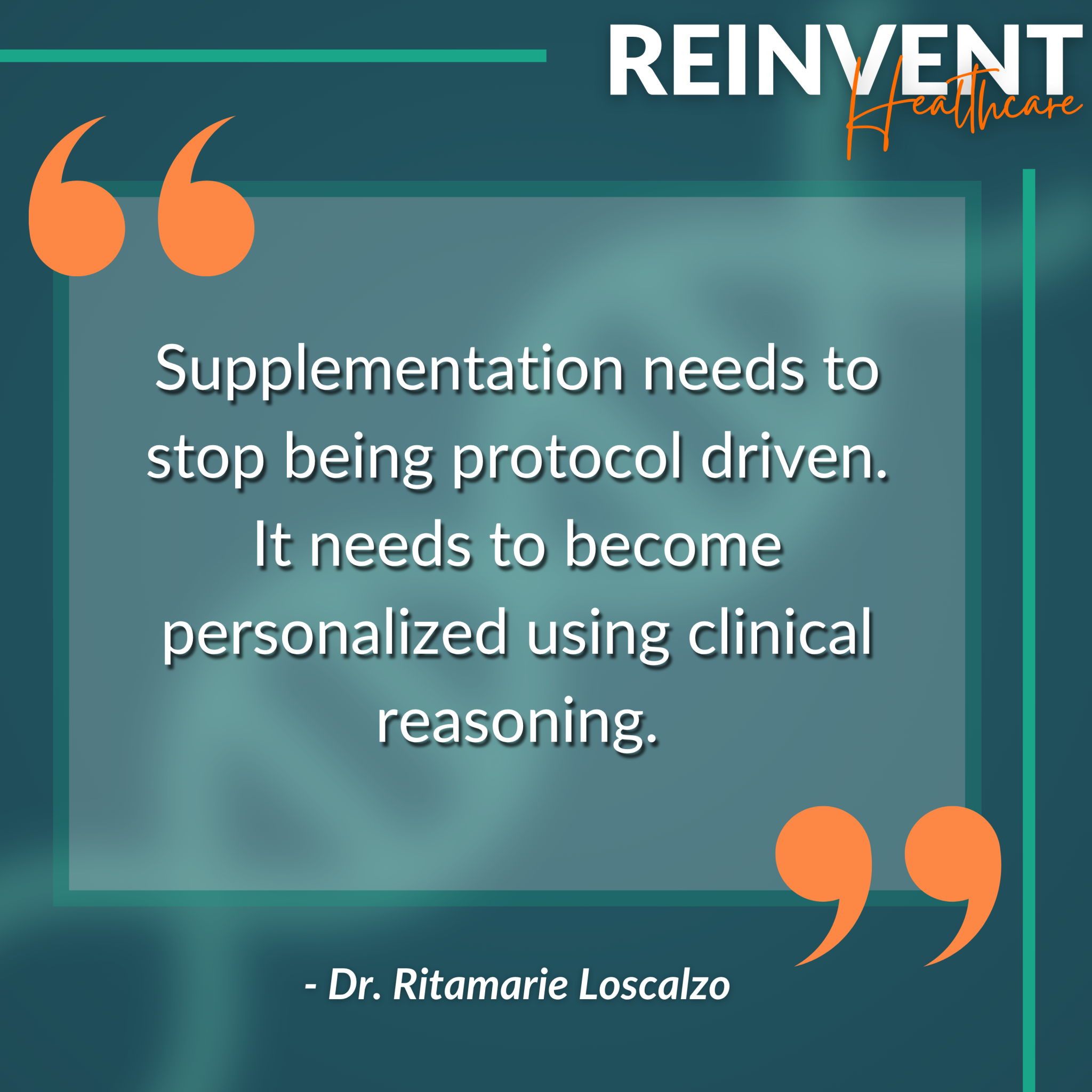
What if the supplement you're recommending isn't wrong? It's just the wrong form for your patient's physiology? What if the lab looks normal, but the enzyme pathway is inefficient? And what if the problem isn't the nutrient at all, but it's the activation, transport, or even the excipients in the capsule? Supplementation needs to stop being protocol driven. It needs to become personalized using clinical reasoning.
In a prior episode, we talked about mechanism before molecule, the six drivers of nutrient imbalance. Supply, is there enough in the diet or in the supplementation? Absorption, how's the digestion working. Activation, are we actually able to convert it to the usable form?
Transport, is it getting into the cell where it belongs? The demand, does this person have a higher need for this particular nutrient, whether it's situational or genetically based? And loss, is there a reason for this person to be actually losing more of this? That episode will give this conversation important context. So if you haven't listened to that yet, go ahead and find it on the podcast app, and it will enlighten things a bit.
But today we're zooming in on one of those mechanisms, which is activation and transport, because this is where genetics and supplement form truly change your decisions.
Today, we're continuing the supplementation conversation, but now it's through the lens of genetics, enzyme efficiency, and precision forms. So if you haven't already downloaded my Smart Supplementation Matrix, pause and grab it in the show notes. It'll anchor everything we're about to discuss.
Something foundational for all of us to keep in mind when we're trying to decide whether to supplement or not is does a nutrient appear low and does that automatically mean to replace it? Really what it means is to investigate the mechanism. Why is it appearing low?
Today, we're going to go deeper into one of the most important and misunderstood layers of that mechanism, which is activation and how genetics and supplement form influence, or should be influencing, our clinical decisions.
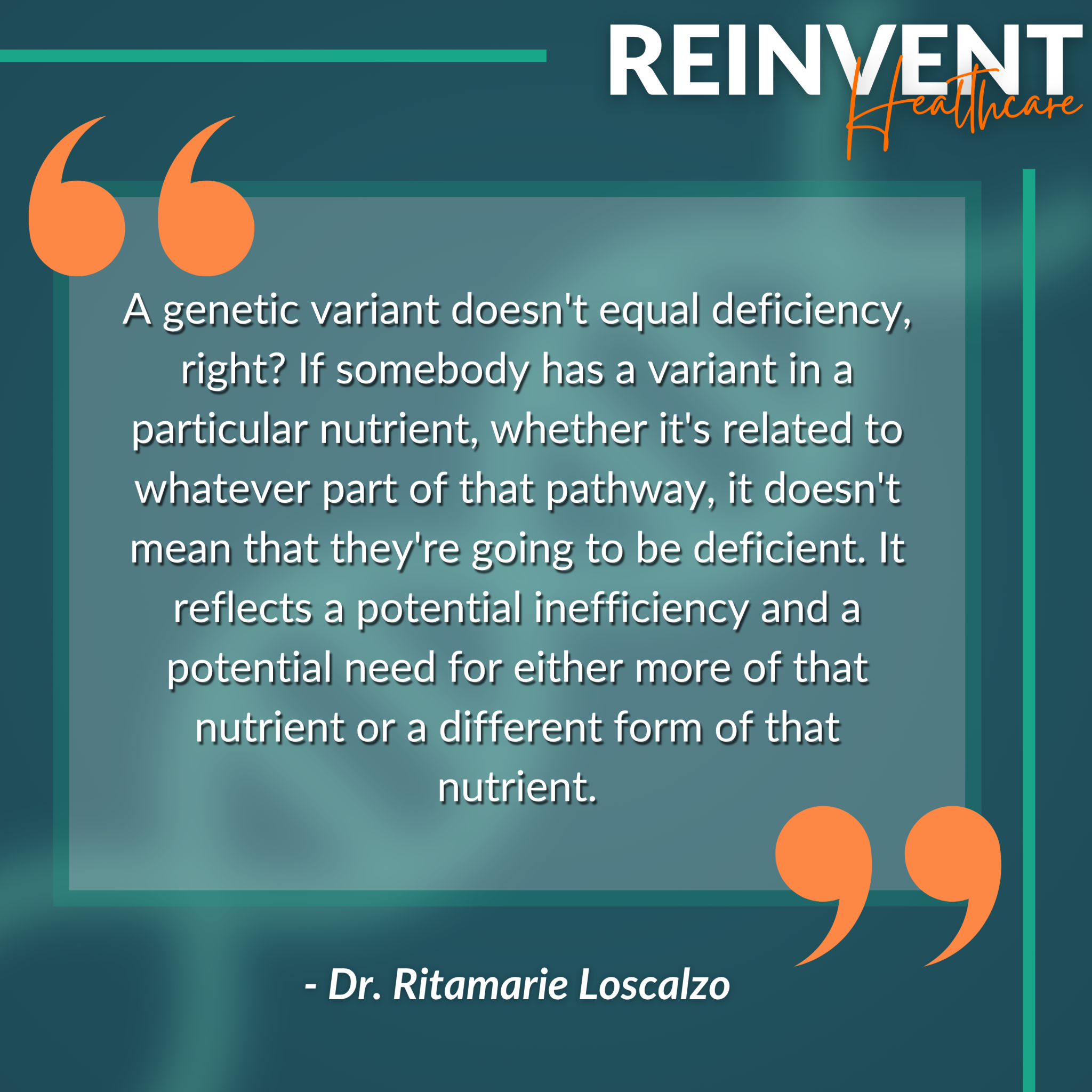
So let's start with some clarity. A genetic variant doesn't equal deficiency, right? If somebody has a variant in a particular nutrient, whether it's related to whatever part of that pathway, it doesn't mean that they're going to be deficient. It reflects a potential inefficiency and a potential need for either more of that nutrient or a different form of that nutrient.
The genes encode specific enzymes, and if an enzyme functions at a reduced efficiency, the pathway may still operate. It's just not optimal, right? So it changes the requirement for that nutrient. It changes the tolerance for that nutrient in terms of excess. It may also change the form selection.
So I'm going to give you an example. Vitamin B6 needs to be converted into its active form, pyridoxal biphosphate. If that conversion step is inefficient, whether it's because they have a genetic SNP there or whatever reason it might be, a person might consume plenty of B6 in their food and supplement, yet they stay functionally insufficient. And so in that case, we need to use pyridoxal 5-phosphate to bypass that bottleneck. Not because activated forms are always better, but because activation is the limiting step, the rate limiting step, and in this particular case, giving the non-activated form wasn't helping.
So clinical precision means identifying a bottleneck, not assuming that we know the solution, and this is where nuance separates protocol from physiology. I don't believe in protocols. You've probably heard me say that on plenty of podcast episodes, unless you're new to the podcast. And now you're going to hear me say it over and over again. I don't believe in protocols.
Everybody has their unique needs based on their experience, their genetics, their situation currently. Not everybody needs methylfolate. Not everybody needs P5P or pyridoxal 5-phosphate, nor activated vitamin D, or chelated minerals. The forms matter when the activation is impaired. They're not automatically better.
And if digestion is compromised, switching to an activated form doesn't fix the absorption, right? Because it's a digestive thing. Insulin resistance impairs cellular transport. Changing forms alone doesn't restore intracellular sufficiency.
If inflammation is blocking receptor signaling, increasing the dose doesn't solve the problem. Form matters when form is the bottleneck.
Otherwise, it's just marketing, right? As practitioners, we need to ask, where is the constraint in this pathway? That question determines the intervention that we're going to recommend to our client.
Dr. Ritamarie Loscalzo (05:46)
So let's look at lab sufficiency versus functional sufficiency. This is where the astute practitioner is going to be able to interpret this in a way that makes the most sense.
Serum vitamin B12 might be perfectly fine within the reference range, or as I see it, a lot of the times elevated. Yet, methamalonic acid might be elevated, or homocysteine might be elevated, or MCV, mean corpuscular volume, might be trending upward. These all suggest functional insufficiency in spite of the fact that the serum amount of B12 is fine. A lot of practitioners make the mistake of seeing that elevated serum B12 and stopping all B12 supplementation.
Similarly, the body regulates serum magnesium very tightly, and intracellular magnesium can be depleted in spite of normal serum values. This is measured by looking at RBC magnesium.
Serum iron can appear fine, yet ferritin patterns and inflammatory markers tell a completely different story.
That's why it's not sufficient to address a lab abnormal in isolation. We can't just look at a lab and say, let's give this person these five vitamins. We need to interpret the labs in context by looking at symptoms, history, genetics, functional markers, and the goal is not normal ranges. The goal is functional sufficiency and optimal ranges.
So let's look at something that's rarely discussed in clinical education. Excipients, binders, and what's actually in the capsule. A lot of people are out there just recommending supplements, supplements, supplements, and I often see people come in, and they're on 20 or 30 capsules a day.
The capsule isn't just the nutrient, right? It includes binders. It includes fillers. It includes flow agents to help it flow through the machinery better. It includes the material that the capsule's made out of, whether it's cellulose, or whether it's gelatin, or something else. And sometimes there's coloring agents put in there, because people need colorful things to put in their bodies. Not.
So for many people, excipients are tolerated without issue. No problem, but when people come in, and these are the people I see a lot of with significant gut permeability, autoimmune activation, chemical sensitivity, histamine instability, that's when excipients might matter. People who are sensitive and sensitive to everything, you have to be careful. And people with impaired digestion, where some of the excipients actually slow down the digestion and absorption of those nutrients.
Some of those common ones include magnesium stearate or any stearate, vegetable stearate, or not. It's still a stearate, and the stearate binds and makes that nutrient less absorbable. It makes it flow through the machinery much better, but it doesn't do a good job in the body, and we may not be getting as much as the label says.
Others that are included are silicon dioxide and microcrystalline cellulose, titanium dioxide. They're not inherently toxic at low levels, but the context matters, right? If somebody is taking 30 or 40 capsules a day, it adds up.
So then there's the delivery form. Tablets have to be compressed and often have binders and fillers and things to hold them together.
Capsules require fewer additives, but they still have a lot of additives and flowing agents. When we use powders, straight powders, they eliminate the capsule material entirely, but powders aren't without a problem, because some of the powders actually are colored, right? Because people don't want to take white, or it would be an off white ugly color, so they put coloring in there. We really have to look carefully at what we're recommending to people.
Liquids might be the most absorbable in specific digestive contexts and especially things that can go sublingual. The correct delivery system depends on your individual person's physiology, not on the branding, not on the company claiming that theirs is the best.
So we discussed synthetic versus natural supplementation or forms of supplements in previous episodes. Now I want to revisit that from a practitioner lens, from an individualized, personalized lens.
The body responds to the molecular structure. If a molecule is bioidentical and purified, its original source doesn't determine its function. And in fact, the body can't tell where it came from. But what does matter, and where it's important to get things that are purer, is purity. Are there excipients? Are there heavy metals? Are there other things? Have they been third party tested to make sure that they actually work? Have they been screened for heavy metals?
Is there any residuals of the solvents that are used to extract these or create these, right? Those have to be tested.
And we have to have transparency of sourcing. The issue is rarely whether it's synthesized, it's how it's synthesized, and the quality of the process, and the quality of making sure that it's a good, absorbable, biocompatible form.
The issue becomes whether it's manufactured in a responsible fashion. And fear-based symptom thinking doesn't improve outcomes, but discernment does. There are people out on the internet who will say, it's synthetic; therefore, it's bad. It's natural, therefore it's good. And I can give you lots of examples of where that logic doesn't work.
How did genetics change this strategy? Well, this is where nutrigenomics becomes very powerful. If someone has reduced methylation efficiency based on their genes, reduced enzyme conversion efficiency, higher oxidative stress load, altered detoxification signaling, their nutrient requirements are going to be very different from somebody who doesn't have those things.
Dr. Ritamarie Loscalzo (11:56)
So they may require higher intake, different forms, targeted cofactors to improve the efficiency of absorption and utilization, and temporary support during stressful times, whether it's emotional stress, physical stress, trauma, environmental stress.
Supplementation is never the entire solution when someone appears to have nutrient inefficiency.
Genetics, of course, influences efficiency. Lifestyle determines the expression of those genes, and their physiology determines what intervention you're going to be recommending to them.
So precision, precision supplementation, is always important, and it needs to stay within a systems framework. Not increase this and that, and this part needs this, and this part needs that. We need to look at the body as an integrated framework of systems, right? And get this, there's always the risk of overcorrection, giving someone too much of a nutrient.
So I often see practitioners learn about genetics. They see that there's a specific SNP that this person has, and they immediately jump to, we're going to supplement with this.
They switch everything to activated forms, and they stack on lots of methylated nutrients. And they even increase the doses aggressively, because of course with this SNP maybe they need more. But what this can create is overstimulation, giving the body too much.
Imbalance methylation, there's such a thing as under methylation and over methylation, and it can lead to new symptoms.
Of course, there's the cost of adding extra supplements when the person doesn't really need to be supplementing. So precision doesn't mean taking more supplements or recommending more supplements. It means better reasoning. It means identifying what is the primary bottleneck and then how to strategically address that.
So here's the takeaway. Supplement form matters. It matters a lot. Genetics matter. They matter a lot. Excipients matter, but only when they're the limiting factor. Our job is not to optimize every single pathway in the body simultaneously. That could be overwhelming.
Our job is to identify the primary constraint. This is how we think in terms of systems, because sometimes fixing or addressing that primary imbalance leads to everything else just kind of falling in place, kind of like dominoes, right? And that's how we become those practitioners who are thinking critically, who are thinking clinically and reasoning about what's going on in the body.
So if you haven't downloaded the supplementation matrix, it provides a structured decision framework for these conversations, everything we've talked about here and in prior episodes. You'll find the link in the show notes.
So if you are ready to dive deeper into clinical precision and nutrigenomics, metabolic pathway analysis, visit INEMethod.com and find out what we're doing there. Because supplementation without systems thinking is just random stacking. And system thinking is what changes the outcome.
How do all these things interconnect?
That's how we rethink healthcare. We want to get away from the “this for that” approach that Western medicine has taken on. We need to look at mechanisms before molecules, precision before protocol, context before trend.
So let's go out and give people what they need and what they deserve. And until next time, shine on.
Listen on your favorite podcast platform!





Share This Episode