
When Labs Look Normal but Aren’t: Advanced Functional Lab Interpretation for Practitioners
If you’ve practiced long enough, you’ve seen this. Labs come back “normal,” and yet… the person in front of you clearly isn’t. Fatigue. Brain fog. Anxiety. Metabolic dysfunction. All of these are dismissed, because the numbers fall inside a reference range.
Reference ranges are statistical. They are not optimal.
In this episode, Dr. Ritamarie walks through how to interpret labs in context by looking at patterns, physiology, and functional markers instead of reacting to isolated numbers.
This is the missing layer between data and clinical results.
What’s Inside This Episode?
• Why “normal” labs can still reflect dysfunction
• The difference between lab sufficiency and functional sufficiency
• How to read patterns instead of isolated markers
• Early signs of methylation strain most practitioners miss
• When serum markers mislead you
• How to think through a hierarchy before supplementing
• When advanced testing adds clarity—and when it doesn’t
Resources and Links:
- Download the full transcript here
- Download our FREE Smart Supplementation Matrix
- Join the Next-Level Health Practitioner Facebook group here for free resources and community support
- Visit INEMethod.com for advanced health practitioner training and tools to elevate your clinical skills and grow your practice by getting life-changing results.
- Check out our other podcast episodes here
Transcript
Dr. Ritamarie Loscalzo
What if your patient’s labs are normal, but their physiology clearly isn’t, you can tell. What if their fatigue and brain fog, neuropathy, anxiety, or muscle weakness are there, yet every standard panel says everything’s fine? And what if the real issue isn’t deficiency, but misinterpretation?
In previous episodes, we talked about the mechanism before molecule and how genetics and supplement form influence nutrient decisions, the form of the supplement, not just the amount.
Today we’re going to go deeper, because advanced supplementation decisions require advanced interpretation.
Today, we’re talking about functional testing and advanced interpretation. The layer that determines whether supplementation is actually indicated. If you haven’t already downloaded my Smart Supplementation Matrix, grab it in the show notes. It’s going to frame today’s discussion beautifully.
Let’s start with a clinical reality. Reference ranges are statistical, right? They’re not optimal ranges at all. They represent population averages and populations that quite frankly, are increasingly metabolically dysfunctioned. So I don’t want my people to be falling in those ranges.
Normal doesn’t automatically mean sufficient, and our job is to interpret physiology, not just numbers.
Let’s look at serum versus functional markers and take B12 as an example. Serum B12 may sit comfortably within range, but if methylmalonic acid is elevated or homocysteine is elevated or mean corpuscular volume, MCV on the CBC, is trending high, we see a different story. It suggests functional insufficiency, not necessarily low intake, but impaired utilization.
Now let’s look at magnesium. Serum magnesium is tightly regulated. The body protects serum levels very aggressively. Intracellular magnesium though, may be depleted long before the serum levels shift. So when someone presents with clear magnesium deficiency signs, like muscle tension, arrhythmias, insulin resistance, or even anxiety, and serum magnesium is normal, we need to ask deeper questions, and we need to look at things like the red blood cell magnesium, which is the cellular amount.
Iron’s another example. You may have elevated ferritin in inflammatory states, and this doesn’t mean that iron is okay. And similarly, the other way around. A lot of doctors are just testing ferritin. We need to be testing both, right? We need to be looking functionally. When we see the ferritin is high, it just means that it’s sequestering the iron. Without really looking and evaluating other inflammatory markers, iron studies, the total iron binding capacity, et cetera, and the context, supplementation would be inappropriate and can even be harmful.
So something that’s often overlooked in functional; as well as conventional circles, are patterns. Patterns matter so much more than isolated markers. Advanced interpretation is pattern recognition, not just looking for the L’s and the H’s on a lab report.
Dr. Ritamarie Loscalzo (04:07)
For example, the combination of elevated homocysteine with borderline B12, low to normal folate, and elevated mean corpuscular volume ,MCV, suggests methylation strain.
Another pattern that’s often overlooked is normal levels of iron, but low transferrin saturation and elevated ferritin and then elevated C-reactive protein. This suggests that we have inflammation, and the iron is being sequestered.
Another pattern is normal serum magnesium and elevated fasting insulin with muscle tension and poor sleep, which suggests an intracellular magnesium stress. The labs must be read in clusters, never in isolation. That’s where we get in trouble, and that’s where conventional medicine misses things.
Dr. Ritamarie Loscalzo (04:59)
Functional testing goes beyond standard panels, and how do we know when we need to go deeper? Standard lab tests provide screening. And when we see abnormalities there, like clearly outside the lab range, there’s most likely some sort of pathology present, but functional testing provides insight into how the pathways are functioning. It provides insight into early dysfunction, and it’s things that we as functional practitioners look at closely.
So for some of those examples, you can look at organic acids to assess methylation. You can look at intermediates and mitochondrial metabolites and B vitamin utilization by how the pathways are functioning. We’re looking at pathways. We can look at amino acids to evaluate substrate availability, neurotransmitter precursors, et cetera.
Fatty acid panels can help us to assess membrane composition, right? And we need intact membranes to be able to get the nutrients into the cells, often overlooked in conventional practices. Micronutrient testing can evaluate what’s in the levels. But even here, testing isn’t just let’s order every test in the book, right?
Testing needs to be strategic; otherwise, we get too much information, and we don’t know where to start.
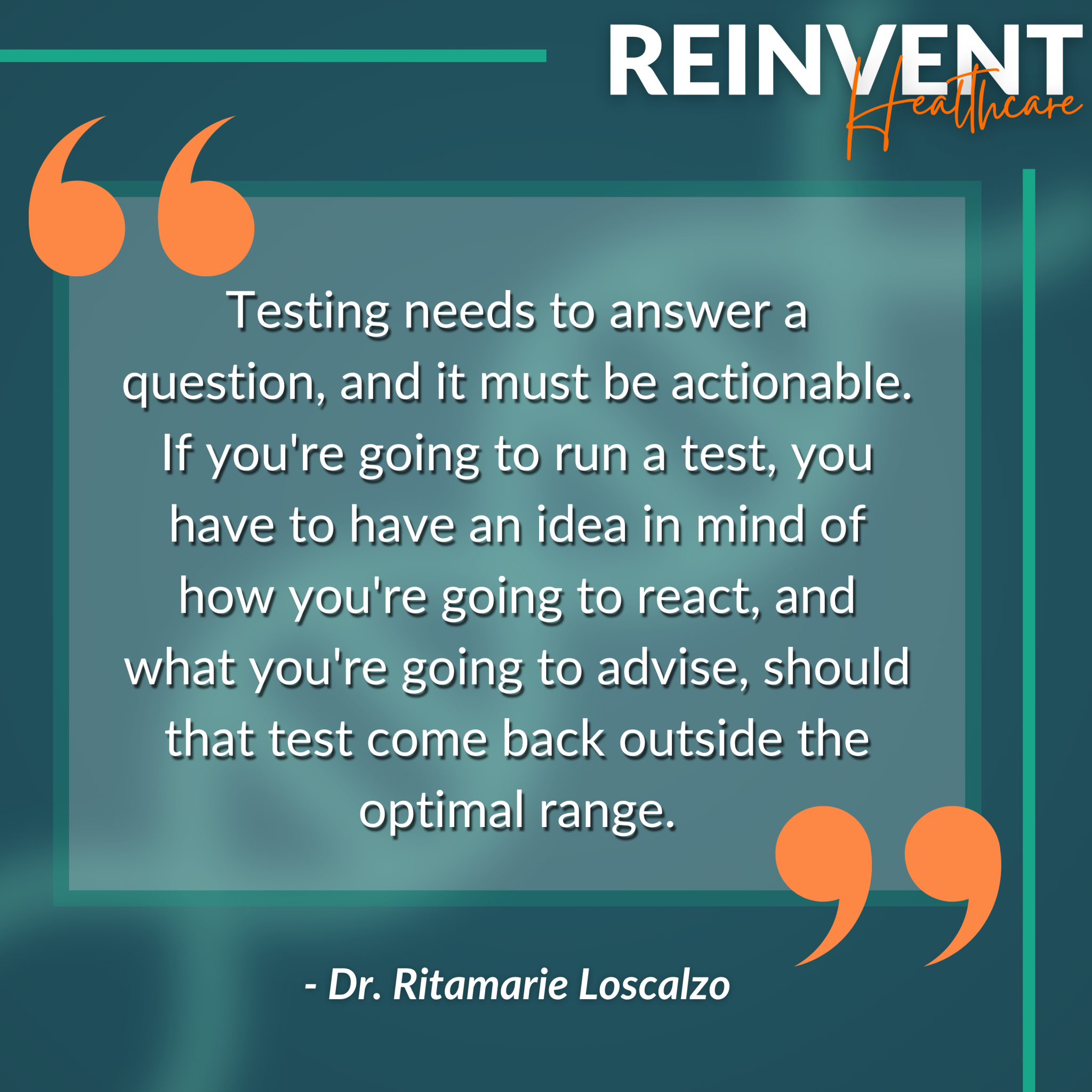
The testing needs to answer a question that’s in our minds, not just satisfy a curiosity. And it must be actionable. If you’re going to run a test, you have to have an idea in mind of how you’re going to react, and what you’re going to advise, should that test come back outside the optimal range.
Dr. Ritamarie Loscalzo (06:44)
Let’s address when supplementation might be premature in your planning with someone. This is where a lot of practitioners make lots of mistakes. They see a borderline marker and say, “Let’s supplement, so it doesn’t get fully deficient.”
What we really need to be asking is, is digestion compromised? Is inflammation blocking the transport of this nutrient into the cells? Is inadequate sleep affecting this picture? Is stress overwhelming all the methyl donors? Is insulin resistance impairing cellular uptake?
If the bottleneck is upstream, supplementation may mask rather than resolve. So this is why we teach systems thinking. Don’t chase numbers. We identify constraints. Where are the constraints existing in this overall system?
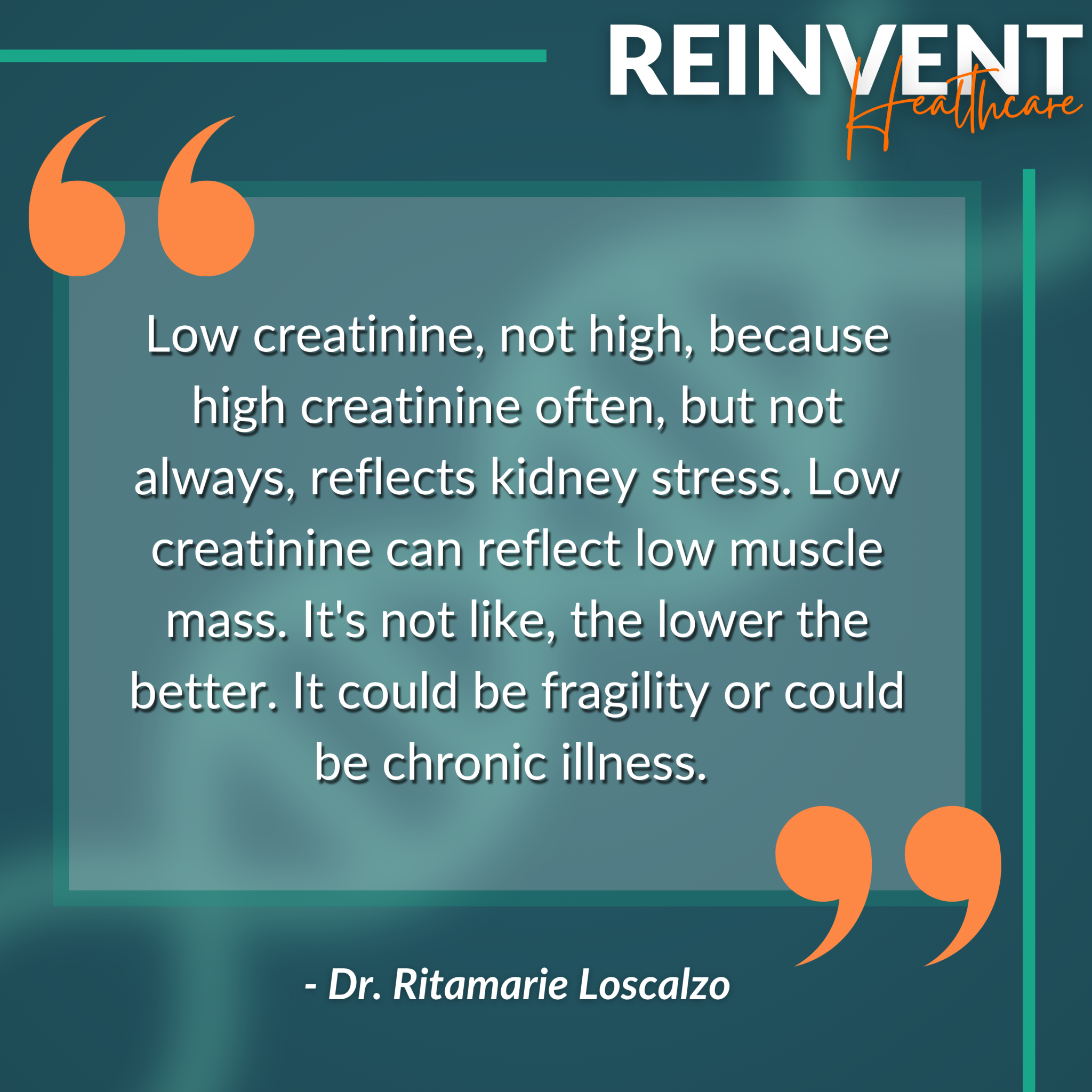
How do we interpret examples, interpret things like low creatinine and other nuances? Creatinine is often viewed only as a kidney marker, right? Creatinine and bun, blood urea nitrogen, and the bun:creatinine ratio, and EGFR. But low creatinine, not high, because high creatinine often, but not always, reflects kidney stress. But low creatinine can reflect low muscle mass.
It’s not like, the lower the better, right? It could be fragility, right? Or it could be chronic illness. So we need to be looking at both ends of the spectrum. Low creatinine is not automatically ideal just because it’s not high, and the kidneys aren’t in stress.
Dr. Ritamarie Loscalzo (08:23)
Low alkaline phosphatase, that’s oftentimes like, it‘s a liver marker. And so if it’s high, we’re looking for a problem, a liver type problem. But low alkaline phosphatase may suggest zinc insufficiency. It’s a functional marker for zinc insufficiency. And then the high normal MCV, mean corpuscular volume, can suggest early B12 or folate deficiency, right? It could be a strain on that system, not necessarily a deficiency.
High-normal fasting insulin can reflect early metabolic dysfunction. It’s the earliest marker of metabolic dysfunction, even when the glucose and A1C are normal. Really, the art is in the context. The science is in the physiology.
What I’d like to do next is look at the hierarchy of intervention. When interpreting labs, I recommend that we go through a hierarchy.
We start with the foundational physiology. What’s going on with a person? How’s their sleep? How’s their blood sugar stability? How’s their protein? Is it sufficient for their needs? There’s not like a magic black box, this is the amount that everyone needs. It’s how much they need for their particular situation, their exercise, their bone health, etc.
We’ve got to look at inflammation. We’ve got to look at digestive integrity. How well are people taking in these nutrients? The low amount of nutrients may not have anything to do with how much they’ve taken in, but how much they’re actually digesting and absorbing.
And then cellular signaling, the membranes in every cell is so important for getting nutrients in and out and for the cells signaling each other.
We look at genetics. Are there pathways that are compromised from a genetic standpoint that may be playing into this? We also have to look at supplementation that’s targeted. Targeted to what’s going on in their body, targeted to the symptoms that they’re presenting with, and also targeted to their particular lab results. We don’t start at the bottom and say, let’s just supplement. We build towards it, right?
We need to be looking at advanced interpretation, and the more advanced testing becomes, the easier it is to overinterpret it. A single abnormal on an organic acid test doesn’t mean pathology, and sometimes we get caught in that trap when we’re going over these things with clients. They go, “I’ve got this, and you didn’t tell me about this. And what does this red over here mean?”
We have to be the voice of reason and really understand how this all fits together and what are the priorities, in terms of addressing.
A single nucleotide polymorphism, a SNP, doesn’t dictate the destiny. It doesn’t mean that that pathway is going to be hosed and not working at all. We need to interpret the data in context, and context requires us to be reasoning clinically.
So my supplementation framework, I have a framework for pretty much everything. It is laid out in a bunch of podcast episodes, podcast 209 to 211 to be exact. So highly recommend that you go back, and we’re on 211 right now.
We have to look at mechanism before molecule. What’s going on there? We look at genetics and precision forms, and then testing and advanced interpretation. All of this together forms a framework. And I believe in framework healing, framework health.
We have to look at frameworks not like this is a protocol, framework for addressing. So when we look at these frameworks, we’re not looking to add more supplements to their list. God knows most people are already on way too many, but we look at them for better decisions, right?
If you haven’t downloaded my Smart Supplementation Matrix document, it’s going to provide the structure that was covered in all of these podcasts. And you can use this in helping you to determine what you should be recommending to your clients, right? And when you should be recommending it. You’ll find the link to that in the show notes.
If you’re ready to evaluate your clinical precision, if you’re ready to look at labs and genetics and physiology and systems thinking, visit inemethod.com and find out how we can support you there.
Advanced testing without advanced interpretation is just accumulating data and not really knowing what to do with it. And interpretation is what changes the outcomes.
This is how we rethink healthcare. This is how we reinvent healthcare. We look at the mechanisms, before we’re looking at the individual molecules and supplementation. We look at precision and frameworks, not protocol.
We look at the context. How does this all go? Not just what’s the latest trending supplementation or the latest trending detox powder, et cetera.
So be a part of this. Stay a part of this effort to reinvent healthcare and make it a client-centered system that helps to really treat them as individuals and not just slap on protocols. And until next time, shine on.
Listen on your favorite podcast platform!





Share This Episode